
ICT 2016 Unit 044: Ten-Year Treasury and Higher-Timeframe Context
Use Treasury prices, yields, dollar context and seasonality to distinguish broad trend and balance without turning macro relationships into signals.
Higher-timeframe context can change how a local structure is read. Ten-year Treasury price and yield, together with dollar context and seasonality, can help describe a broad environment. They are context layers, not independent signals.
Environment before local technique
First classify the broad environment as directional, transitional or balanced. Then ask whether the local swing, liquidity event or gap fits that environment. A technically clean local pattern can still fail when the wider context is misread.
Planned diagram position: after ## Environment before local technique and before ## Treasury price and yield move in opposite directions.
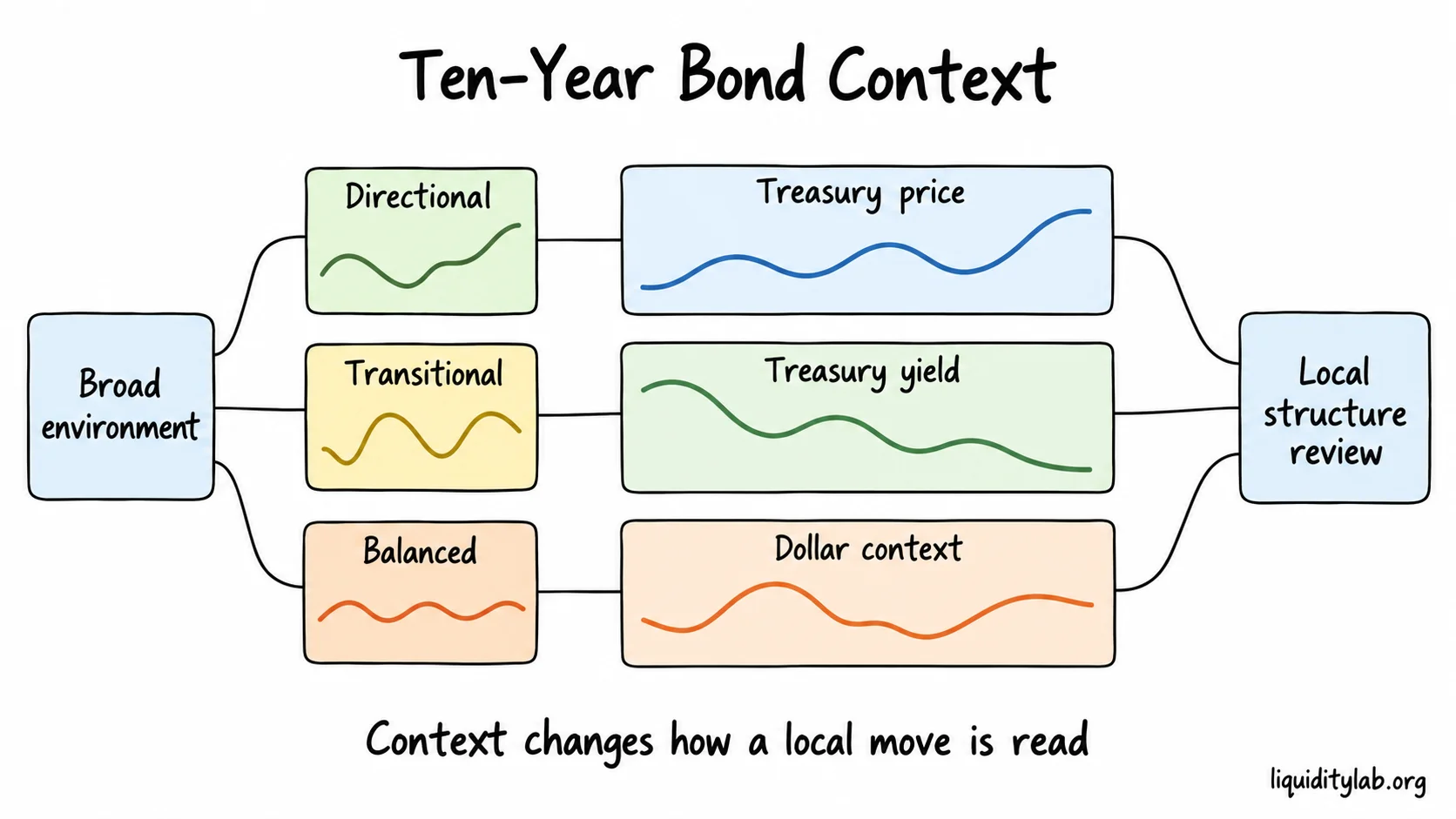
Higher-timeframe context is a filter for interpretation, not an independent signal.
Treasury price and yield move in opposite directions
Bond prices and yields commonly move in opposite directions. Keep the two series separate in the review so a yield change is not mistaken for a price change. The relationship can weaken or vary across regimes.
Why the dollar belongs in the context
Yield expectations can influence dollar behavior and risk preferences, but the relationship is not a mechanical one-candle formula. Compare timing, structure and the later response before describing a cross-market explanation.
Seasonality is a background filter
Broad seasonal windows, including the middle of the year, can frame a review of volatility and participation. They do not establish a date, direction or reversal. Use them to ask better questions about the selected sample.
Trend environment and balanced environment
In a directional environment, continuation and pullback deserve different observations from a balanced environment. Write which environment you are studying and what would show that it has changed.
Review workflow
- Classify the higher-timeframe environment.
- Separate Treasury price from Treasury yield.
- Add dollar context and seasonality only when relevant.
- Compare the local structure with the broad environment.
- Record the later response and any regime change.
- Keep the macro explanation conditional.
A weather map above a street map
Treasury price, yield and dollar context are like a weather map above a street map. They can change how a local move is read, but they do not describe every local turn or supply a fixed forecast.
Misconceptions: price and yield are not the same series; seasonality is not a date signal; a broad environment can remain mixed.
Review exercise
Choose three completed periods: one directional, one balanced and one transitional. Compare Treasury price, yield, dollar context and local structure. Record where the relationship clarified the environment and where it remained mixed.
Short review
1. Treasury and dollar context disagree. Sample reasoning: preserve the mixed environment and ask which later structure would clarify it.
2. The local move contradicts the broad backdrop. Sample reasoning: record the contradiction instead of forcing local structure to fit the macro story.
Learning boundary
Higher-timeframe Treasury analysis does not provide automatic entries, stops, targets, probabilities or macro forecasts. Continue with Unit 045: Treasury–Dollar SMT for the Pro cross-market review layer.
Review questions
- Which observations define the broad environment?
- How did Treasury price and yield relate in the selected period?
- What did the dollar comparison add or leave unresolved?
- Which local reading would weaken the macro explanation?