
ICT 2016 Unit 013: Loss Management and Preserving the Next Opportunity
Treat a planned loss as a bounded learning cost, then review risk reduction after a loss without turning recovery examples into guarantees.
A loss is information about one hypothesis, not a reason to immediately increase exposure. Loss management begins by defining the cost before the observation and preserving the ability to study the next case.
Bounded cost, not zero loss
No review process can remove every losing case. A useful boundary is a loss small enough that the plan can continue, with the exact boundary depending on the person, product and conditions. The source's percentages and ratios are examples, not universal settings.
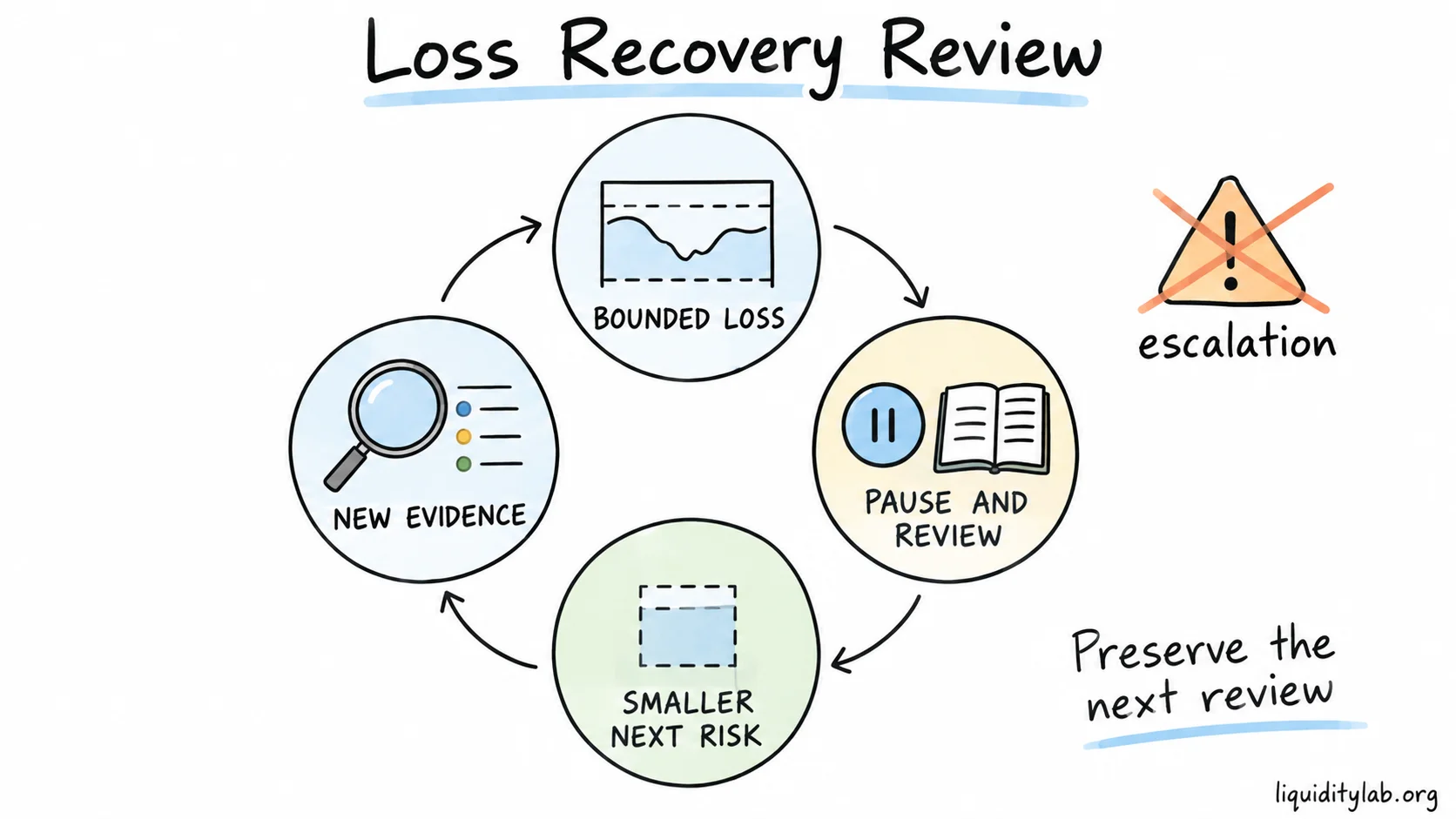
A bounded loss preserves the next review; it does not promise recovery.
Risk and recovery examples
Risk units help compare cases. A 1:3 or 1:5 example can show how several small losses might be covered by fewer larger gains, but arithmetic does not make the larger outcome reachable. Include costs, partial exits and losing runs in the record.
After a loss
Two common reactions are immediate escalation and complete avoidance. A calmer process is to pause, record what invalidated the hypothesis, reduce the next planned exposure if appropriate, and wait for a new structure. “Stay with the direction” must never mean holding a failed idea or doubling down.
Review exercise
Select a completed sample and record the first loss, the next planned risk, the new evidence and the actual result. Compare a reduced-risk continuation with an escalation scenario as a thought experiment. The goal is to see how much learning space each choice preserves.
Continue with Unit 014: The Seven-Step Context Filter. Risk examples are educational boundaries, not entries, targets, probabilities or return promises.