
ICT 2016 Unit 026: Liquidity Hunts and Path Resistance
Review external and internal liquidity as conditional explanations for price paths, returns and multi-timeframe resistance.
Liquidity language describes where orders may be concentrated around a range. It does not prove that the market must sweep a level or reverse afterward. This lesson separates external liquidity beyond a range from internal areas such as gaps and order blocks, then asks what the later response actually established.
External and internal liquidity
External liquidity may sit above a visible high or below a visible low, where breakout orders and protective orders can cluster. Internal liquidity describes unfinished or repeatedly traded areas inside the range, including gaps, order-block candidates and dense candle bodies.
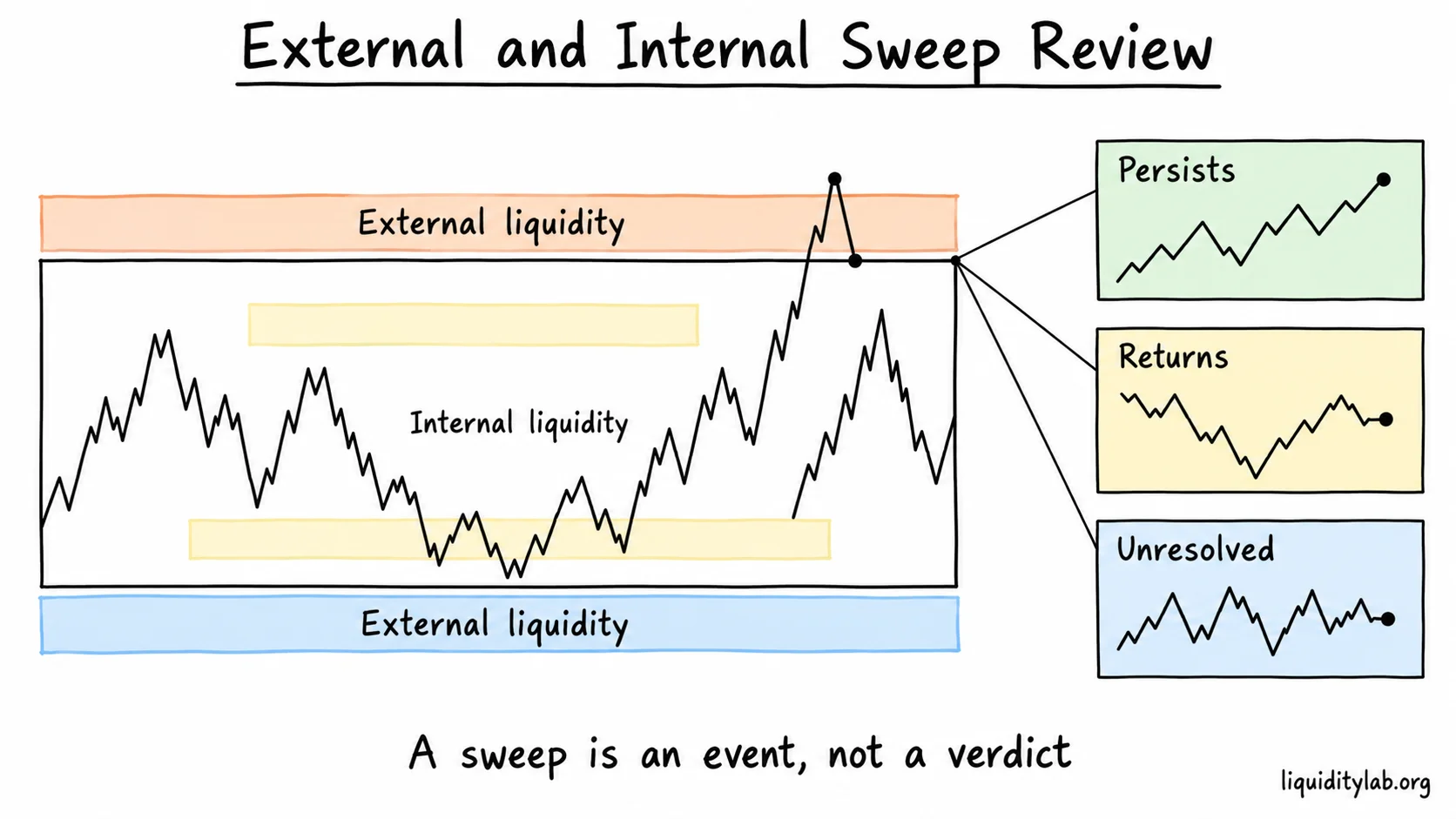
The later response classifies the sweep; the level alone does not.
A sweep is an event, not a verdict
A brief move beyond a high or low can release orders and return into the range. It can also persist and build a new structure. Classify the event from the sequence that follows: persistence, return, or unresolved evidence. The label should remain provisional when the review window is incomplete.
Path resistance
A path may look relatively open when the higher-timeframe context, visible destination and local structure agree. It may feel more resistant when the move works against the larger range, has no clear destination or repeatedly crosses unfinished areas. These are review descriptions, not promises about speed or direction.
Multi-timeframe review
Use the largest available window to describe the surrounding range, a middle window to compare acceptance and rejection, and the local window to record the event. A local sweep does not automatically replace the larger structure. Rebuild the range when a new extreme changes the evidence.
Review exercise
Choose a completed range and mark one external pool and two internal areas. Hide the candles after the first sweep, write two competing explanations, then reveal the sequence. Record whether price persisted, returned or remained unresolved, and what evidence changed your view.
Learning boundary
Liquidity is an observation framework. It does not provide automatic entries, stops, targets, probabilities or proof of intentional manipulation. Continue with Unit 027: Order-Block Footprints to examine how a candidate order block gains or loses structural support.
Review questions
- Which levels are external, and which areas are internal?
- What did the sweep itself establish, and what remained unknown?
- Did the later sequence persist, return or remain unresolved?
- Does the higher-timeframe range support the local interpretation?
- What counterexample would challenge the liquidity explanation?