
ICT 2016 Unit 011: Partial Exits and the Observation Loop
Study partial exits as a prewritten decision process, then review first outcomes, remaining exposure and execution drift without treating 3R as a rule.
Partial exits solve a decision problem: how can a plan record an early result while leaving a smaller remaining position to be observed? They do not guarantee a profit or determine the correct split for every person.
Sequence before action
The source organizes a plan as direction, location, invalidation and management. Keep the order explicit. A visually attractive small pattern cannot replace the larger context, and a distant location can make a precise local pattern irrelevant.
First outcome and remaining observation
Some ICT examples call an early milestone 3R, where R is one planned risk unit. Treat that number as course vocabulary, not a universal trigger. A first partial exit can reduce exposure, while the remaining portion is reviewed against a larger reference. The trade-off is real: less exposure can mean less participation if the later move extends.
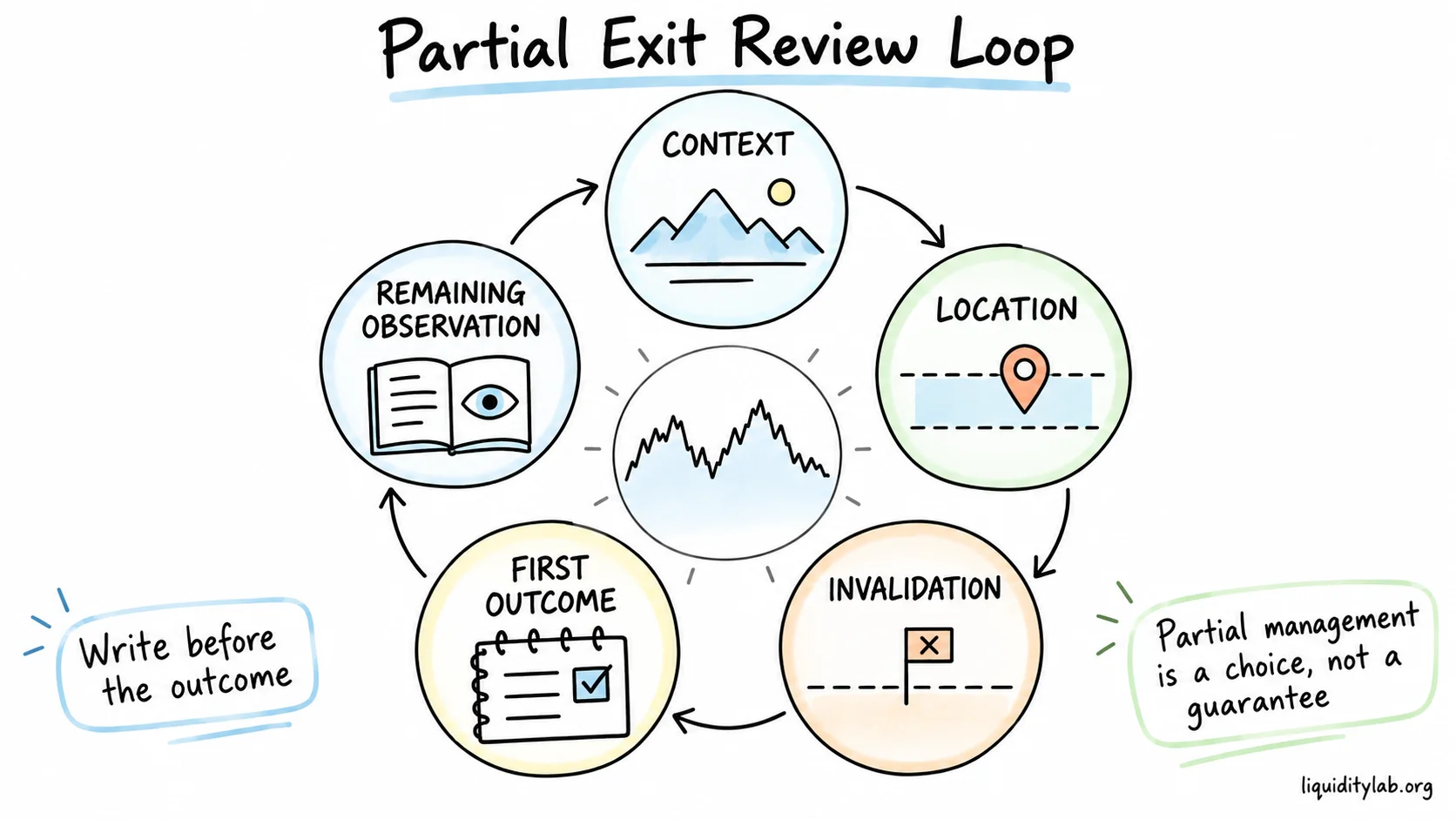
Partial management is a sequence of decisions that must be written before the outcome.
| Before the outcome | After the outcome |
|---|---|
| State the context and invalidation. | Record what actually happened. |
| Define the first review milestone. | Check whether the milestone was reached. |
| Define remaining conditions. | Record whether the remaining path continued, returned or ended. |
Satisfaction is a review variable
Trying to capture an entire range can turn a good process into a stressful one. A smaller, repeatable portion may be a reasonable study objective, but “half the range” is still an example rather than a target. Compare the chosen satisfaction point with the original hypothesis and the later path.
The plan–execute–record–review loop
- Plan: write context, location, invalidation, first milestone and remaining conditions.
- Execute: follow the prewritten sequence or record the deviation.
- Record: capture the actual path, costs, emotions and timing.
- Review: change one process variable at a time.
The goal is an auditable process. It is not to make every outcome look correct after the fact.
Historical exercise
Use a completed sample and hide the later path. Write the management plan, then reveal the candles one section at a time. Record whether the first milestone was reached, whether the remaining observation was useful and whether the plan changed under pressure. Include a case where the initial idea failed.
Continue with Unit 012: Win Rate and Risk–Reward. Partial exits are an educational process choice; they do not provide entries, stops, targets, probabilities or return promises.