
ICT 2016 Unit 006: Fair Value Gaps and Fast Repricing
Learn to describe a fast price sequence and a fair value gap as review vocabulary, then record whether later price returns, pauses, continues or passes through.
Units 004 and 005 described location inside a selected range. Unit 006 adds a sequence question: did price move quickly enough that the middle of the sequence contains relatively little visible overlap? ICT lessons often call this a fair value gap, or FVG.
Start with what the chart shows
An FVG is a chart description of a fast, directional sequence and the space between its surrounding candles. It is useful to mark the area and ask what happened later. It is not proof that no trades occurred there, proof of a hidden order, or a guarantee that price will return.
The supermarket analogy is simple: a crowded aisle has many visible interactions, while a shopper moving quickly through an aisle leaves less visible overlap in the record. The analogy helps describe a sequence; it does not reveal the shopper's private plan.
Put the gap inside a range
The same FVG can be located in the discount, equilibrium or premium half of a larger selected movement. Record both descriptions:
| Layer | Question |
|---|---|
| Range position | Is the marked area below, near or above the midpoint? |
| Sequence | How did price move through the area? |
| Later test | Did price return, pause, continue or pass through? |
The layers answer different questions. A discount FVG is not automatically a buy zone, and a premium FVG is not automatically a sell zone. Location narrows the review; it does not finish it.
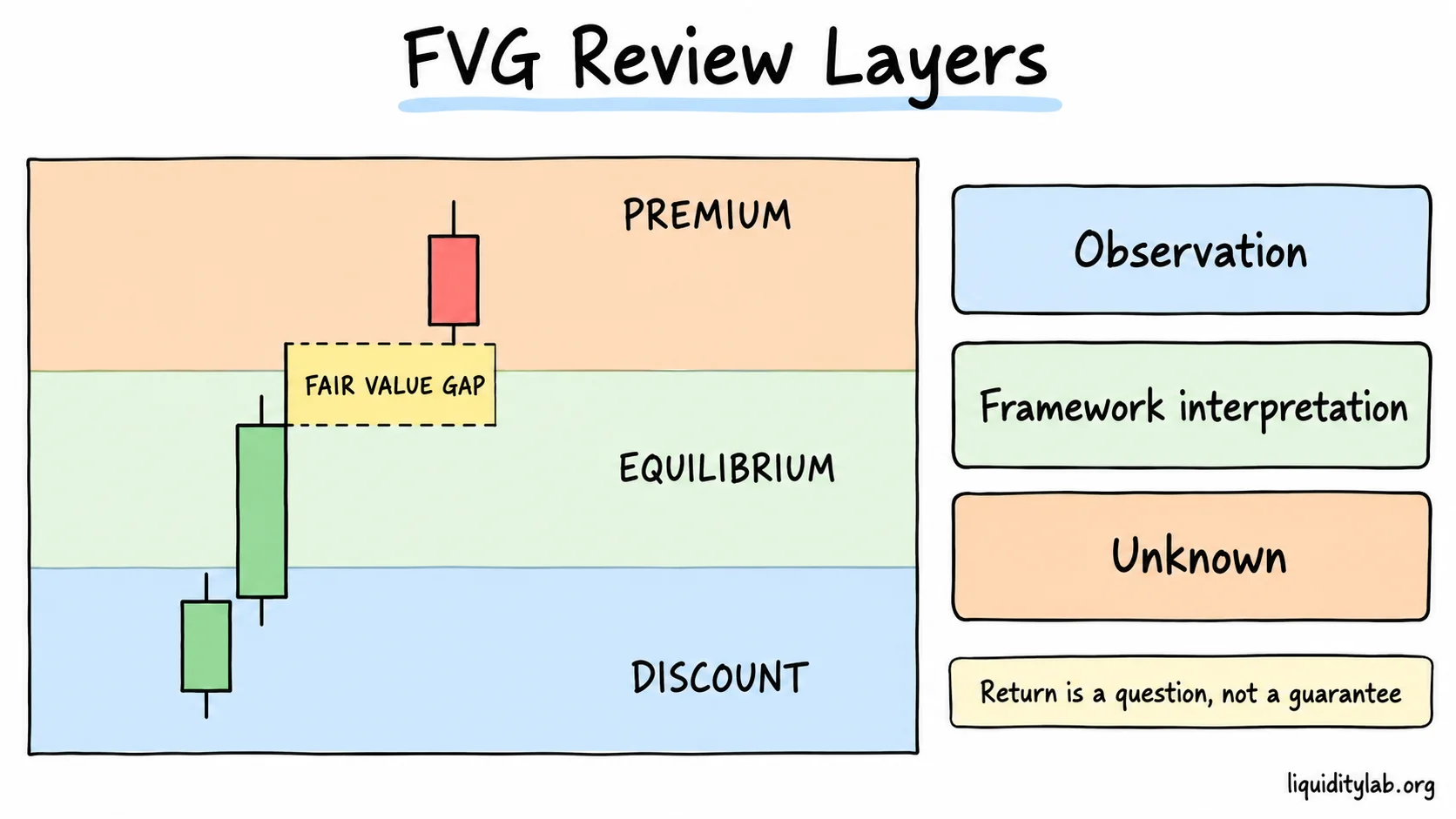
A fair value gap is reviewed through observable sequence, framework interpretation and unknowns.
A five-part FVG review
- Mark the candles and timeframe used to define the gap.
- Describe the preceding overlap and the speed of the departure.
- Place the gap inside the larger range and state the endpoints.
- Record the first later interaction without calling it a fill or failure too early.
- Compare the result with an alternative explanation and keep unresolved cases.
Possible later outcomes include a brief pause, a return followed by continuation, a return followed by rejection, or a clean passage through the marked area. “Rebalance” is a useful label for studying the return; it is not a forecast that every gap must be revisited.
Do not convert a gap into an institutional story
The source material uses market-maker language to explain why price may seek a more balanced path. Keep that as a framework interpretation. Direct evidence is limited to the candles, the selected interval, the range references and the subsequent path.
Write the record in three layers:
- Observation: the marked sequence, range position and later interaction.
- Framework interpretation: the movement can be studied as imbalance or repricing.
- Unknown: who traded, why the movement happened and whether the next interaction will resemble a prior case.
This lets the lesson remain useful even when the preferred explanation is not supported by the next candles.
Review exercise
Select three completed fast movements from the same instrument and timeframe. Mark the gaps before reviewing later data. For each one, record whether price returned within your chosen window and what happened next. Include cases that never returned and cases that passed straight through.
Then ask:
- Was the movement genuinely clear on the chosen timeframe?
- Did the range endpoints stay fixed during the review?
- Did I treat a later return as a fact or as proof of a theory?
- Which outcome would make this description less useful?
Continue with Unit 005: Premium and the Limits of Relative Value or return to the ICT 2016 course hub.
FVG, imbalance and rebalance are study vocabulary for describing completed price sequences. They do not provide market direction, entries, stops, targets, probabilities or return promises.