
ICT 2016 Unit 016: When a Flag Becomes a False Continuation
Review flag-like consolidations through context, liquidity and post-breakout persistence without treating a failed continuation as an automatic reversal signal.
A flag is a visual description of a pause after movement. It does not decide whether the next move will continue. A useful review separates the shape from the larger location and the reaction after the boundary is crossed.
Why a flag can mislead
A flag-like consolidation often attracts attention because the expected continuation is easy to name. The same shape can appear in a supportive location, at a crowded high or low, or inside a wider range where the local direction is only temporary.
Ask three questions before explaining the pattern:
- What was the broader context before the flag formed?
- Which visible highs, lows or equal levels may concentrate orders?
- Did the breakout persist, return into the flag or remain unresolved?
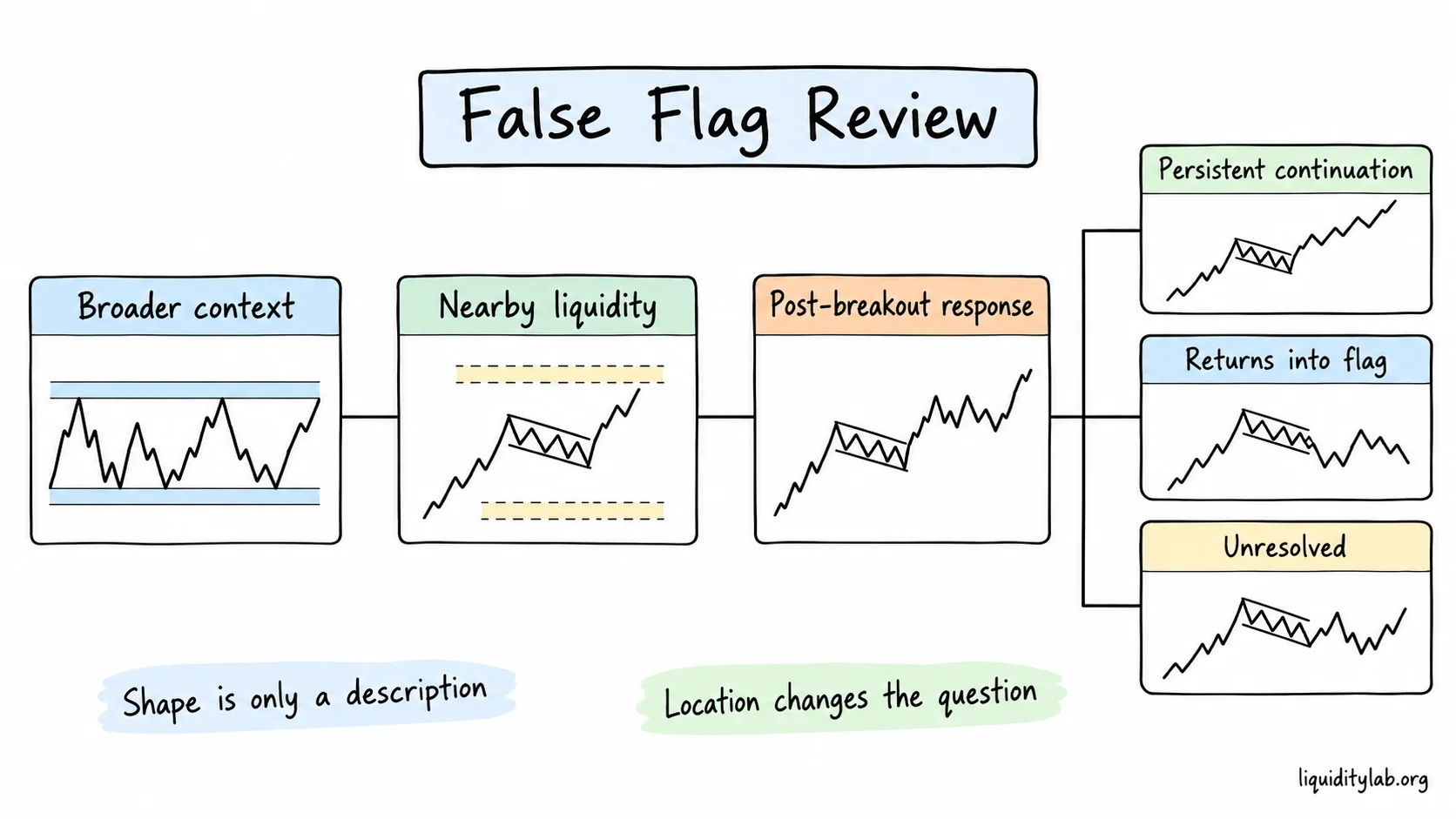
Shape describes a case; context and later response determine the review.
Liquidity and direction mismatch
A bullish-looking flag near a broader premium area may need a different interpretation from one forming after a supported expansion. A bearish-looking flag near a broader discount area deserves the same caution. Location changes the question; it does not predict the answer.
Do not describe a failed continuation as proof of a hidden operator. The chart shows a move, a boundary test and a later response. Participant intent remains an interpretation with uncertainty.
A bounded review exercise
Hide the candles after several completed flags. Record the higher-timeframe location, nearby reference levels and the continuation hypothesis. Reveal the next section and classify the outcome as persistent, returning or unresolved. Keep all three categories in the journal so the memorable reversal does not become the only example.
Learning boundary
A false-flag label is useful for reviewing a case. It does not provide an entry, stop, target, probability or counter-trade instruction. Continue with Unit 017: Timeframe Selection to examine how the observation window changes the interpretation.