
ICT 2016 Unit 020: Anticipatory Planning Across Timeframes
Use monthly, weekly and daily observations to plan scenarios without confusing a higher-timeframe hypothesis with a prediction.
Anticipatory planning means defining what you will observe before the next move appears. A monthly chart can supply context while weekly and daily charts describe structure and detail. None of these layers guarantees an outcome.
Context before detail
Start with the broad range, major displacement and visible liquidity on the higher timeframe. Then move down only to inspect how price behaves around the selected area. A lower-timeframe signal can add detail without rewriting an unfinished larger observation.
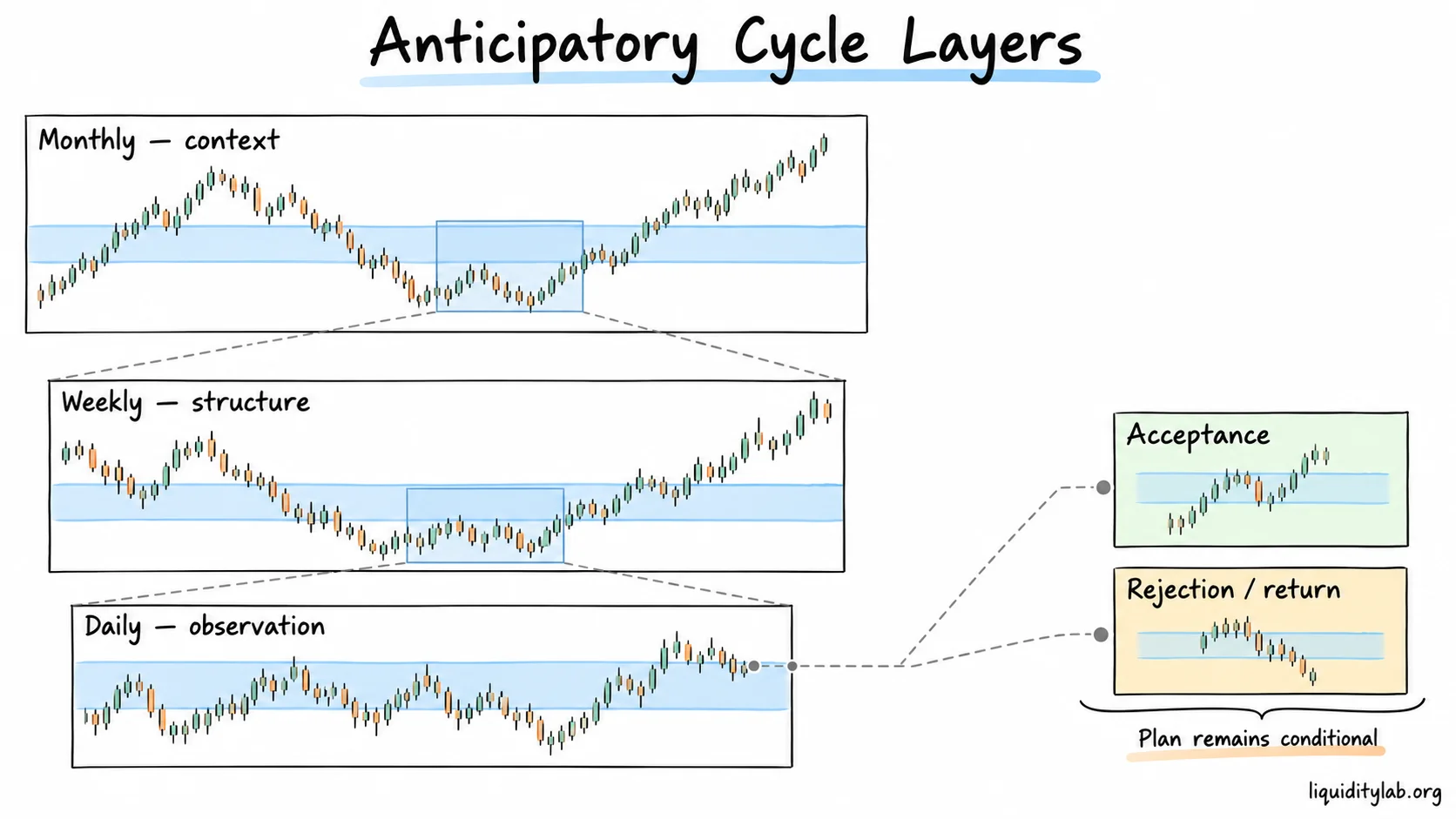
A plan can be early and conditional; it becomes a prediction only when uncertainty is removed without evidence.
Write scenarios, not answers
For each selected area, write at least two paths: acceptance and continuation, or rejection and return. Add an invalidation condition that would make the current explanation less useful. This keeps anticipation connected to later evidence.
Order areas as observation zones
An order-block label can identify a candle or region to revisit. It is not an automatic buy or sell line. Record whether price reacts quickly, balances, passes through or never returns. The observation window matters as much as the original label.
Review exercise
Choose a completed higher-timeframe range. Before revealing the lower-timeframe sequence, write its context, two scenarios and one uncertainty. Reveal the sequence and mark which part of the plan survived. Repeat with a case where the zone failed.
Learning boundary
Anticipatory planning is a method for preparing observations. It is not a forecast, execution plan or return promise. Continue with Unit 021: Institutional Market Structure to compare related markets without turning correlation into certainty.