
ICT 2016 Unit 031: Reclaimed Blocks
Review reclaimed blocks as old areas revisited after displacement, with persistence, failure and unresolved outcomes.
A reclaimed block describes an old price area that becomes relevant again after price has moved away and returned. The label organizes a sequence; it does not prove that old orders are literally re-entering or that the next reaction will continue.
The sequence matters
Mark the original area, the displacement away from it and the later return. A simple pullback without a meaningful change in structure is not enough to establish a reclaimed-area hypothesis.
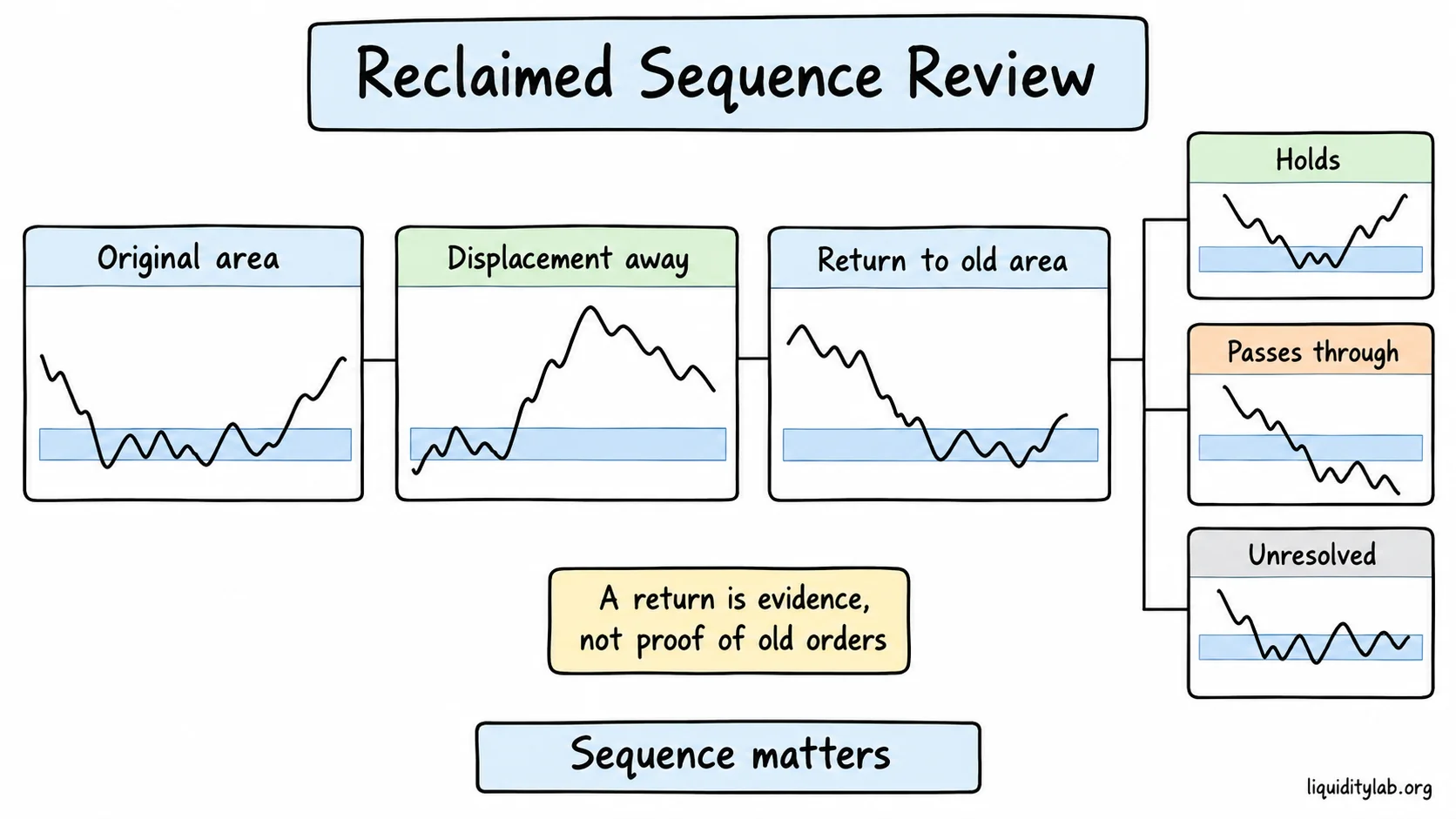
A reclaimed-area hypothesis depends on displacement and the later return.
What the return can show
The return may hold, pass through, or produce a brief reaction before failing. Compare the response with the higher-timeframe range and nearby liquidity. Keep the explanation provisional when the review window is incomplete.
Reclaimed versus mitigated
Mitigation emphasizes a changed role after an earlier structure loses its original interpretation. Reclaimed language emphasizes a return to an area after displacement. The same chart can support either description only when the sequence and evidence are stated clearly.
Review exercise
Choose two completed returns and one failed example. Record the original area, displacement, return behavior and invalidation condition. Write what is observable and what remains an interpretation.
Learning boundary
Reclaimed blocks do not provide automatic entries, stops, targets, probabilities or proof of hidden intent. Continue with Unit 032: Propulsion Blocks to compare a shallow return with renewed movement.
Review questions
- What displacement preceded the return?
- Did the old area hold, fail or remain unresolved?
- How does the explanation differ from mitigation language?
- Which failed example prevents hindsight selection?