
ICT 2016 Unit 008: Price Swings, Time Windows and Contraction
Organize price swings by time window, review false starts and contraction, and keep session language as a hypothesis rather than a mechanical entry rule.
Price rarely travels in a straight line. Highs, lows, pauses and renewed movement create a rhythm that can be studied without assuming that every turn was planned by a hidden participant.
Swings are a sequence
Describe a completed sequence as high, low, higher high, lower low or overlapping range. The chosen timeframe matters: a reversal on an hourly chart may be a small retracement inside a daily movement. Keep both descriptions when they are true at different scales.
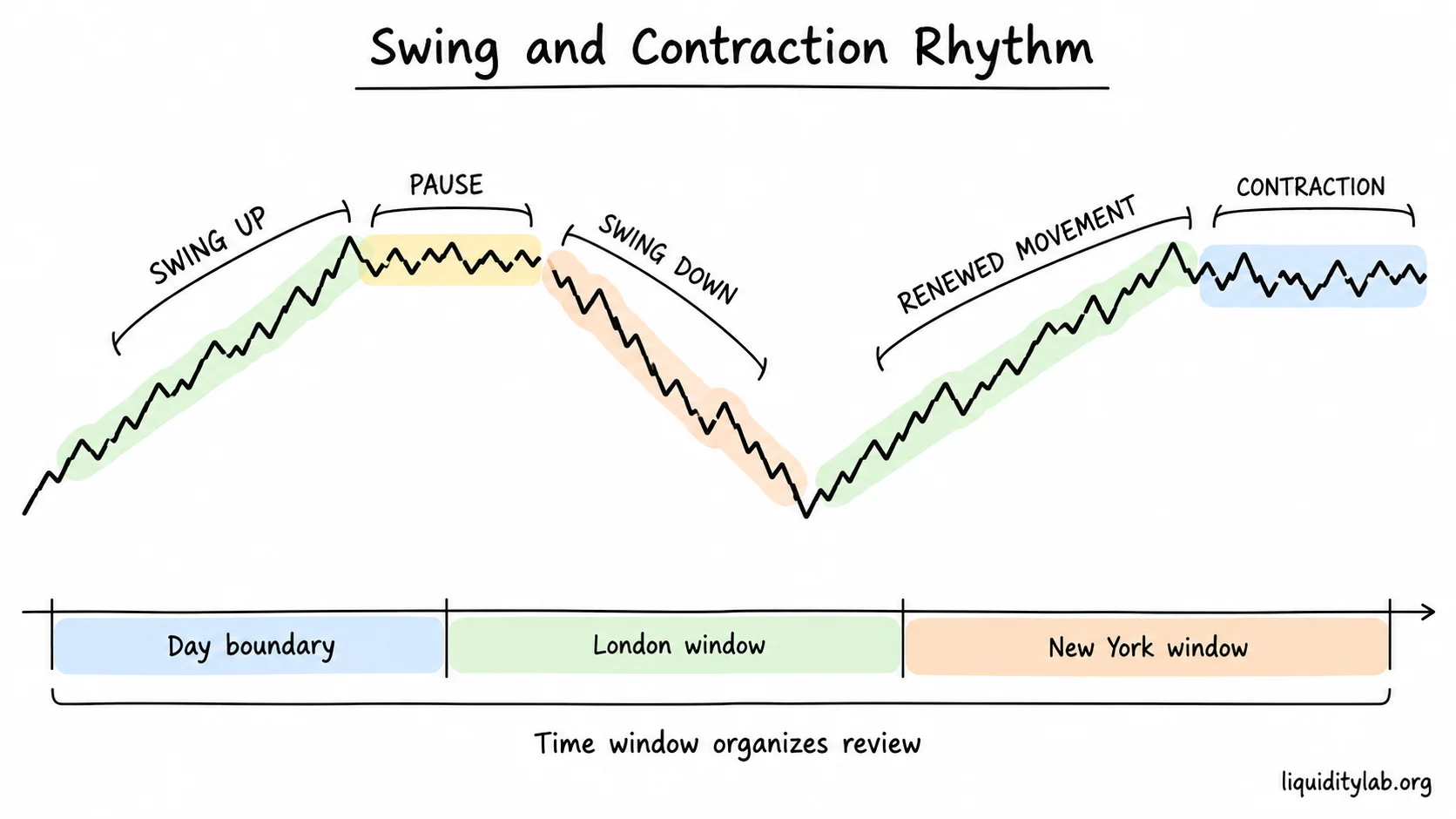
Swings describe a sequence; they do not select a required future path.
Time windows organize observation
Midnight, London and New York windows can help a learner compare when movement and overlap occurred. They are conventions, not universal clocks. State the timezone, session definition and visible interval before comparing examples.
| Window | Review question |
|---|---|
| Day boundary | What background range was already visible? |
| European activity | Did overlap or directional movement change? |
| New York activity | Did the first move persist, return or remain unresolved? |
Do not convert a common example into a schedule. A time window can organize a sample; it cannot guarantee a false move or a reversal.
Contraction after movement
After a large departure, price may overlap within a narrower area. Call this contraction when the description fits the selected window. It can precede continuation, a return to the old range or another repricing. The quiet period is evidence about the sequence, not proof that energy is being stored for one inevitable breakout.
Review the first move and the later result
Framework language sometimes calls a first move a false start or a Judas swing. Keep that label provisional. Record the initial direction, the location, the time window and the later response. Only after the observation window closes can you say whether the move persisted, returned or remained unresolved.
Historical exercise
On a completed day, mark the day boundary and the chosen London and New York windows. Record each window's high, low, first movement, contraction area and later path. Compare several consecutive days, including days that do not resemble the teaching example.
Ask:
- Is the swing visible on more than one timeframe?
- Did the time definition stay fixed?
- Did contraction actually precede a departure in this sample?
- Which explanation remains uncertain?
Continue with Unit 009: Small-Account Study and Risk Boundaries. Time windows, swings and contraction support review; they do not provide entries, stops, targets, probabilities or return promises.