
ICT 2016 Unit 024: Head-and-Shoulders Patterns as a Review Case
Study neckline breaks through higher-timeframe context, nearby liquidity and post-breakout response without treating a classic pattern as a mechanical reversal.
Head-and-shoulders is a useful visual description, not a verdict. A neckline break can persist, return into the pattern or fail after releasing concentrated orders.
Pattern and context
Mark the shoulders, head and neckline, then step back to describe the larger range and direction. A bearish-looking pattern inside a wider supported structure deserves a different review from one forming at a crowded high.
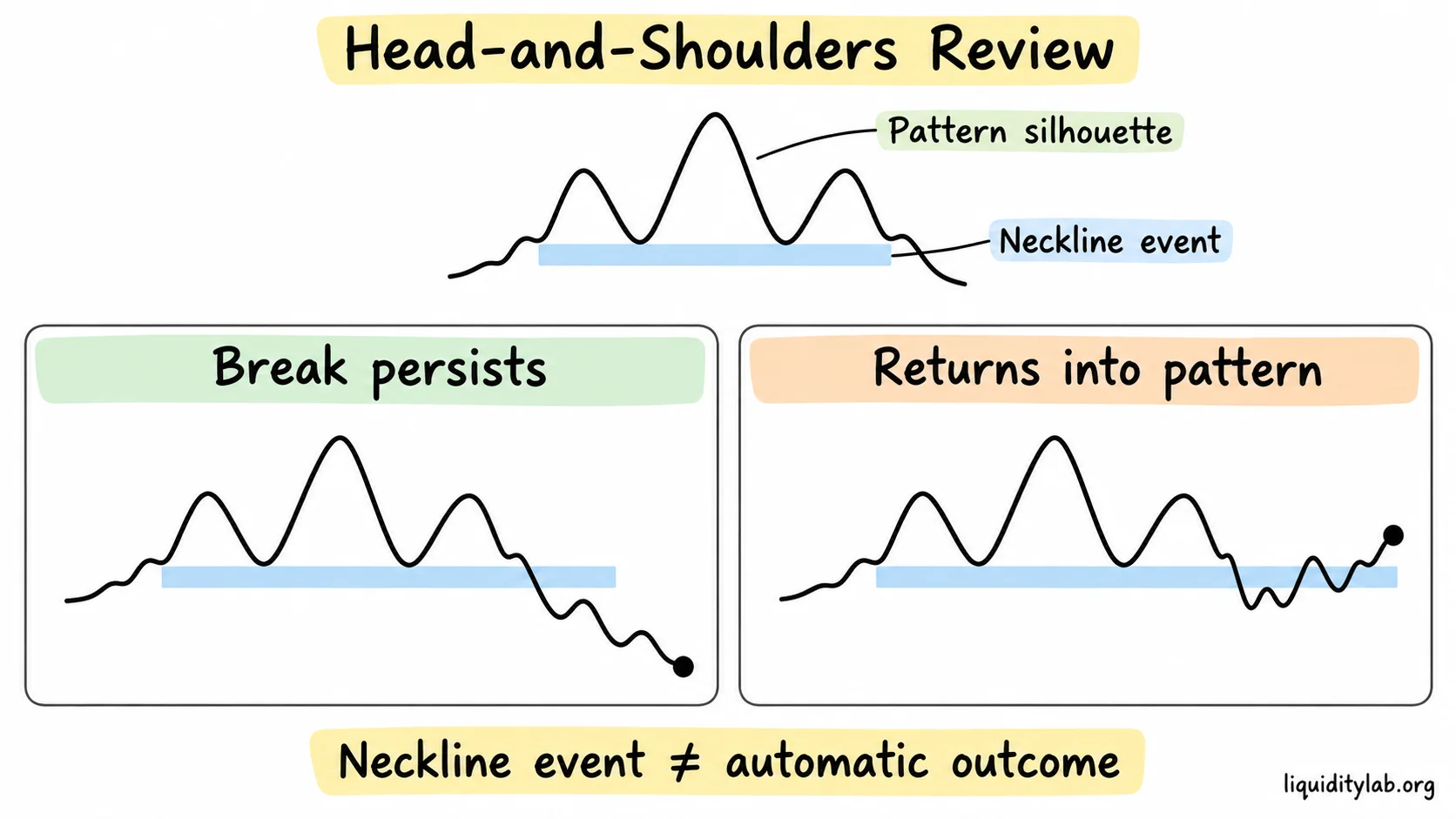
A neckline event changes the evidence; it does not decide the outcome by itself.
Liquidity around the neckline
The neckline can attract breakout orders and stops from both sides. A short excursion through the level may release orders before price returns, but a sustained break is also possible. Record the response instead of assuming an unseen actor designed the pattern.
Review exercise
Hide the candles after completed patterns. Write the higher-timeframe context, nearby liquidity and two competing outcome scenarios. Reveal the sequence and score the quality of the description, including unresolved cases.
Learning boundary
Head-and-shoulders analysis does not provide entries, stops, targets, probabilities or proof of institutional intent. Continue to the broader ICT / SMC Learning Path after recording what the pattern did and did not establish.