
ICT 2016 Unit 005: Premium and the Limits of Relative Value
Use one selected range to describe premium and discount, then test the description against price behavior without treating relative value as a reversal signal.
Unit 004 introduced the midpoint of a selected range. This unit looks at the upper half, called premium, while keeping the same boundary: “relatively high” is a description of location, not a command to sell or a promise of reversal.
Premium depends on a reference
If a completed movement runs from 100 to 200, 150 is its equilibrium reference. Price above 150 can be described as premium within that movement. A price of 180 may be high relative to this range, yet still be accepted for a long time if demand remains strong.
The everyday comparison is a concert ticket. A ticket resold above its usual price is at a premium relative to that reference. The word does not tell us whether demand will continue, whether the ticket is worth buying or whether the price will return to its old level.
Keep the three locations together
| Relative location | Review question |
|---|---|
| Discount | What evidence describes price below the midpoint? |
| Equilibrium | What exactly is the selected midpoint measuring? |
| Premium | What evidence describes price above the midpoint? |
Do not turn the table into a route. Price can remain in premium, move through equilibrium, or return to the range without producing a clean reversal. The useful record is the path and the timeframe.
A premium observation workflow
- Mark the completed movement and explain why its endpoints were selected.
- Draw the midpoint and, if used, the 62%–79% teaching band.
- Record the first time price entered the premium half.
- Compare the response with the larger structure and the selected observation window.
- Keep continuation, rejection, return and unresolved cases in the journal.
This workflow protects against hindsight. If the range is redrawn only after a reversal, the new premium zone may simply describe the outcome instead of testing a prior observation.
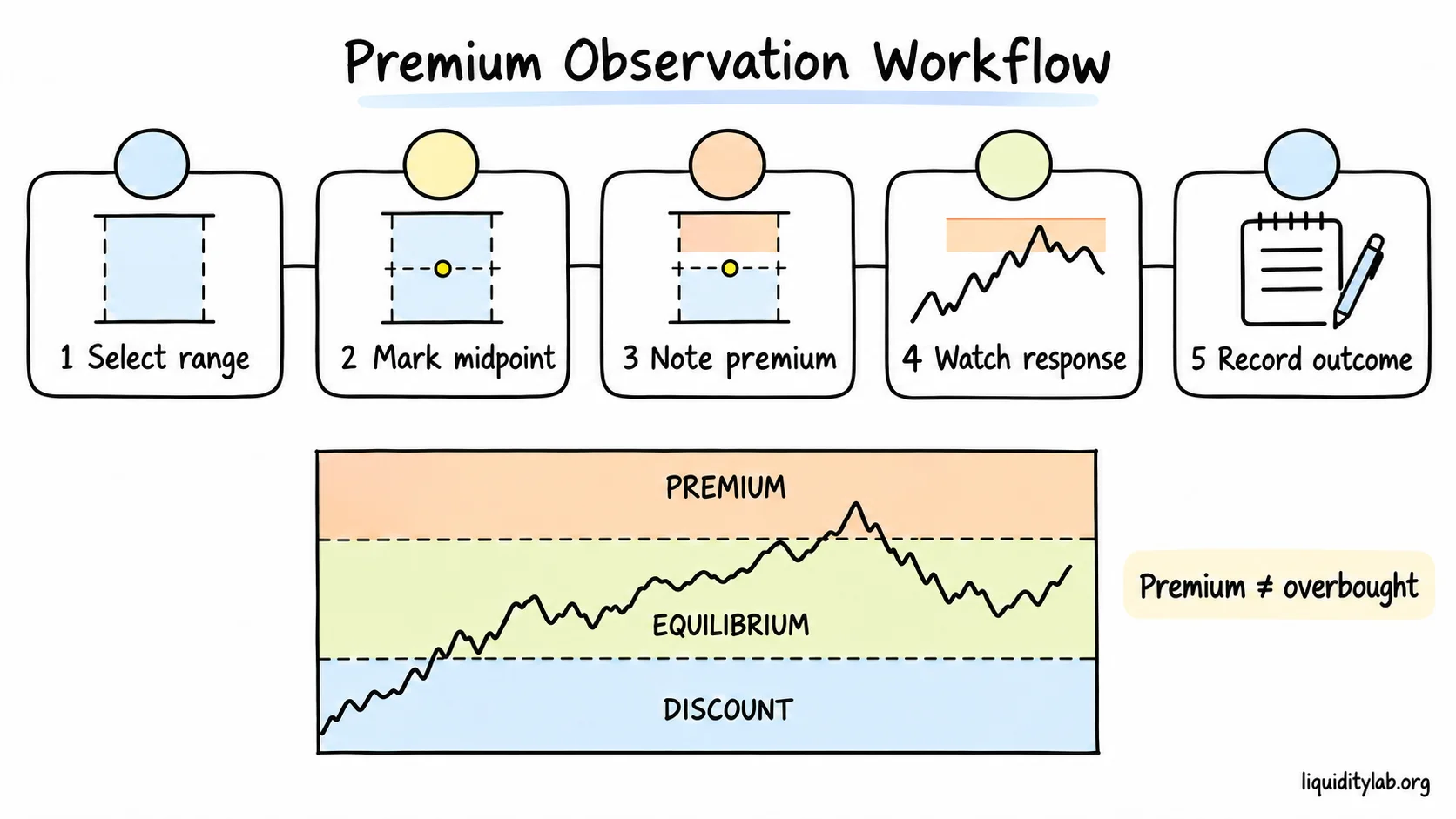
The workflow keeps range selection, location and later response as separate review steps.
Premium is not overbought
“Premium” refers to one selected range. “Overbought” is an indicator or momentum description. Neither one proves that price must decline. A strong movement can extend while remaining above its midpoint, and a weak movement can fail below a midpoint without offering a clear reversal.
Similarly, a claim that large participants distribute in every premium zone is a framework story. It may be useful as a question—what price evidence would support or weaken that interpretation?—but it is not visible intent.
Historical review example
Take a completed movement from 200 down to 100. The midpoint is 150. On the later rebound, record whether price stopped near the midpoint, entered the upper half and continued, or returned through the range. Do not remove the cases that fail to resemble the teaching model.
The review is stronger when the definition is fixed before the sample is collected: instrument, timeframe, endpoint rule, session convention and what counts as a return. A vivid example is an illustration, not a performance claim.
Reflection prompts
- Did I define premium relative to a visible range?
- Did I confuse “above the midpoint” with “must fall”?
- Which later candle changed my description, and what did it actually show?
- What remains uncertain about participants, motive and future path?
Unit 006 extends this location language into fair value gaps and fast repricing. You can revisit Unit 004: Balance, Discount and Relative Position before continuing.
Premium and discount are relative educational descriptions. This lesson does not provide market direction, entries, stops, targets, probabilities or return promises.