
ICT 2016 Unit 019: Institutional Footprints as a Review Hypothesis
Review liquidity, displacement and order-block reactions as possible institutional footprints without claiming to know participant intent.
Institutional sponsorship is a way to organize chart evidence, not a way to identify a hidden participant with certainty. The useful review starts with liquidity, observes the reaction and keeps the explanation conditional.
From liquidity to reaction
Map the visible highs, lows and equal levels before explaining a move. A sweep or breakout may release orders, meet opposing flow and return toward a prior order area. The chart shows the path; it does not reveal who placed every order.
Three footprint questions
- What liquidity was approached or released? Mark the reference before naming the story.
- Where did price react? Record the body, wick, displacement and any return to an order-block area.
- Did the response persist? A fast reaction is evidence for that case, not proof that every similar zone will hold.
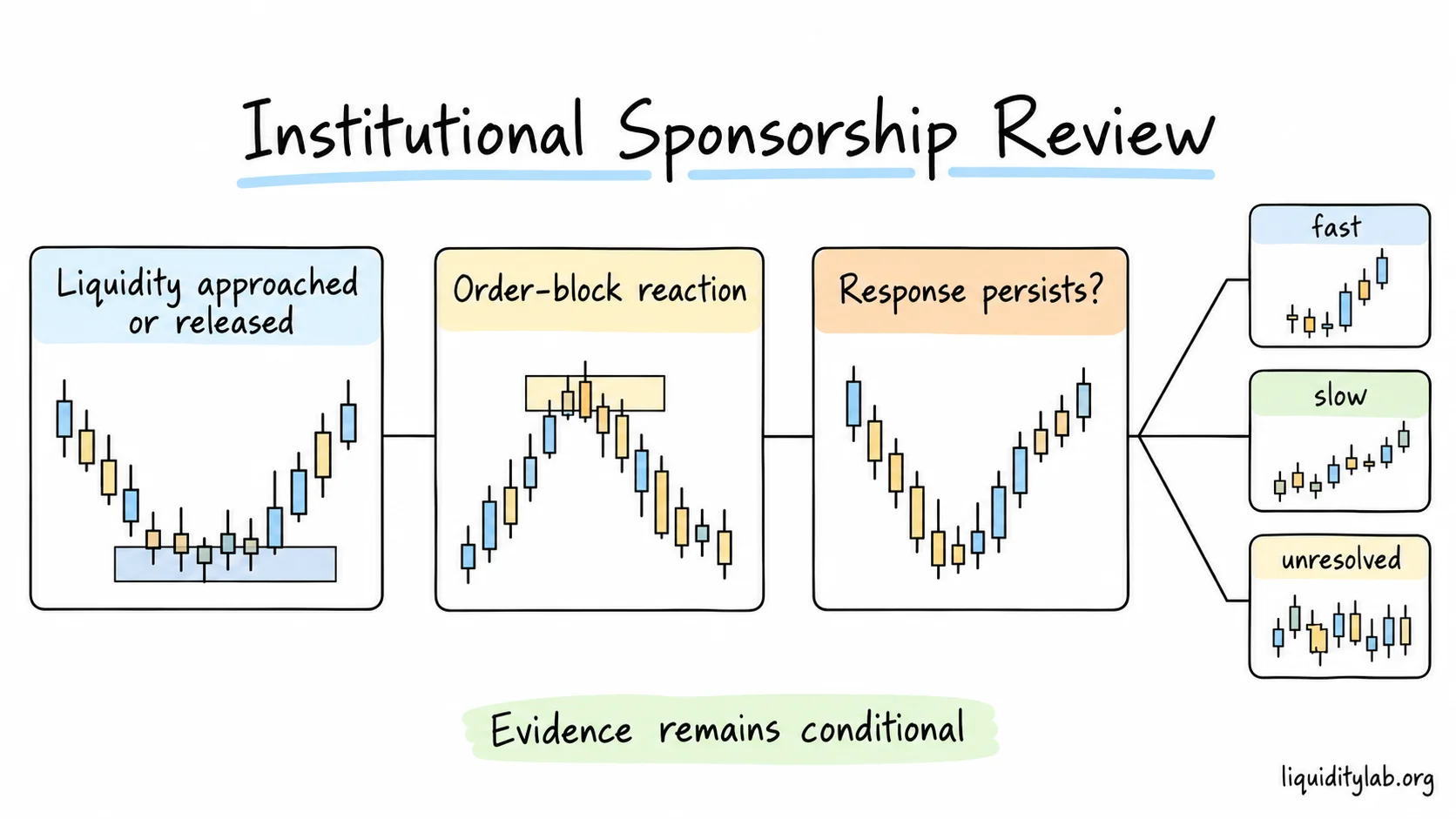
A possible footprint becomes useful only when the observed reaction and its limits are recorded together.
Time windows add context
Opening periods can change participation and liquidity, but a clock is not a direction signal. Compare the time window with location, structure and the later response. If the same pattern appears outside the window, keep it in the sample rather than treating the session label as a cause.
Review exercise
Select completed moves that include a sweep, a return and a displacement. Hide the later candles, write two competing explanations and then reveal the response. Keep failed, slow and unresolved cases beside the clean examples.
Learning boundary
Institutional sponsorship is an interpretive framework. It does not provide entries, stops, targets, probabilities or a reliable method for inferring intent. Continue with Unit 020: Anticipatory Cycle to examine how expectation can be organized across larger timeframes.