
ICT 2016 Unit 029: Breaker Blocks
Review breaker blocks as failed structure that may change role after a break and retest, without treating them as automatic support or resistance.
A breaker block is a former structure whose role may change after the market breaks it and later retests the area. The useful question is not whether the block is bullish or bearish by name, but what changed, where the retest occurred and what the following response established.
A failed structure can change role
Mark the original range or order-block candidate, then identify the break that invalidated its first interpretation. Only after that sequence does a role-reversal hypothesis become reviewable. A fast break without a later test remains incomplete evidence.
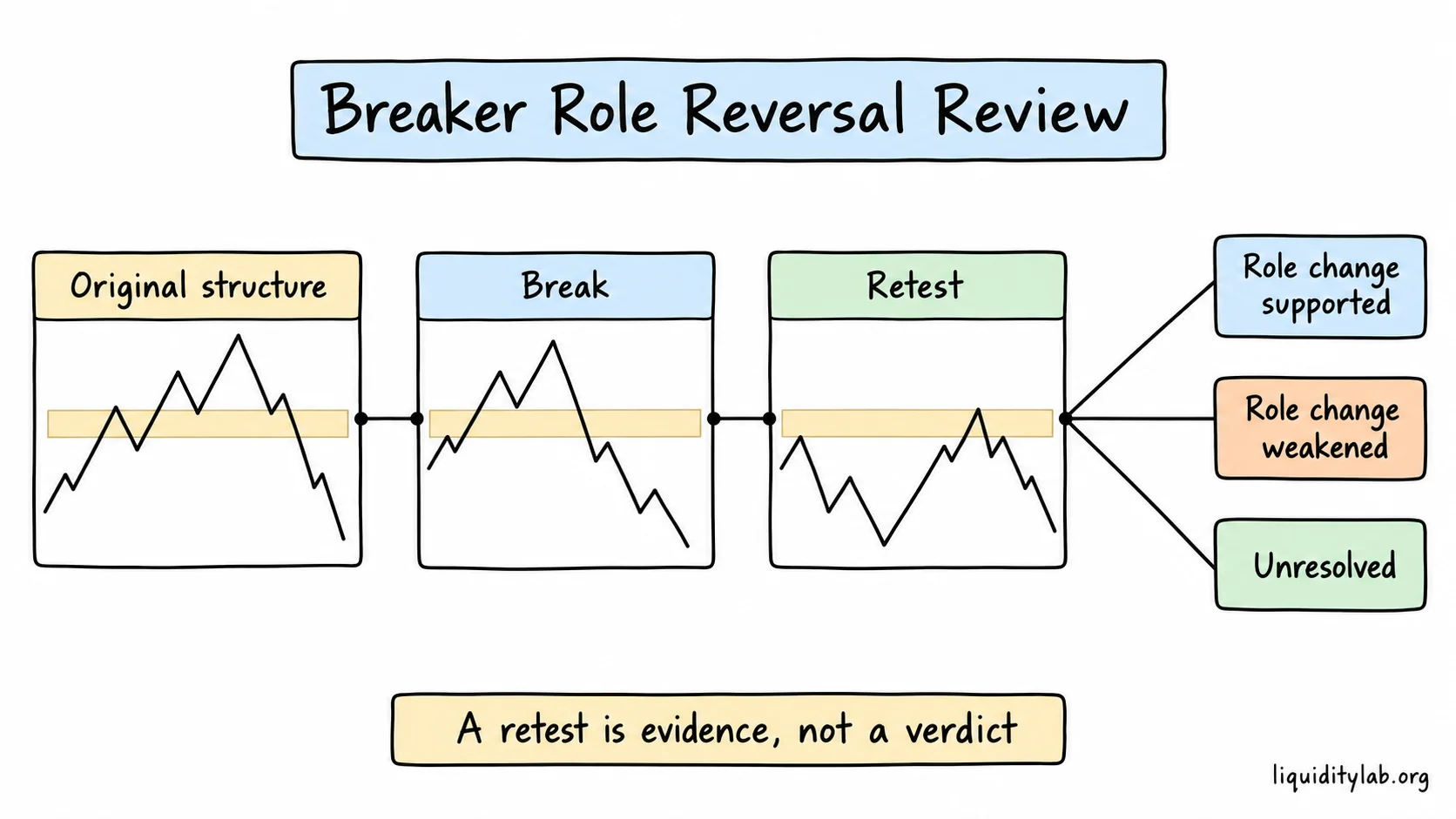
The retest supplies evidence for or against a breaker interpretation.
Retest and response
When price revisits the former area, record acceptance, rejection, continuation or failure. The retest can support a role change, weaken it or remain unresolved. A familiar shape cannot substitute for the sequence that gives it meaning.
Breaker versus ordinary support
Traditional support and resistance labels describe observed reactions. Breaker language adds a prior failed interpretation and a possible role reversal. Keep both layers separate so the framework does not turn a single retest into a certainty claim.
Review exercise
Find two completed role changes and one failed example. For each, write the original hypothesis, the invalidating break, the retest location and the later response. Compare what was visible at the retest with what became clear only afterward.
Learning boundary
Breaker blocks do not provide automatic entries, stops, targets, probabilities or proof of trapped participants. Continue with Unit 030: Rejection Blocks to study rejection as a separate evidence pattern.
Review questions
- Which original structure failed?
- What made the retest a role-reversal question?
- Did the response support, weaken or leave the explanation unresolved?
- How would a normal support label describe the same evidence?