
ICT 2016 Unit 036: FVG Rebalance Traps
Review fair-value gaps as fast repricing areas and compare complete repair, partial repair and continued acceptance.
An FVG can describe a fast sequence where two-way trade appears thin. The later return may rebalance part of the path, all of it, or none of it. The gap is an observation about delivery and participation, not a reason to chase price.
A fast sequence leaves a question
Mark the three-candle imbalance or other thinly traded area, then place it inside the larger range. Do not treat the visual gap as proof of strength. The next interaction supplies the evidence.
Planned diagram position: after ## A fast sequence leaves a question and before ## Complete and partial repair.
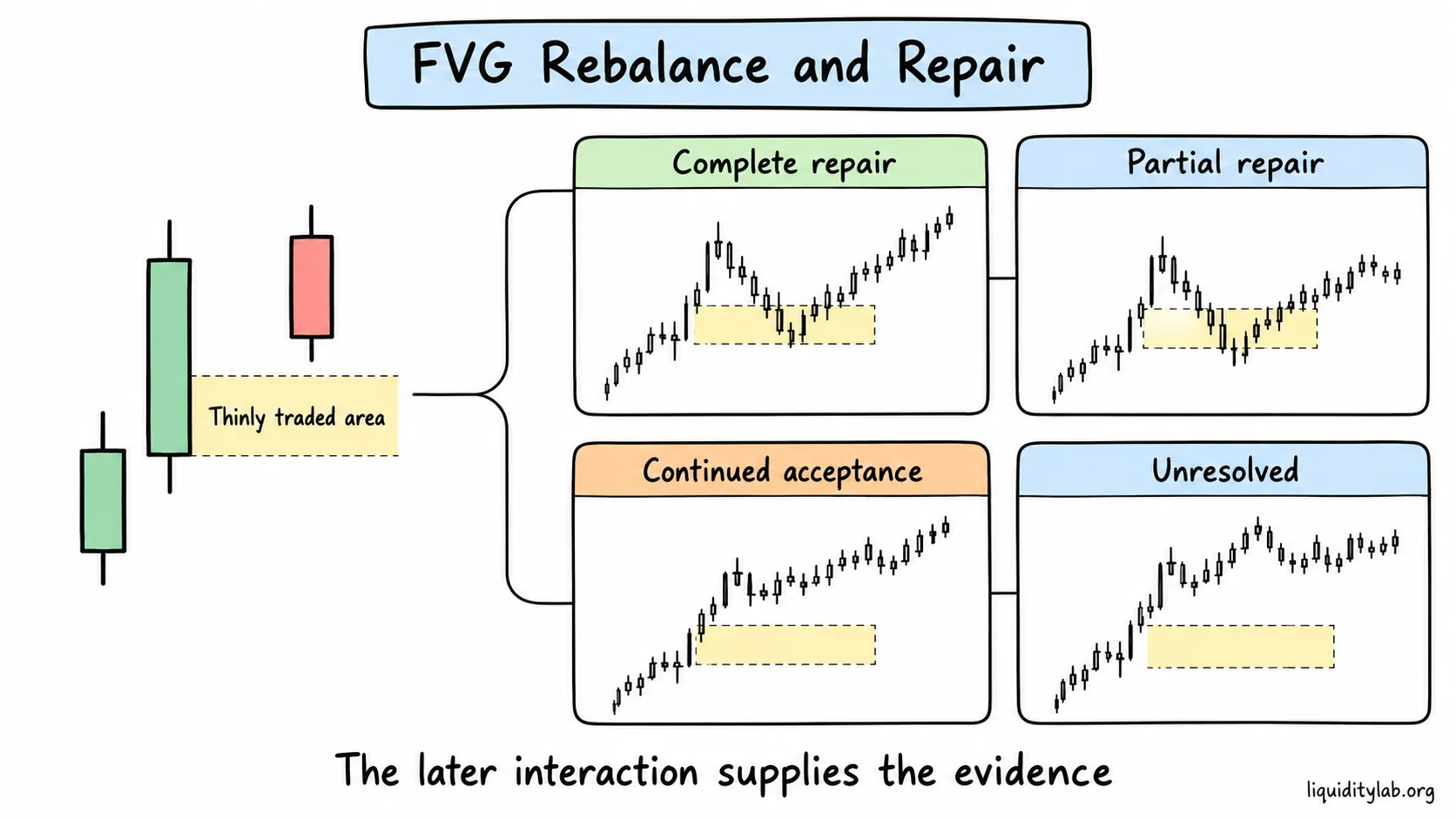
An FVG is a delivery question, not a chase signal.
Complete and partial repair
Price may fully traverse the area, touch part of it, continue accepting beyond it, or leave the question unresolved. Record the first return and the later state separately so hindsight does not turn a repair into a fixed rule.
FVG and liquidity
FVGs often sit near internal liquidity, while visible highs and lows may provide external context. Compare location, timeframe and response. A gap near a pool can attract attention without guaranteeing a specific route.
A fast lane with several exits
Imagine a road segment where traffic moved quickly and left fewer visible pauses. A later vehicle may drive through the whole segment, enter only part of it, continue beyond it or never return. The road image separates original delivery from later response; it does not turn an FVG into a destination.
Misconceptions: every FVG is not filled; a partial repair does not predict continuation; the rectangle alone is not evidence.
Review exercise
Select three fast sequences from completed charts. Mark the gap, nearby liquidity and first return. Classify one complete repair, one partial repair and one continued or unresolved case when the evidence allows.
Short review
1. Price touches one edge and continues. Sample reasoning: record partial interaction only if the selected boundaries support it; do not call it complete repair.
2. The gap is never revisited. Sample reasoning: record unvisited during the window instead of inventing a missing fill.
Learning boundary
FVG analysis does not provide automatic entries, stops, targets, probabilities or a chase signal. Continue with Unit 037: Divergence Phantoms to compare price action with a separate momentum or related-market explanation.
Review questions
- What makes the sequence look thinly traded?
- Did price fully repair, partly repair, continue accepting or remain unresolved?
- What liquidity references surround the gap?
- Which observation would weaken the rebalance explanation?