
ICT 2016 Unit 004: Balance, Discount and Relative Position
Learn to describe balance, discount and premium as range-relative locations, then review what price actually does without turning a midpoint into a signal.
Unit 003 used a balance area as a place to observe overlap, departure and return. This unit adds a second question: where is price located inside a selected range? The answer can be useful as a description, but it cannot tell us what price must do next.
Start with a chosen range
Suppose a clearly visible movement runs from 100 to 200. Its arithmetic midpoint is 150. If price is below 150, I can describe it as being in the discount half of that selected movement. Above 150, I can describe the premium half. These labels only make sense after the endpoints and timeframe have been stated.
The range is a measuring choice, not a permanent feature of the market. A different swing, data window or timeframe can produce a different midpoint. Save the original reference before revising it so the journal shows how the description changed.
Three locations, three questions
| Location | What it describes | What it does not prove |
|---|---|---|
| Discount | Price is below the midpoint of the selected range. | That price is cheap, safe or ready to rise. |
| Equilibrium | Price is near the midpoint of the selected range. | That trading is most active or that price must pause. |
| Premium | Price is above the midpoint of the selected range. | That price is overvalued or must fall. |
This language is relative, like saying that a ticket is expensive compared with its usual price. A holiday ticket can remain expensive when demand is strong; a discounted item can remain cheap because the underlying demand has weakened. Price position is a starting point for investigation.
Measure the movement before interpreting it
Use a repeatable sequence:
- Choose the timeframe and a completed, legible swing.
- Mark the high and low that define the movement.
- Calculate or draw the 50% midpoint.
- Record whether current price is above, near or below that midpoint.
- Review the surrounding structure and write down the next observable outcome.
Starting from a daily chart often makes the selected swing easier to explain. A smaller chart can add detail later, but it should describe the same interval rather than replace the higher-timeframe context with noise.
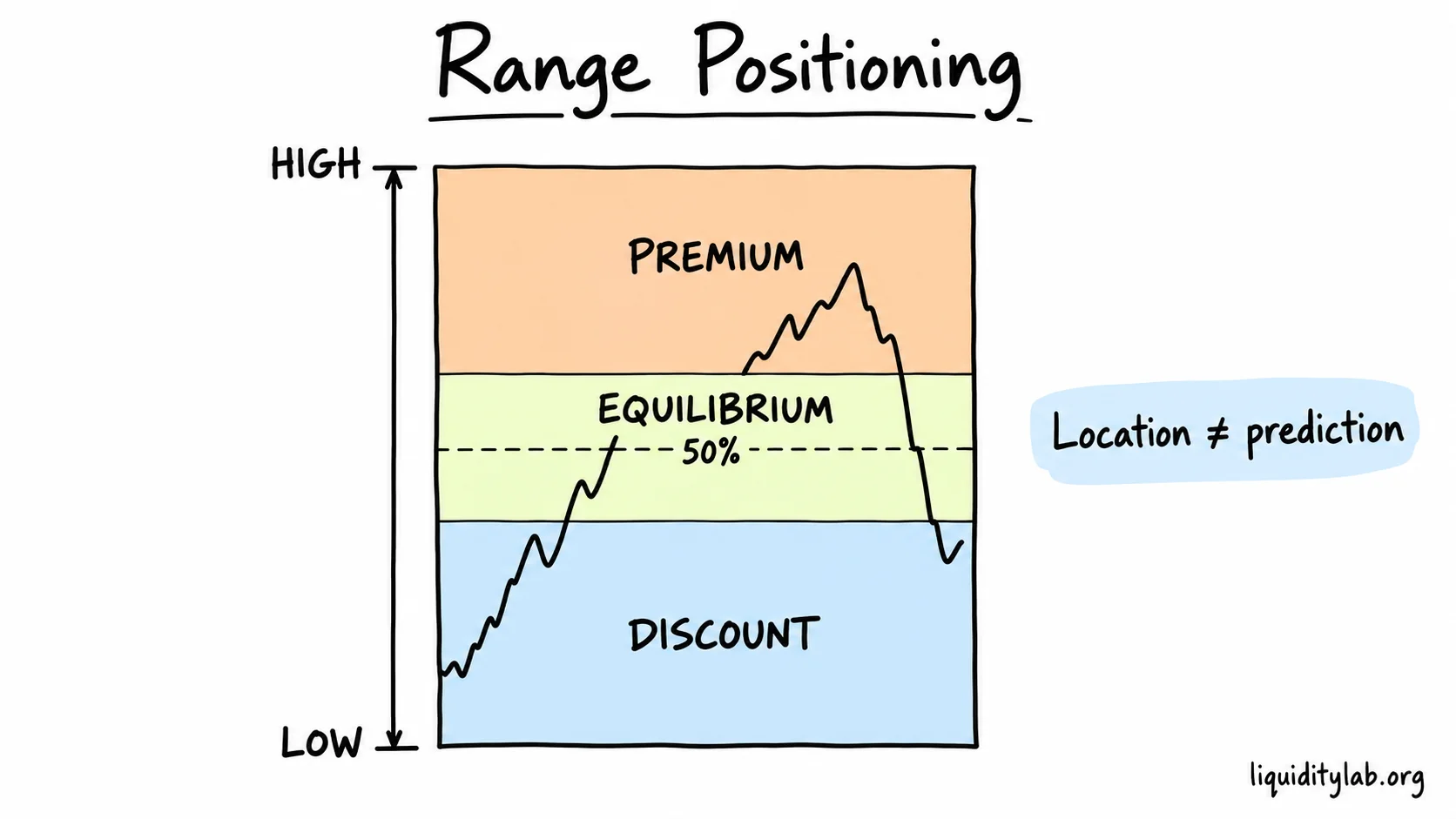
Range position describes location inside a selected movement; it does not predict the next move.
The 62%–79% teaching band
ICT material sometimes calls the deeper part of a range a 62%–79% discount or premium band. Keep this as course vocabulary for comparing historical examples. It is not a universal bargain zone, a reversal rule or a reason to act. Record whether price reaches the band, passes through it or never returns, and keep all three outcomes in the sample.
Separate fact, framework and hypothesis
When price returns to a discount area, write three layers:
- Fact: the selected high and low, midpoint, date, timeframe and actual path.
- Framework language: the range is being viewed through premium/discount and liquidity concepts.
- Hypothesis: a particular reaction may make the current range more or less useful.
Claims about a market maker accumulating below equilibrium are interpretations. A chart can show movement and overlap; it cannot identify an institution's private plan. This separation keeps a familiar story from replacing evidence.
A review exercise
Choose one completed daily swing. Before looking at later candles, write the endpoints and midpoint. Then record whether the first return produced hesitation, continuation, a deeper excursion or no clear response. Add the smaller-timeframe description only after preserving the daily view.
Ask:
- Why do these endpoints represent a meaningful movement?
- Did I describe location, or did I silently convert it into a prediction?
- What happened after price reached the midpoint or deeper band?
- Which part of my explanation would remain if I removed institutional-intent language?
Continue learning
Unit 005 examines the premium side of the same range-relative language. Unit 006 then adds fair value gaps and asks what happens after a fast repricing. Return to Unit 003: Balance and the Observation Journal when the range boundaries need a clearer review record.
Balance, discount and premium are educational position descriptions. They do not provide market direction, entries, stops, targets, probabilities or return promises.