Four Market Scenarios Framework
Learn a simple four-scenario framework for describing market state before looking for setups or framework labels.
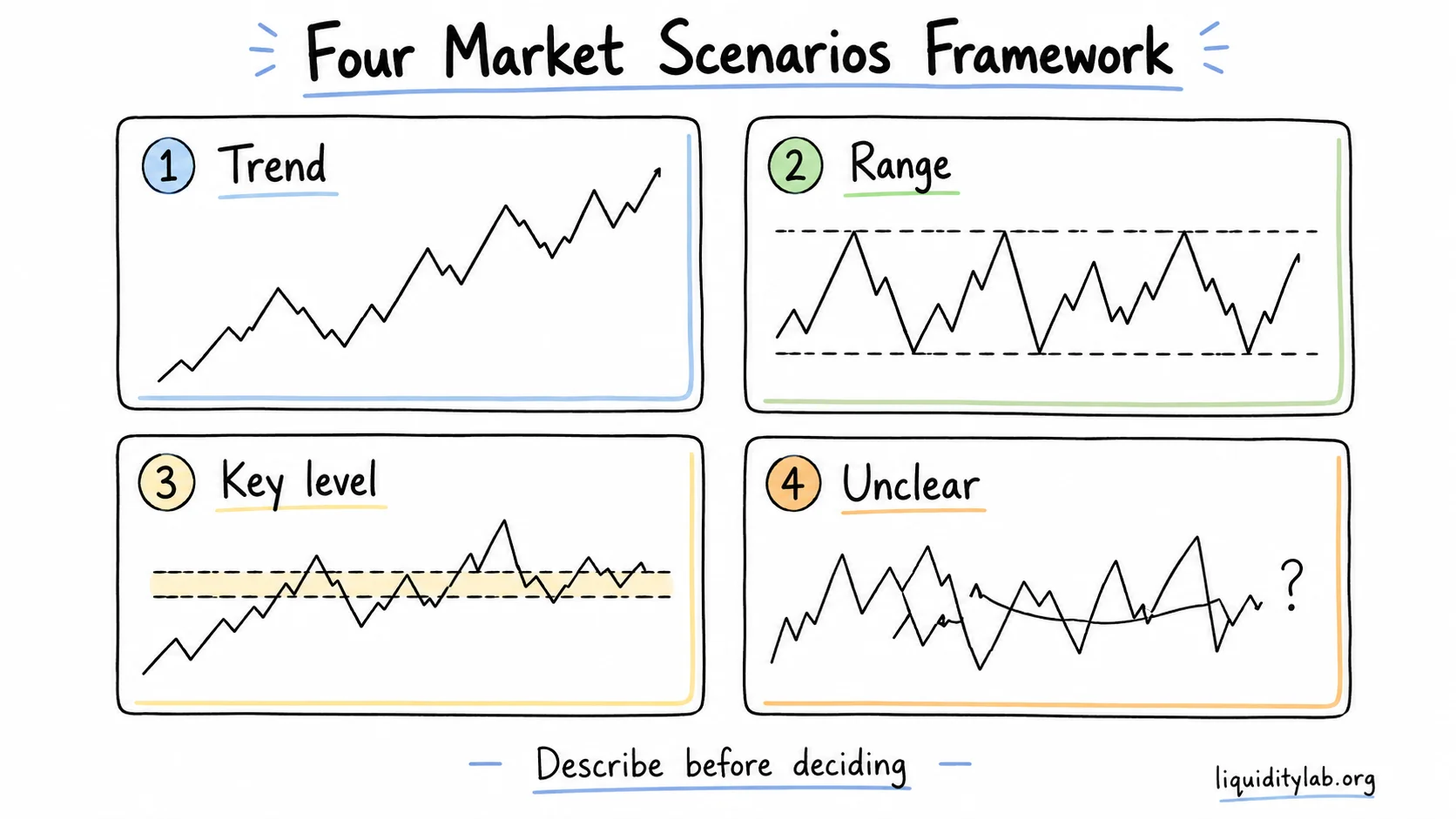
When you open a chart, do not start with:
Will price go up or down?
Start with:
Which scenario is this?
The four-scenario framework gives you a simple first filter.
In the LiquidityLab Market Structure OS, this lesson is the bridge between the Structure layer and the Simulation layer: first label the market state, then practice possible observation paths.
Scenario 1: trend
Price is trending when the structure is orderly.
In an uptrend, price forms higher highs and higher lows.
In a downtrend, price forms lower lows and lower highs.
The key word is clean. If the swings are obvious and the sequence is not messy, trend is a reasonable first label.
Useful observation questions:
- Are swing highs and swing lows progressing in one direction?
- Is overlap limited?
- Are pullbacks still contained inside the larger structure?
Common mistake:
Treating every pullback as reversal.
Scenario 2: range
Price is ranging when it rotates inside a clear area without clean directional progress.
Signs of range behavior:
- price keeps returning to the same area
- highs and lows stop building a clean sequence
- candles overlap more
- breakout attempts return inside the range
Useful observation questions:
- Where are the upper and lower areas?
- Is price near a boundary or in the middle?
- Did the latest break hold outside the range?
Common mistake:
Treating every candle inside the range as a new signal.
Scenario 3: near a key level
Sometimes the main issue is not trend or range. The main issue is location.
Price may be approaching:
- a prior high
- a prior low
- an equal high or equal low
- a range boundary
- a level many traders can see
Near a key level, the first job is to observe reaction.
Useful observation questions:
- Does price reject the area?
- Does price accept beyond the area?
- Does price sweep the level and return?
- Does follow-through continue?
Common mistake:
Entering before price shows how it reacts.
Scenario 4: unclear
Sometimes the correct label is:
I do not understand this structure yet.
This is not weakness. It is a valid market state.
Signs of an unclear scenario:
- swing points are messy
- timeframes conflict
- price is far from meaningful levels
- candles overlap without useful structure
- you cannot explain the current state in one or two sentences
Useful observation question:
What would need to become clearer before this chart is worth studying further?
Common mistake:
Forcing a trade idea because not acting feels uncomfortable.
Quick table
| Scenario | Main feature | Better question |
|---|---|---|
| Trend | ordered swing sequence | Is the pullback still inside the structure? |
| Range | repeated rotation | Is price near a boundary or in the middle? |
| Key level | important location | Does price accept, reject, or sweep? |
| Unclear | no clean read | What information is missing? |
Practice
For one week, open charts and do only one task:
Label the current scenario.
Do not look for entries. Do not predict direction. Just label the market state and write one reason.
This trains the habit of describing before deciding.
Continue with
- LiquidityLab Market Structure OS
- Market Structure Basics
- Trading Range Structure
- What Are Key Levels?
- Liquidity Sweep
- AI Structure Workbench Beginner Manual
Educational content only. Not financial advice.