ICT / SMC Learning Path for Beginners
A beginner-friendly ICT and SMC study path that starts with structure, then moves into liquidity, FVG, order blocks, and framework mapping.
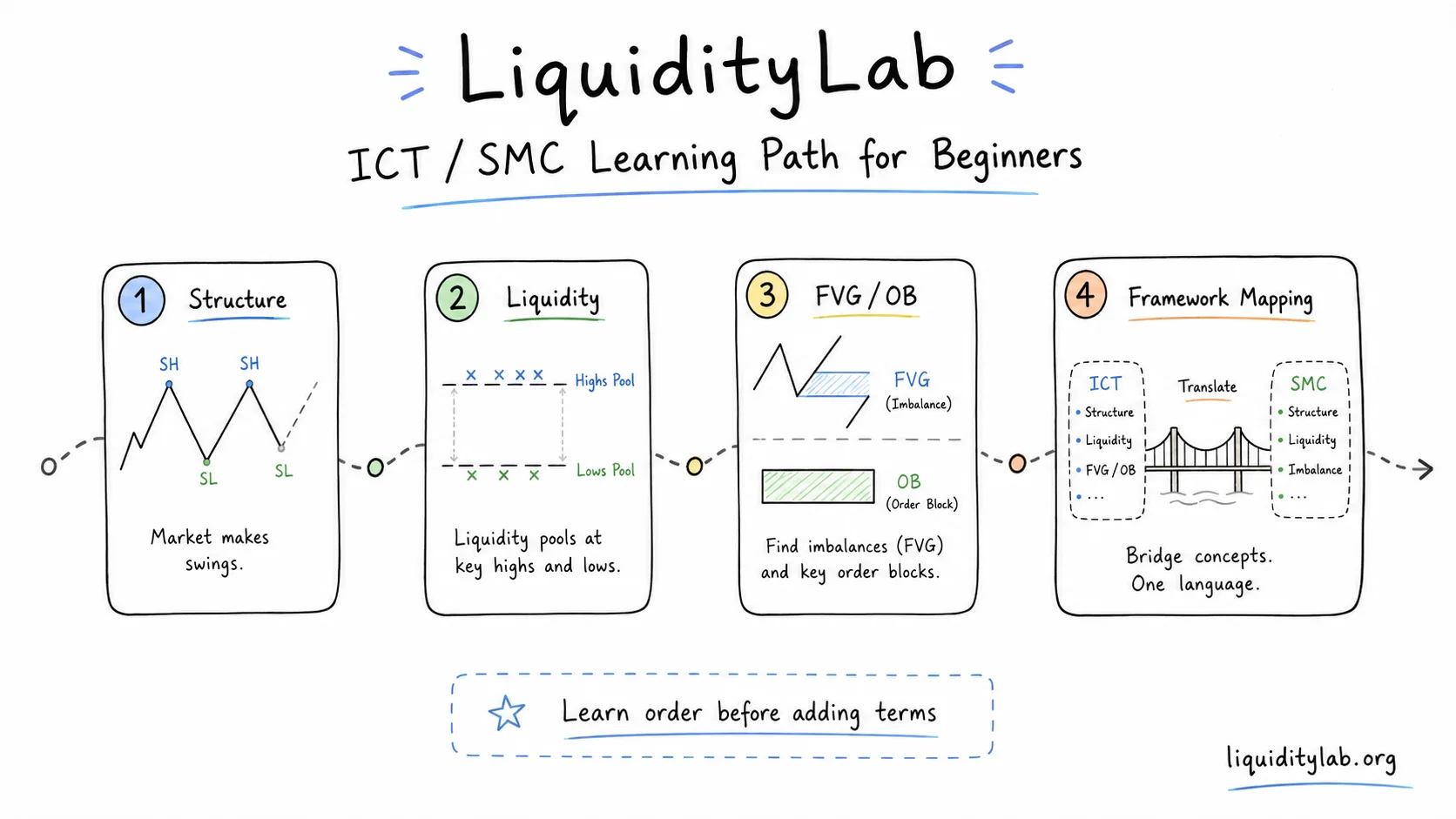
You do not need to learn every ICT or SMC term at once.
The problem for beginners is usually not lack of information. It is the order of learning.
This path gives you a safer sequence.
Stage 1: structure first
Start with market structure.
Before learning order blocks, fair value gaps, or liquidity sweeps, you should be able to describe:
- swing highs
- swing lows
- trend
- range
- BOS
- MSS
Goal:
Open a chart and describe the current structure without using advanced terms.
Recommended pages:
Stage 2: core ICT / SMC vocabulary
After structure, learn the basic vocabulary.
Start with:
Goal:
Recognize each concept as a structure label, not as a complete strategy.
Do not try to trade every label you learn. First learn what the label describes.
Stage 3: structure change and liquidity
Next, study how structure and liquidity interact.
Useful topics:
Goal:
Explain whether a move is continuation, possible shift, liquidity sweep, or still unclear.
This is still observation work. It is not a signal checklist.
Stage 4: framework mapping
Once the core terms are familiar, learn how SMC connects to the larger LiquidityLab structure layer.
Recommended page:
Goal:
Understand that SMC and price action may describe the same structure with different words.
Avoid the double-confirmation trap:
If two frameworks describe the same evidence, that does not make the evidence independent.
Continue with a course sequence
The ICT 2016 Study Notes now develop Units 001–015 as connected lessons, with worked examples, counterexamples and review exercises. Start there when you want to move from recognizing vocabulary to explaining your reading. These are independent study notes; the concept pages above remain reference material.
What to avoid
Avoid these beginner traps:
- learning too many terms before structure is clear
- treating every SMC label as a trade setup
- using multiple frameworks as a voting system
- asking for certainty instead of context
- skipping review because the chart "looks obvious"
Weekly study routine
Use a simple weekly rhythm:
- Read one concept page.
- Mark three examples by hand.
- Write one observation record.
- Review one mistaken interpretation.
The purpose is not to collect terms. The purpose is to build a stable reading process.
A useful boundary
ICT / SMC can be a powerful vocabulary.
But vocabulary does not replace risk education, execution rules, or review.
In the LiquidityLab model, learn the market structure layer first. Then use SMC as a framework-mapping layer.
Continue with
- AI Structure Workbench Beginner Manual
- SMC Liquidity and Order Flow Language
- SMC and Price Action Integration Language
Educational content only. Not financial advice.