
ICT 2016 Unit 022: From Macro Context to Micro Structure
Connect bonds, rates and the dollar to a structured multi-timeframe review without treating macro relationships as mechanical signals.
Macro context helps define the weather around a market. It does not determine the next candle. A useful review moves from bonds and rates to the dollar, related markets and finally the local structure while keeping each link conditional.
Five observation layers
- Funding environment: describe bond prices, yields and changing costs of capital.
- Dollar reference: observe how the dollar index is behaving relative to that backdrop.
- Cross-market relationship: compare related instruments for confirmation or mismatch.
- Price location: mark ranges, order areas, gaps and visible liquidity.
- Local structure: record the reaction without letting a micro move erase context.
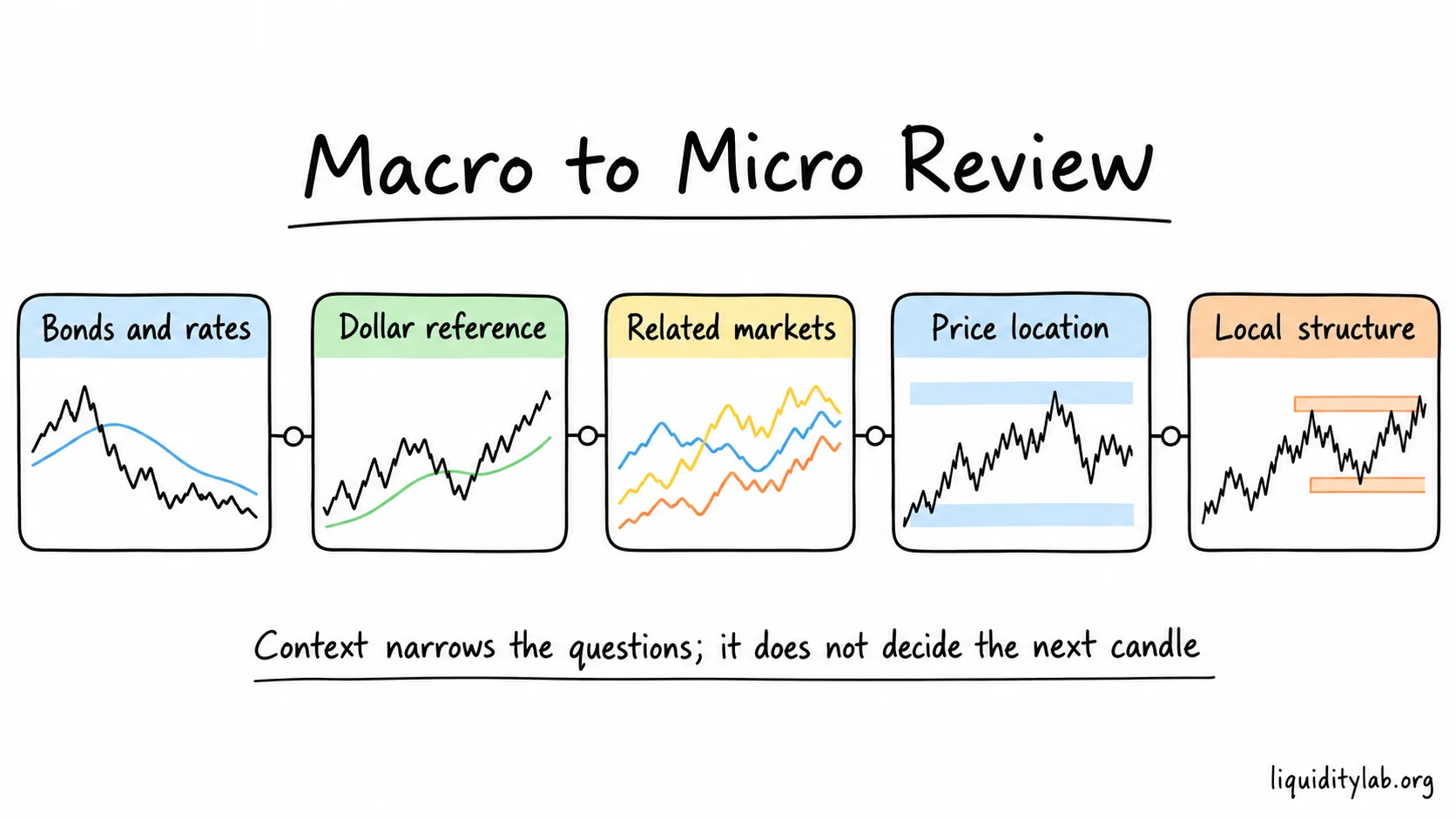
Macro context narrows the questions; it does not supply an automatic trade direction.
Relationships are not formulas
Bond prices and yields often move inversely, and rate expectations can influence the dollar. Policy, risk appetite, inflation expectations and liquidity can temporarily change those relationships. Record the observed relationship before explaining it.
Review exercise
Choose a completed period and write one sentence for each layer. Then hide the local chart and ask which macro claims still stand. Reveal the local sequence and note whether it confirmed, contradicted or left the larger hypothesis unresolved.
Learning boundary
Macro-to-micro analysis is a context framework. It does not provide entries, stops, targets, fixed quarterly reversals or return promises. Continue with Unit 023: False Trendlines to examine how local geometry can organize crowd expectations.