
ICT 2016 Unit 025: Interest-Rate Positioning
Use long-, medium- and short-term rate relationships as conditional context for reviewing the dollar and related markets.
Interest rates can add context to a currency chart, but they do not decide the next candle. This lesson turns the 30-year, 10-year and 5-year rate references into a comparison routine: describe each series, compare their agreement or divergence, then check whether the dollar and related markets tell a compatible story.
Three rate horizons
- Long horizon: the 30-year reference gives a broad funding and duration backdrop.
- Middle horizon: the 10-year reference helps describe intermediate repricing.
- Short horizon: the 5-year reference can change faster as expectations move.
The labels are observation layers, not guarantees. A divergence can persist, resolve, or be overwhelmed by policy, inflation expectations, risk appetite and liquidity conditions.
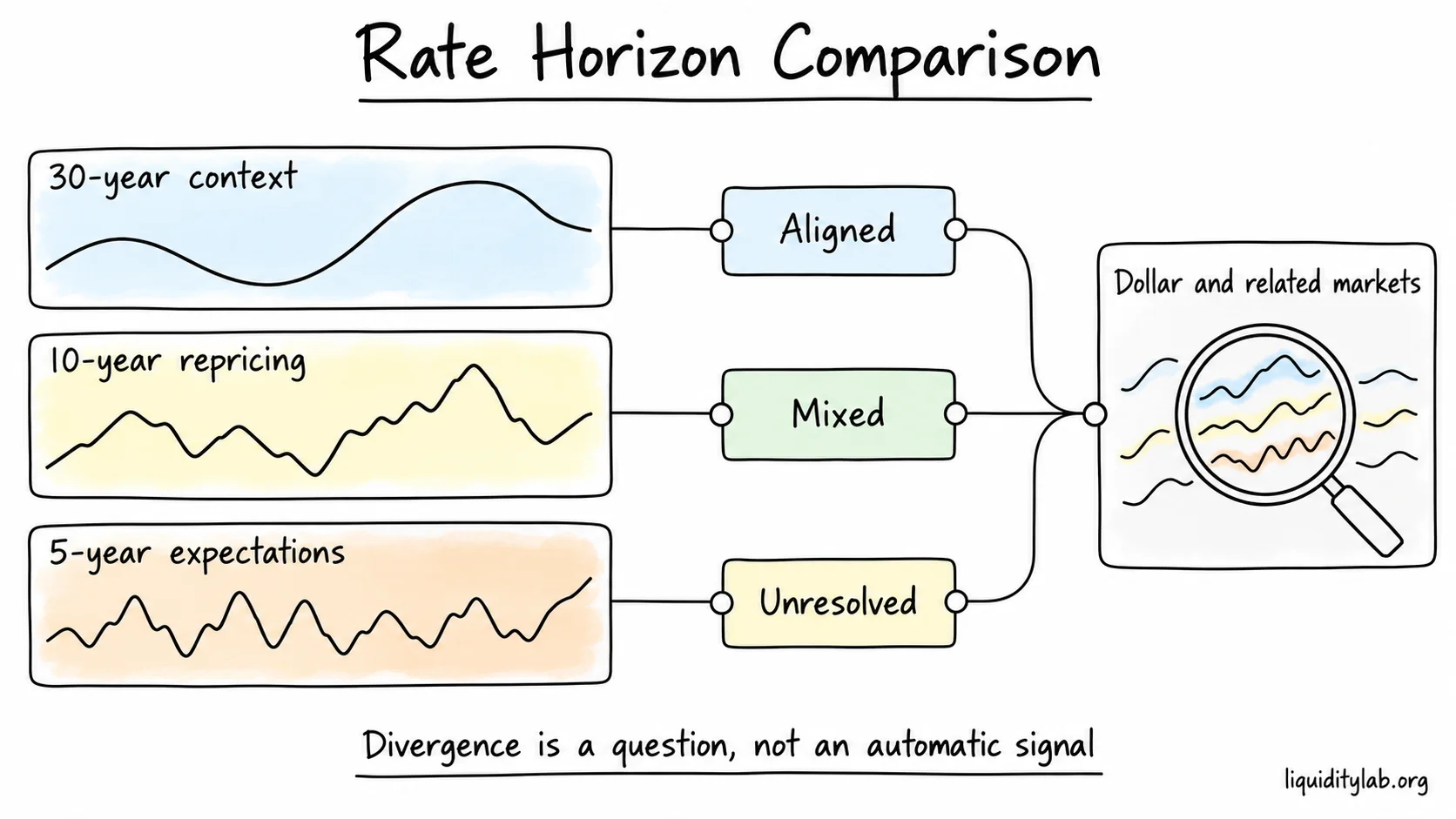
Rate horizons add context; divergence still needs cross-market review.
Divergence is a question
When one horizon rises while another stalls or falls, record the mismatch before explaining it. Compare the dollar, bonds and related markets over the same window. A price move that looks strong in isolation may have weaker cross-market support; a quiet dollar may be sitting beside a meaningful change in rate structure.
A simple analogy
Think of three thermometers in the same building. One measures the basement, one the main floor and one the roof. Different readings do not prove that the building is collapsing. They tell you to inspect where the temperatures changed, how quickly they changed and whether the rooms are connected.
Review workflow
- Mark the selected period and the visible state of each rate horizon.
- Describe whether the series are aligned, mixed or changing leadership.
- Compare the dollar and one related market without assuming an inverse formula.
- Record a confirming observation and a counterexample.
- State what remains unknown and what evidence would weaken the explanation.
Dollar and related markets
The dollar, bonds, commodities and other currencies may provide context for one another, but correlations are conditional. Check quotation direction, timeframe alignment and price location. A single failed high or low can be useful evidence; it is not proof of accumulation, distribution or participant intent.
Learning boundary
Rate structure is a context layer, not a standalone entry, stop, target or return method. Do not convert a rate divergence into an automatic currency trade. Continue with Unit 026: Liquidity Hunts to study how visible order concentrations can alter the path.
Review questions
- Which horizon changed first, and what is directly observable?
- Are the three horizons aligned, mixed or unresolved?
- Does the dollar move agree with the related-market evidence over the same window?
- What alternative explanation could fit the same chart?
- Which missing observation would make the current hypothesis weaker?