
ICT 2016 Unit 033: Vacuum Blocks
Review vacuum blocks as thinly traded repricing areas and compare complete repair, partial repair and continued acceptance.
A vacuum block is a review label for a fast move through an area with relatively little visible two-way trade. The later return may repair part of the path, all of it, or none of it. The gap is evidence about participation, not a chase signal.
Fast repricing leaves a question
Mark the rapid move, the thinly traded area and the surrounding range. Avoid treating the visual gap as proof of strength. The next interaction is needed to describe whether price accepts, repairs or bypasses the area.
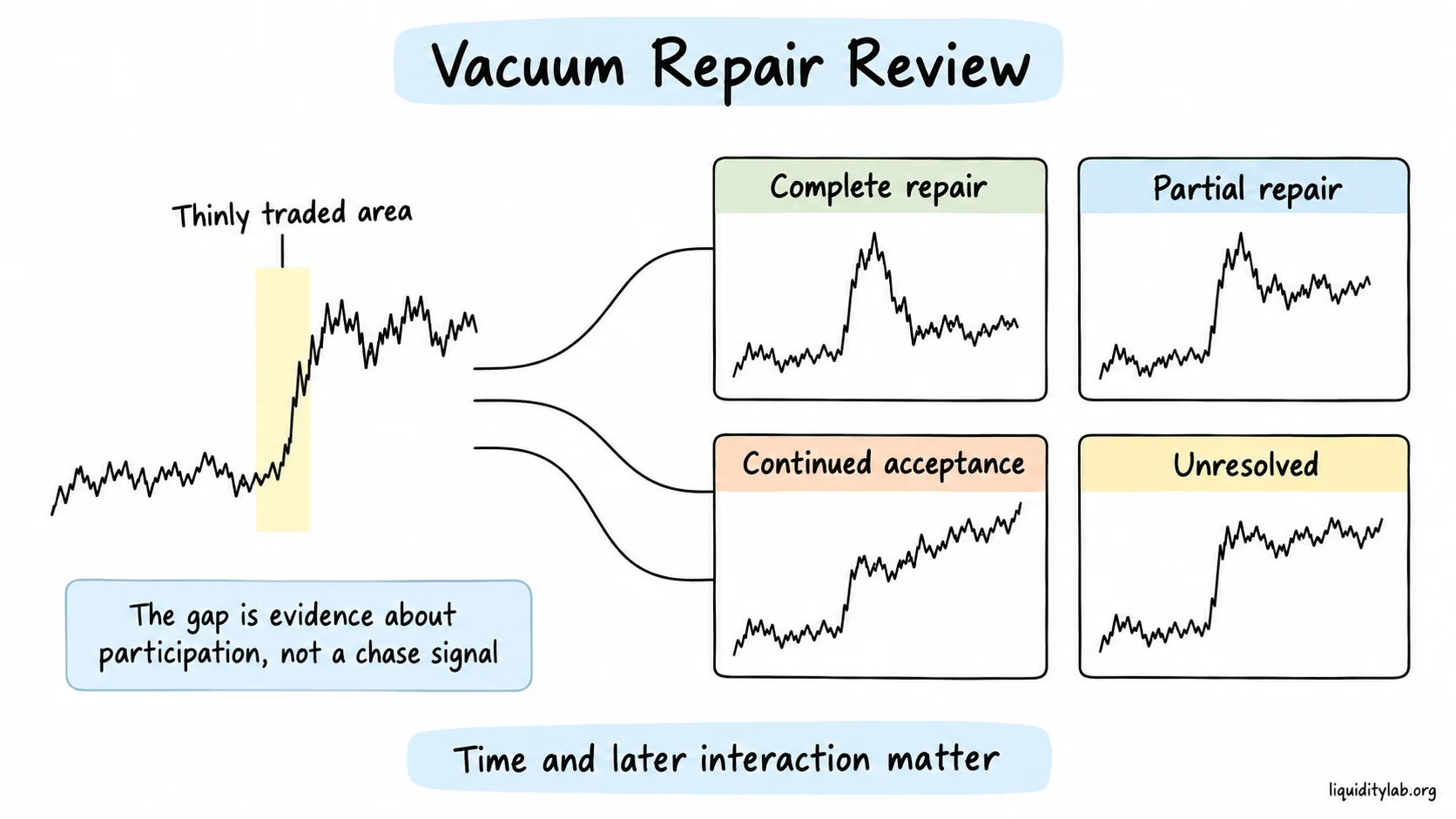
A fast move needs a later interaction before its role can be described.
Complete, partial and absent repair
Classify the later interaction as complete repair, partial repair, continued acceptance or unresolved. Time matters: a gap that has not been revisited is not evidence that it never will be. A return can also fail to restore the old balance.
Vacuum versus fair-value gap
The terms overlap in everyday chart language, but this lesson emphasizes the path and its later repair rather than a mechanical three-candle definition. Use whichever label makes the observation clearer, and state the evidence that supports it.
Review exercise
Select three fast repricing sequences. Mark the thin area, the first return and the later state. Record one complete repair, one partial repair and one example that remained unresolved, if the data allows.
Learning boundary
Vacuum blocks do not provide automatic entries, stops, targets, probabilities or a reason to chase fast movement. Continue to the broader ICT / SMC Learning Path after comparing repricing, repair and uncertainty.
Review questions
- What makes the area look thinly traded?
- Did price fully repair, partly repair, continue accepting or remain unresolved?
- How does the label differ from a mechanical fair-value-gap rule?
- What evidence would weaken the vacuum explanation?