
ICT 2016 Unit 010: From Higher-Timeframe Context to Local Detail
Use higher-timeframe context and local structure to write a bounded market hypothesis, while treating shorter risk distance as a question to validate.
Multi-timeframe study is a way to organize evidence. A higher timeframe supplies context; a smaller timeframe can describe local structure and a possible invalidation point. The smaller view does not turn uncertainty into certainty.
Context before detail
Start with the weekly or daily chart and state the selected range, key levels and current market state. Then map those references onto an hourly or intraday chart. Only after the context is fixed should a smaller chart be used to examine a boundary test or local sequence.
What risk compression can and cannot mean
A local structure may place a hypothetical invalidation point closer to the observation area. That can reduce the distance used in a review, but it can also increase sensitivity to noise, spread or a brief excursion. A shorter distance is not automatically a lower-risk decision.
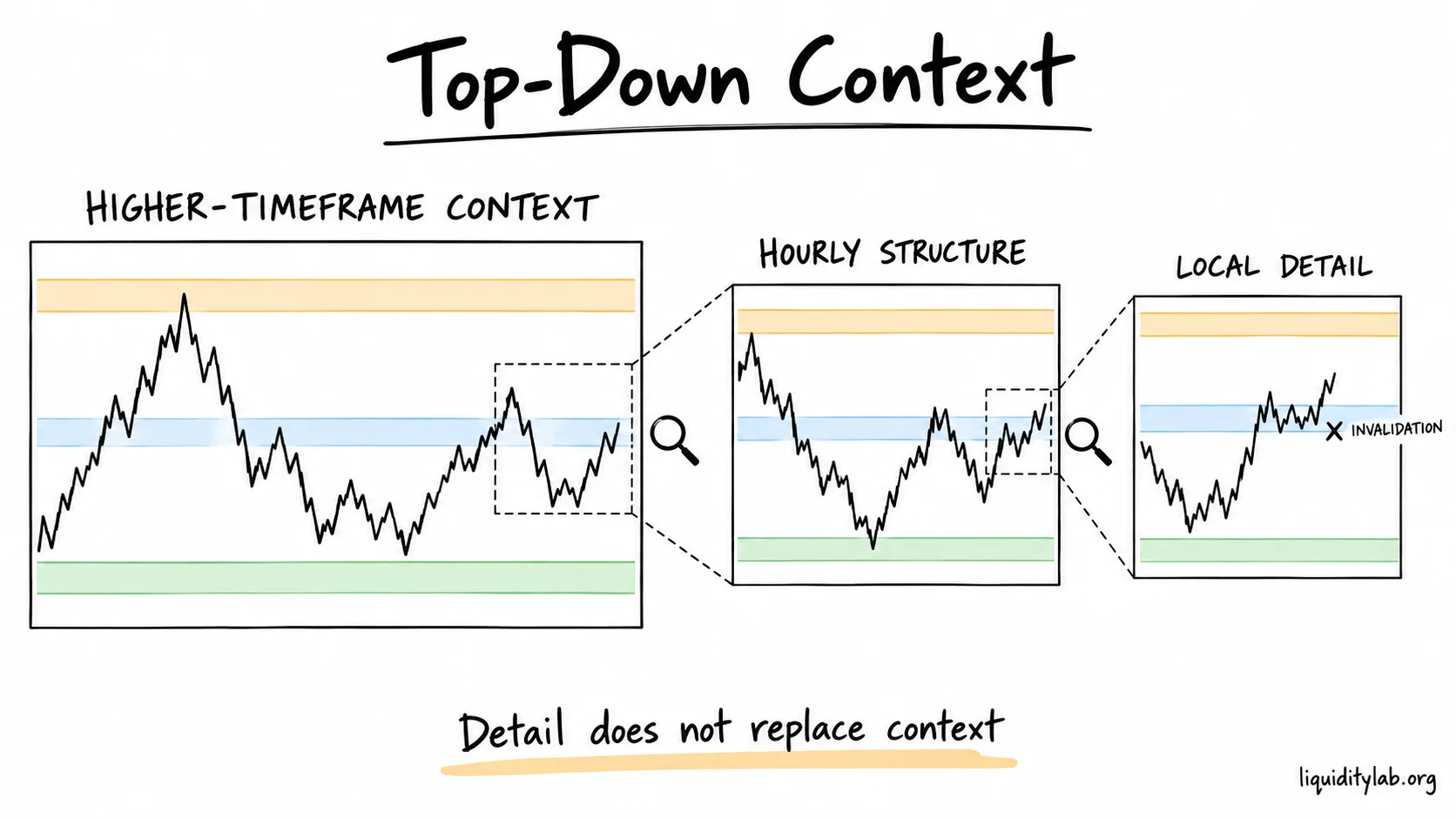
Higher-timeframe context comes before local detail; smaller does not mean safer by default.
| Question | Review wording |
|---|---|
| Context | What larger range or level was selected, and why? |
| Local detail | What sequence appeared near that reference? |
| Invalidation | What observation would weaken the hypothesis? |
| Limitation | What could the smaller timeframe hide? |
The source's example distances are teaching examples, not parameters. Record the structure that makes an invalidation meaningful rather than choosing a small number first.
A top-down review sequence
- Mark higher-timeframe context.
- Carry only relevant references down one timeframe.
- Describe the local reaction without forcing a pattern label.
- Write the invalidation condition before reviewing the outcome.
- Compare the local result with the larger context.
This is a study workflow. It does not require a trade and does not promise a better price.
Exit planning is part of the hypothesis
If a review includes staged exits, define them before looking at later candles. A first observation can reduce exposure in the hypothetical plan, while the remaining path is recorded against a larger reference. Staging can reduce emotional pressure and can also reduce participation in a later extension. Both effects belong in the journal.
Review exercise
Choose a completed range. Hide the later candles, mark the higher-timeframe context, and then inspect one smaller timeframe. Record whether the local structure genuinely clarified the hypothesis or merely added noise. Include a case where the smaller view failed.
Continue with Unit 011: Partial Exits and the Observation Loop. Multi-timeframe analysis is an educational review method; it does not provide entries, stops, targets, probabilities or return promises.