
ICT 2016 Unit 035: Liquidity Pools
Review buy-side and sell-side liquidity as visible order concentrations without turning stop clusters into guaranteed destinations.
A liquidity pool is a useful label for an area where similar orders may cluster around visible highs, lows or repeated boundaries. It helps organize a chart review, but it does not prove that price must visit the pool or that an unseen participant is targeting one trader.
Buy-side and sell-side pools
Buy-side liquidity may sit above visible highs, while sell-side liquidity may sit below visible lows. Mark both sides before explaining a move. The same level can be a breakout reference for one observer and a protective-order cluster for another.
Planned diagram position: after ## Buy-side and sell-side pools and before ## A sweep is not a destination.
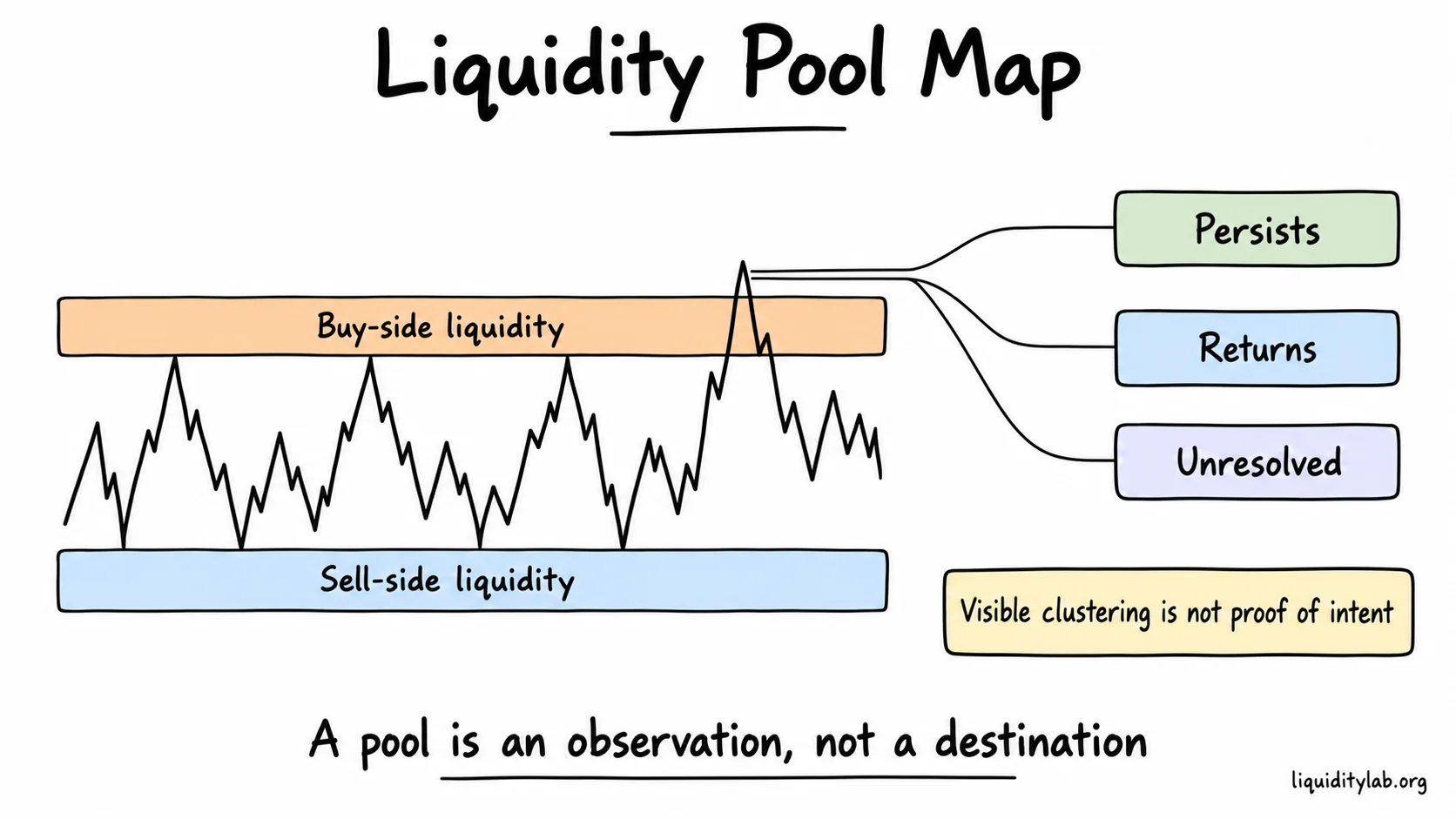
Visible order clustering needs a later response before it can explain the path.
A sweep is not a destination
Price can briefly cross a pool and return, continue through it, or remain unresolved. Classify the later response rather than treating the first touch as proof of a planned route. Rebuild the range when a new extreme changes the evidence.
The observer's position matters
A useful review asks what a crowded participant might see and what the chart actually confirms. This does not require claiming that the market knows an individual's stop. It only requires separating visible clustering from assumptions about intent.
A queue outside a doorway
Imagine a doorway where many people choose to wait because it is easy to see. The queue is observable; the reason each person is there is not. A clean high or low can mark a visible concentration without proving that price must visit it.
Misconceptions: a pool is not a target; a sweep does not prove manipulation; more marked pools do not automatically add information.
Review exercise
Mark one buy-side and one sell-side pool in a completed range. Hide the later candles, write two competing path explanations, then reveal the response and classify persistence, return or unresolved evidence.
Short review
1. Price crosses the high and accepts above it. Sample reasoning: weaken a sweep-and-return explanation and give persistence more weight.
2. A clean low is never touched. Sample reasoning: record an unresolved visible hypothesis rather than calling it irrelevant.
Learning boundary
Liquidity pools do not provide automatic entries, stops, targets, probabilities or proof of manipulation. Continue with Unit 036: FVG Rebalance Traps to study what fast repricing can leave behind.
Review questions
- Which visible references define the pool?
- What did the first sweep establish, and what remained unknown?
- Did price persist, return or remain unresolved?
- What alternative explanation fits the same order concentration?