
ICT 2016 Unit 009: Small-Account Study and Risk Boundaries
Reframe small-account growth around survival, written risk boundaries and repeatable review; treat compounding examples as arithmetic, not promises.
Small-account study is first a question of preserving the ability to keep learning. A dramatic short-term result can hide an unacceptable risk of interruption.
Resist the fast-growth story
The wish to turn a small balance into a large one quickly is understandable, but a heavy position can remove the next opportunity to learn. One lucky outcome does not establish a reliable process. A better first question is: what loss would stop the study plan?
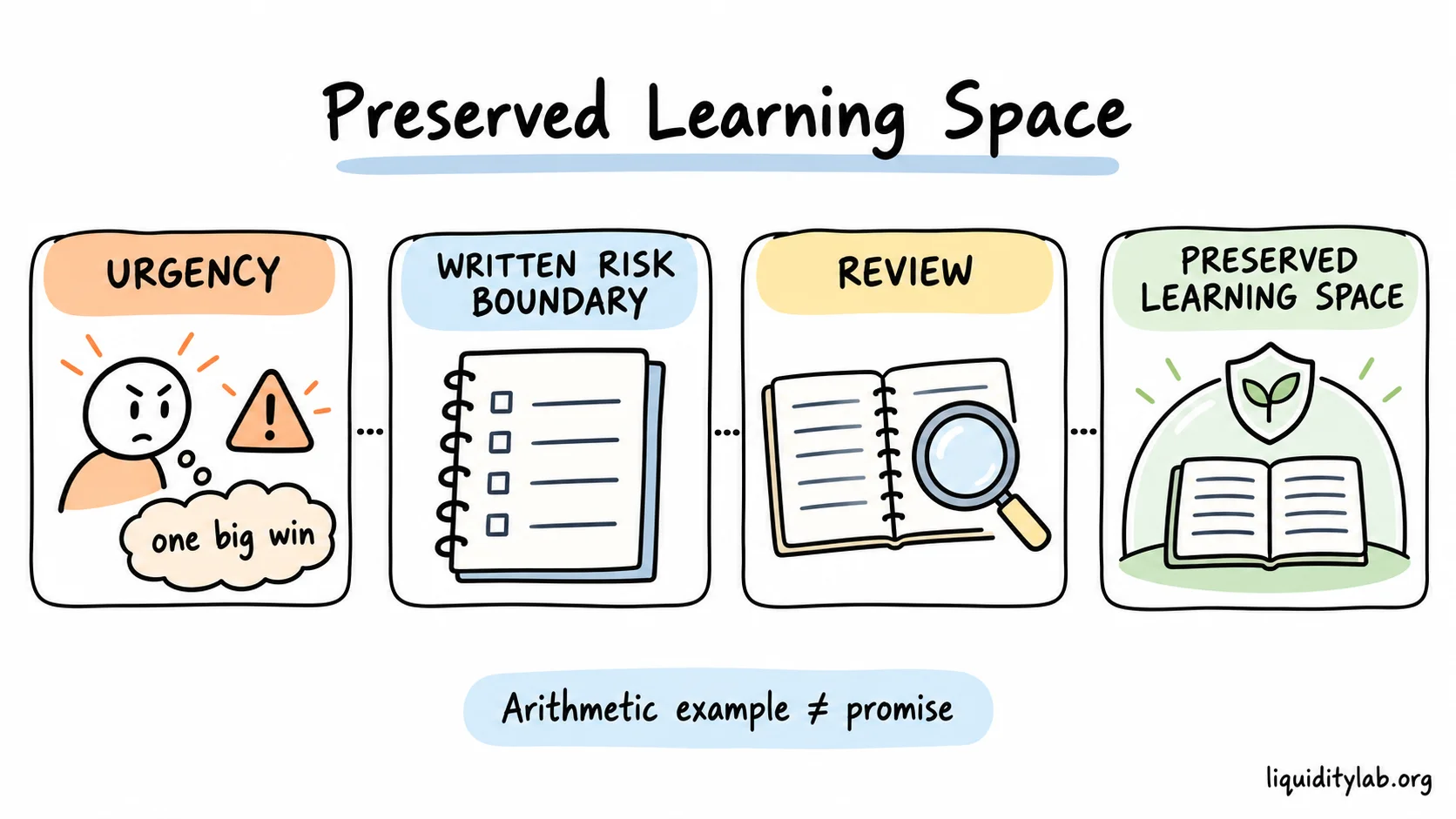
The first objective is preserving learning space, not a promised growth rate.
Compounding is arithmetic, not a forecast
Compounding examples show how repeated gains can grow a balance over time. They usually omit losing periods, fees, taxes, pauses, changing conditions and emotional limits. Keep the calculation as a way to understand time, not as a monthly target or outcome claim.
Risk comes before return
Before discussing a possible return, write the maximum acceptable loss, the conditions that invalidate the idea and what happens after a loss. The source's 2% example is a teaching boundary, not a universal setting. Different products, volatility and personal circumstances require different decisions.
Potential reward-to-risk ratios are also hypotheses. A stated 3:1 relationship does not guarantee that the larger outcome is reachable or that the loss will remain at the planned amount.
A review-first process
- State the observation, timeframe and market context.
- Write the invalidation condition and maximum acceptable loss before acting.
- Record whether the plan was followed, changed or abandoned.
- Review the result without removing inconvenient cases.
- Check whether several losses would still leave financial and psychological room to continue learning.
This process treats discipline as a study variable. It does not turn a risk example into personal financial advice.
When a position is losing
Floating loss often tempts people to move an invalidation boundary, wait for a return to entry or reverse direction impulsively. A written boundary gives the review a stable reference. If it is reached, record that the hypothesis failed; do not rewrite the earlier plan after the fact.
Historical exercise
Use a completed sample and record the planned loss boundary, potential relationship between loss and gain, whether the plan changed, and the result after several consecutive losses. Also test the process without its largest winning case. The goal is to learn what the process depends on, not to manufacture a smooth equity curve.
The figures in the source—2%, 3:1, monthly growth and long-term balance examples—are illustrative teaching numbers. They are not targets, guarantees or suitable parameters for every person.
Continue with Unit 007: Liquidity and Path Resistance when you want to connect risk boundaries back to the market context. Small-account growth is a risk and behavior topic before it is a money-growth topic.