
ICT 2016 Unit 012: Win Rate, Risk Units and Review Quality
Compare win rate with average gain, average loss and risk units, while treating examples such as 3R as review language rather than performance promises.
Win rate is one measure of a sample, not the whole explanation. A useful review also records average gain, average loss, drawdown, costs, execution drift and what happens after a losing sequence.
One risk unit
R is a measurement convention: one planned unit of loss. If a hypothetical invalidation distance is ten points, 1R is ten points and 3R is three such units. The convention helps compare cases; it does not make a target reachable or a loss acceptable.
Win rate and average outcome
A simple expectation frame is:
win rate × average gain − loss rate × average loss
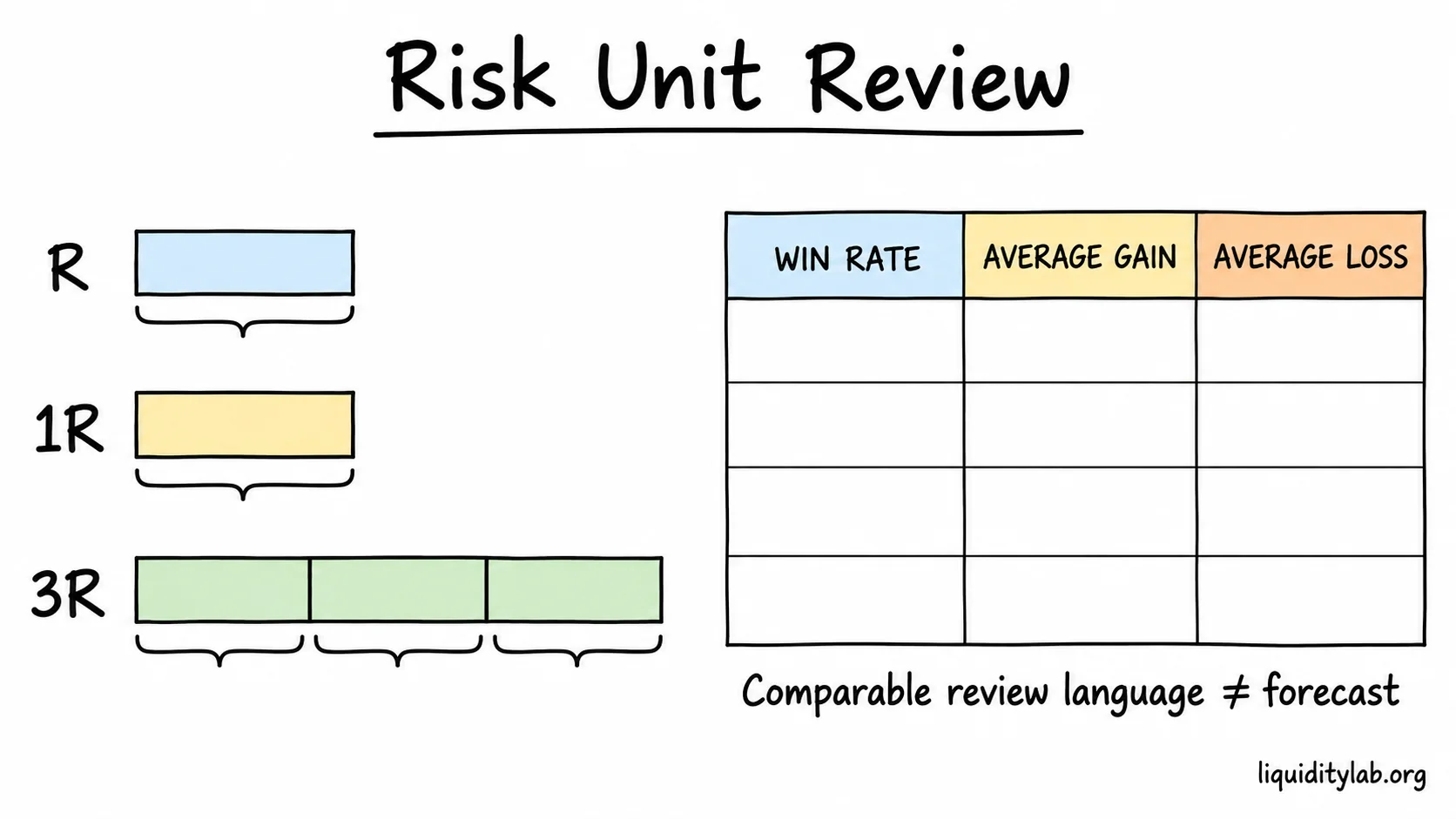
Risk units make samples comparable; they do not guarantee a result.
This is a way to organize completed data. It omits many practical complications unless they are recorded separately: fees, slippage, partial exits, changing exposure, dependence between observations and sample size. It cannot forecast the next case.
| Review field | Why keep it |
|---|---|
| Win rate | Shows how often the recorded outcome was positive under the definition. |
| Average gain | Shows the size of positive outcomes. |
| Average loss | Shows the size of negative outcomes. |
| Maximum losing run | Tests whether the process can be continued. |
| Plan adherence | Separates the idea from execution drift. |
Three wins and seven losses can still be a positive arithmetic example if the gains are larger, while many small wins can be erased by one large loss. Both are illustrations, not claims about a strategy.
Why early milestones matter
An early partial exit can reduce exposure and make the remaining observation easier to review. It can also reduce the final result if the move continues. Record both effects instead of labeling one as universally correct.
Historical exercise
Select ten completed cases and calculate the fields above. Repeat the summary after removing the largest positive result. Then inspect the longest losing run and ask whether the financial and psychological boundary would have allowed continued learning. Do not discard inconvenient cases.
The source examples—1%–2%, 3R, a 30%–40% win rate and fixed point distances—are teaching numbers. They are not personal parameters, targets or guarantees.
Continue with Unit 010: From Higher-Timeframe Context to Local Detail or return to the ICT 2016 course hub. Win rate and risk–reward language supports historical review; it does not provide entries, stops, targets, probabilities or return promises.