
ICT 2016 Unit 043: Swing Points and Stop Runs
Review institutional swing-point candidates through stop-run, breakout and failure responses without turning a boundary break into a reversal rule.
A swing point is a structural reference created around a meaningful high or low and its later response. The useful question is whether the boundary break produces displacement and acceptance, or a stop run followed by failure.
A boundary can trap two explanations
A visible high or low can attract protective orders and breakout participation at the same time. A quick break may therefore look like continuation before the chart supplies a response. Keep both the breakout and stop-run explanations open until structure develops.
Planned diagram position: after ## A boundary can trap two explanations and before ## Breakout and failure are different sequences.
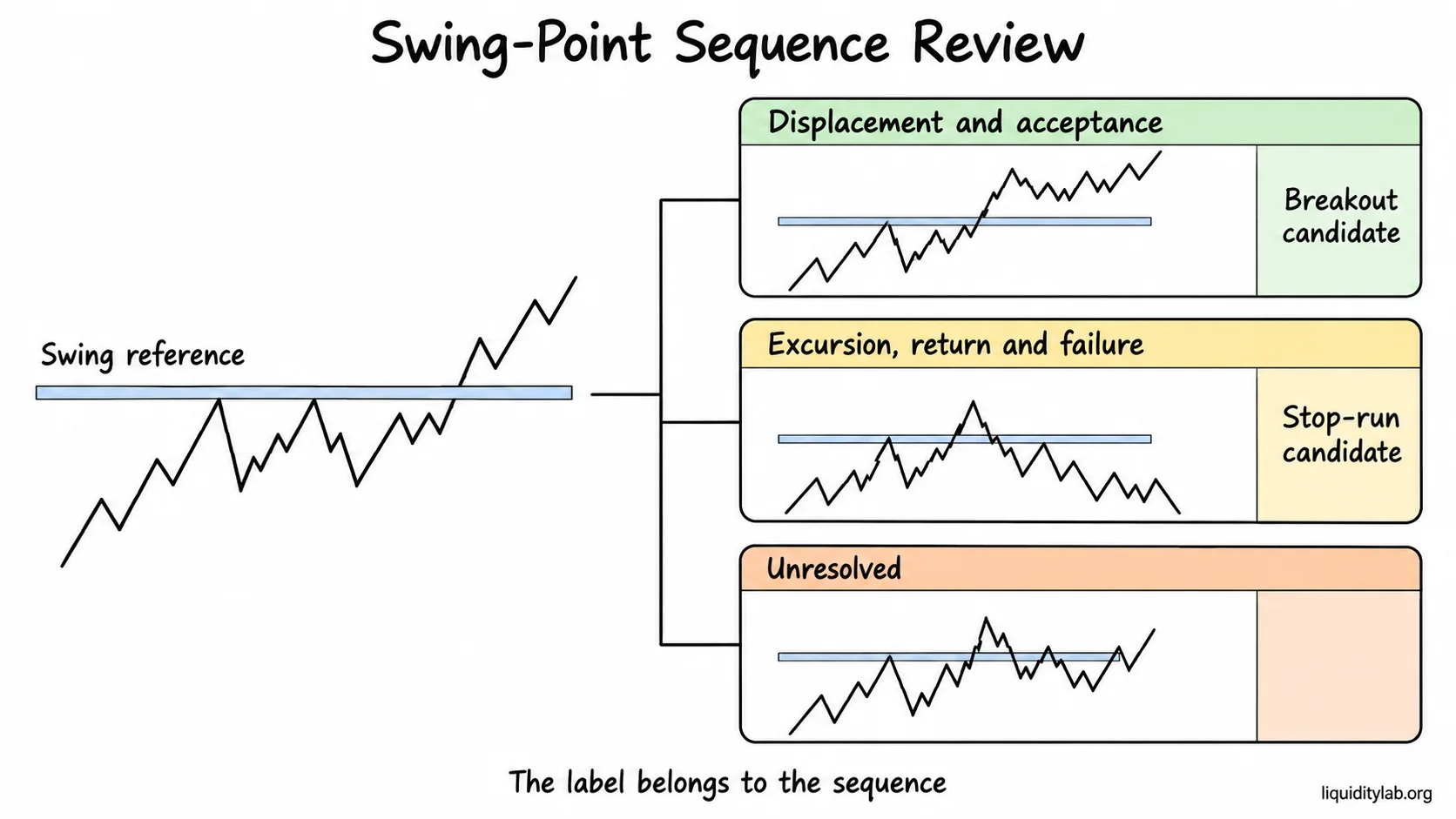
A swing-point label depends on the later structure, not the first break.
Breakout and failure are different sequences
For a breakout candidate, record displacement, body closes beyond the reference and follow-through. For a failure candidate, record the excursion, return into the range and any subsequent shift. The label belongs to the sequence, not to the first candle alone.
Reference quality matters
The more visible and well-defined the high or low, the easier it is for many observers to mark the same level. That makes it useful for review, but it does not prove that a stop run was planned or that every clean level will be swept.
Confirmation has a cost
Waiting for structure confirmation can reduce ambiguity while leaving less room in the completed move. This is a study tradeoff, not a recommendation about execution. Record what became clear and what remained unknown at each stage.
Review workflow
- Mark the swing reference and the timeframe that defines it.
- Describe the approach and nearby liquidity.
- Record displacement, body acceptance and follow-through.
- Compare the breakout and stop-run explanations.
- Note the later structure shift or continued acceptance.
- State the evidence that would invalidate the label.
A trail with two possible turns
A swing reference is a trail marker. A break can lead to sustained travel or a brief excursion followed by a return. The marker organizes the comparison; the sequence decides whether a breakout or stop-run description remains useful.
Misconceptions: the first break is not the label; a failed swing is not proof of intent; confirmation does not erase the earlier uncertainty.
Review exercise
Find one breakout-type swing point, one failure-type swing point and one unresolved example. Hide later candles, write the competing explanations, then reveal the response and compare confirmation timing.
Short review
1. Price breaks and accepts. Sample reasoning: record displacement and follow-through as evidence for a breakout candidate.
2. Price breaks and returns. Sample reasoning: record an excursion and failure candidate while waiting for later structure.
Learning boundary
Swing points and stop runs do not provide automatic entries, stops, targets, probabilities or reversal certainty. Continue with Unit 044: Ten-Year Treasury and Higher-Timeframe Context to add macro context before interpreting local structure.
Review questions
- What makes this high or low a useful reference?
- Which observations support breakout versus stop-run explanations?
- Did acceptance continue or fail after the excursion?
- What remained unresolved when the label was first applied?