
ICT 2016 Unit 039: Quarterly IPDA and Market Rhythm
Use quarterly context and 20, 40 and 60 trading-day windows to organize a review of structure and liquidity without turning time into a reversal clock.
Market behavior can change over a broad time window without following a mechanical quarterly reversal schedule. Quarterly IPDA language is most useful as a calibration layer: it helps define what to review before a lower-timeframe explanation is trusted.
A time window is a calibration layer
Start with a daily chart and identify the latest meaningful structure change. Then compare the 20-, 40- and 60-trading-day windows around it. These windows organize the review; they do not announce a date or direction.
Planned diagram position: after ## A time window is a calibration layer and before ## Look back for completed delivery.
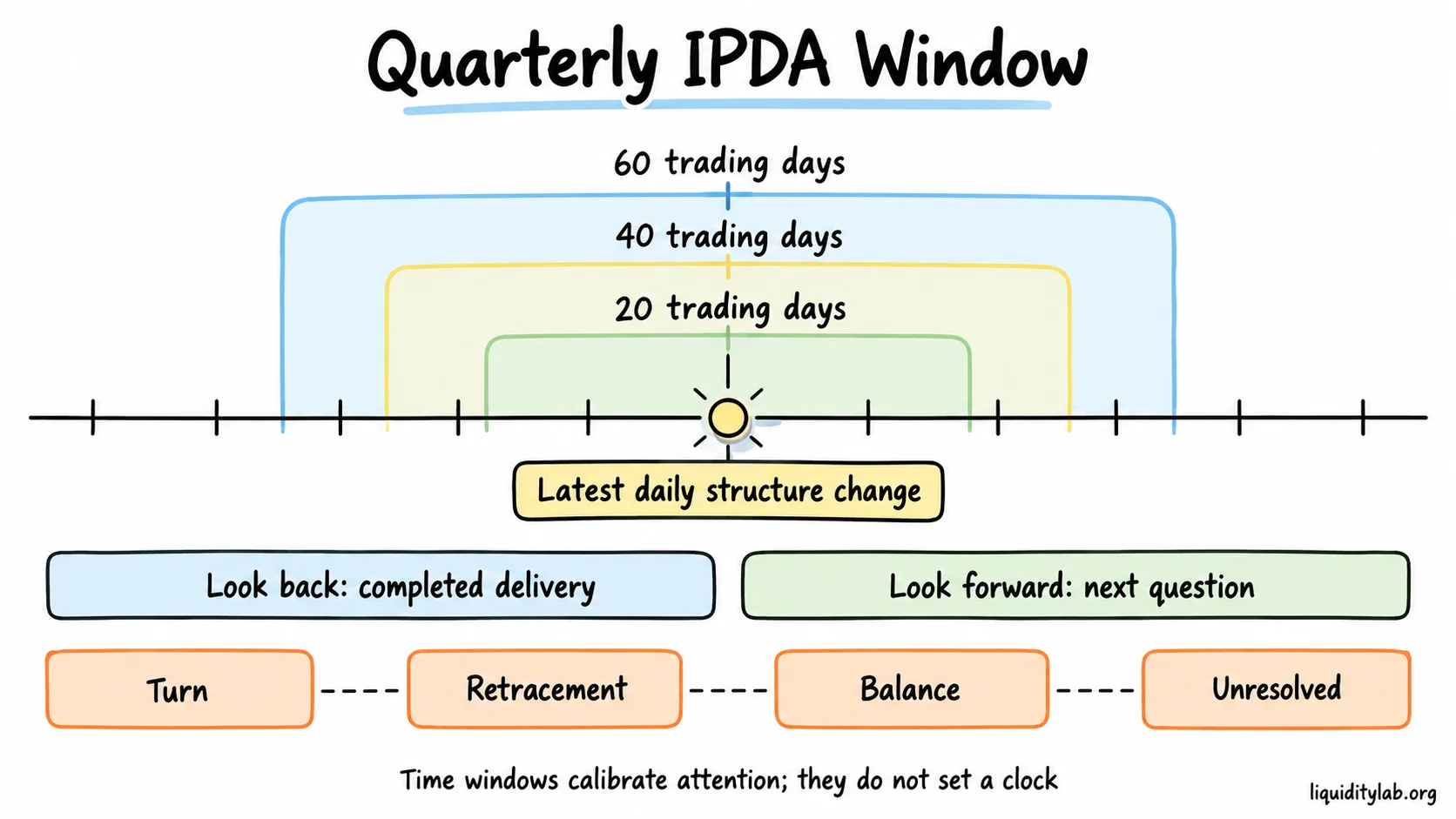
Quarterly context is a calibration layer, not a mechanical reversal schedule.
Look back for completed delivery
Within the selected windows, mark completed highs and lows, liquidity around them, FVGs, order blocks and areas where price accepted or returned. The goal is to build a traceable reference set rather than to collect every historical level.
Look forward with an open question
Use the same window to state what must be watched next: a boundary test, a return into an unfinished area or a change in structure. A forward window narrows attention while leaving the outcome unresolved.
Quarterly change is not a fixed switch
Three to four months can contain a meaningful change in volatility, direction or participation, but the change may be a turn, a retracement or renewed balance. Compare the response with the prior structure instead of forcing a quarterly narrative.
Relative context and benchmarks
Compare the selected instrument with a relevant benchmark or related market when that comparison is part of the question. Relative strength can add context, but it does not establish manipulation, intent or a trade signal by itself.
Review workflow
- Mark the latest daily structure change.
- Draw the 20-, 40- and 60-day review windows.
- Record completed delivery and visible liquidity inside each window.
- Write one forward question for the next window.
- Compare the instrument with its benchmark only when the relation is relevant.
- Reassess the window when new structure invalidates the original framing.
A calendar with several zoom levels
A 20-day, 40-day and 60-day window are like three calendar zoom levels. The close view shows recent delivery, the middle view adds context and the broad view shows a longer rhythm. None sets a turn date.
Misconceptions: quarterly context is not a fixed switch; a look-forward window is not a forecast; more historical levels do not automatically improve a review.
Review exercise
Select three completed quarters or comparable broad windows. For each, record the daily structure change, the 20/40/60-day references and the later response. Include one period where the market stayed balanced so the exercise does not select only clean turns.
Short review
1. The quarter stays balanced. Sample reasoning: retain balance as a valid outcome instead of forcing a turn narrative.
2. The windows disagree. Sample reasoning: record the disagreement and state which new structure would change the calibration.
Learning boundary
Quarterly IPDA language does not provide automatic dates, entries, stops, targets, probabilities or position-size instructions. Continue with Unit 040: Open Float and Quarterly Highs/Lows to examine visible liquidity around broader reference points.
Review questions
- What structure change anchors the selected window?
- Which references were completed delivery rather than speculation?
- What did the forward window leave unresolved?
- Which observation would weaken the quarterly explanation?