
ICT 2016 Unit 018: Institutional Order Flow as a Liquidity Hypothesis
Treat institutional order flow as a liquidity hypothesis and review bodies, wicks and nearby highs or lows without claiming to know participant intent.
Price can look random when a chart is viewed as a sequence of isolated candles. A liquidity-based review asks where orders may be concentrated and how the observed move interacted with those areas.
From candle to path
Prior highs, prior lows and equal levels can hold different types of pending orders. A move through one level may release orders, meet opposing flow and return to the prior range. These are observations and hypotheses, not proof of a particular institution's plan.
Read the path in three layers:
- Mark the visible liquidity references.
- Describe the body, wick and acceptance or rejection around each reference.
- Record where the next obvious liquidity layer sits after the interaction.
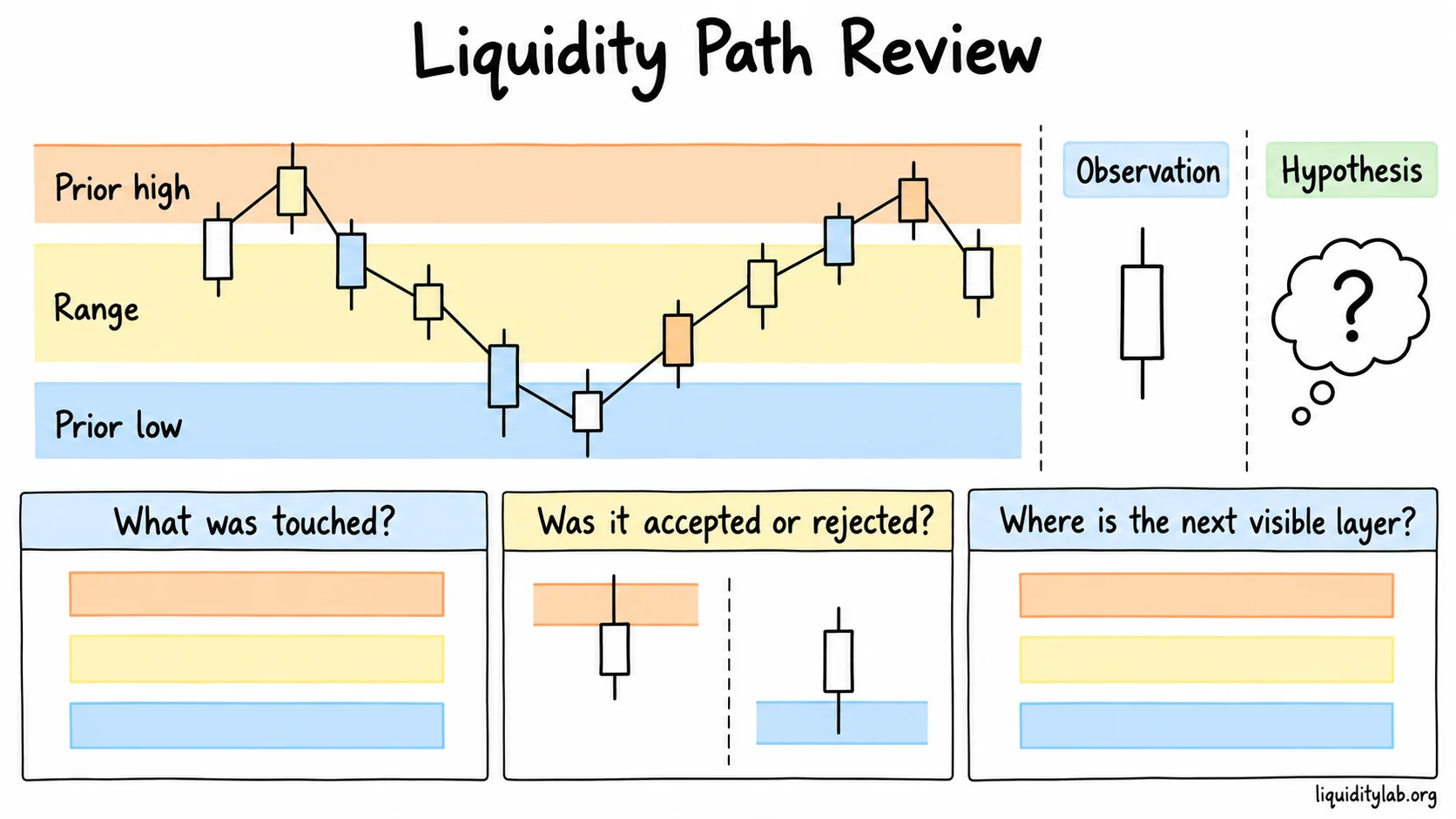
Visible price interactions are observations; unseen orders and participant intent remain hypotheses.
Bodies, wicks and context
A candle body can help locate the main traded portion of a move. A wick may show a brief excursion or rejection. Neither can be interpreted safely without the surrounding range, timeframe and later response.
The question is not whether one wick predicts the next candle. The question is whether the sequence produced acceptance, return, balance or unresolved evidence.
Review exercise
Select a completed sequence containing a high or low sweep. Hide the later candles and map the nearby liquidity layers. Write two competing explanations, then reveal the outcome and mark which evidence changed your view. Keep the participant story separate from what the candles actually show.
Learning boundary
Institutional order flow is a framework for organizing chart evidence. It does not reveal private orders, guarantee a path or provide entry, stop, target or return advice. Continue to the broader ICT / SMC Learning Path after recording the uncertainty in your journal.