
ICT 2016 Unit 042: Open Float and Liquidity Pools
Use a 120-day continuous range and 20, 40 and 60-day windows to review visible liquidity pools without treating them as guaranteed destinations.
Open Float can be used as a broad review lens for unfinished liquidity around visible highs, lows and range boundaries. A 120-day continuous range places several quarterly references on one map; it does not tell us which pool price must visit next.
One map, several time responsibilities
Start with the 120-day range, then nest 20-, 40- and 60-day windows inside it. The broad range supplies context while the shorter windows describe recent delivery. Do not let a smaller window erase the larger structure.
Planned diagram position: after ## One map, several time responsibilities and before ## What an unfinished pool can explain.
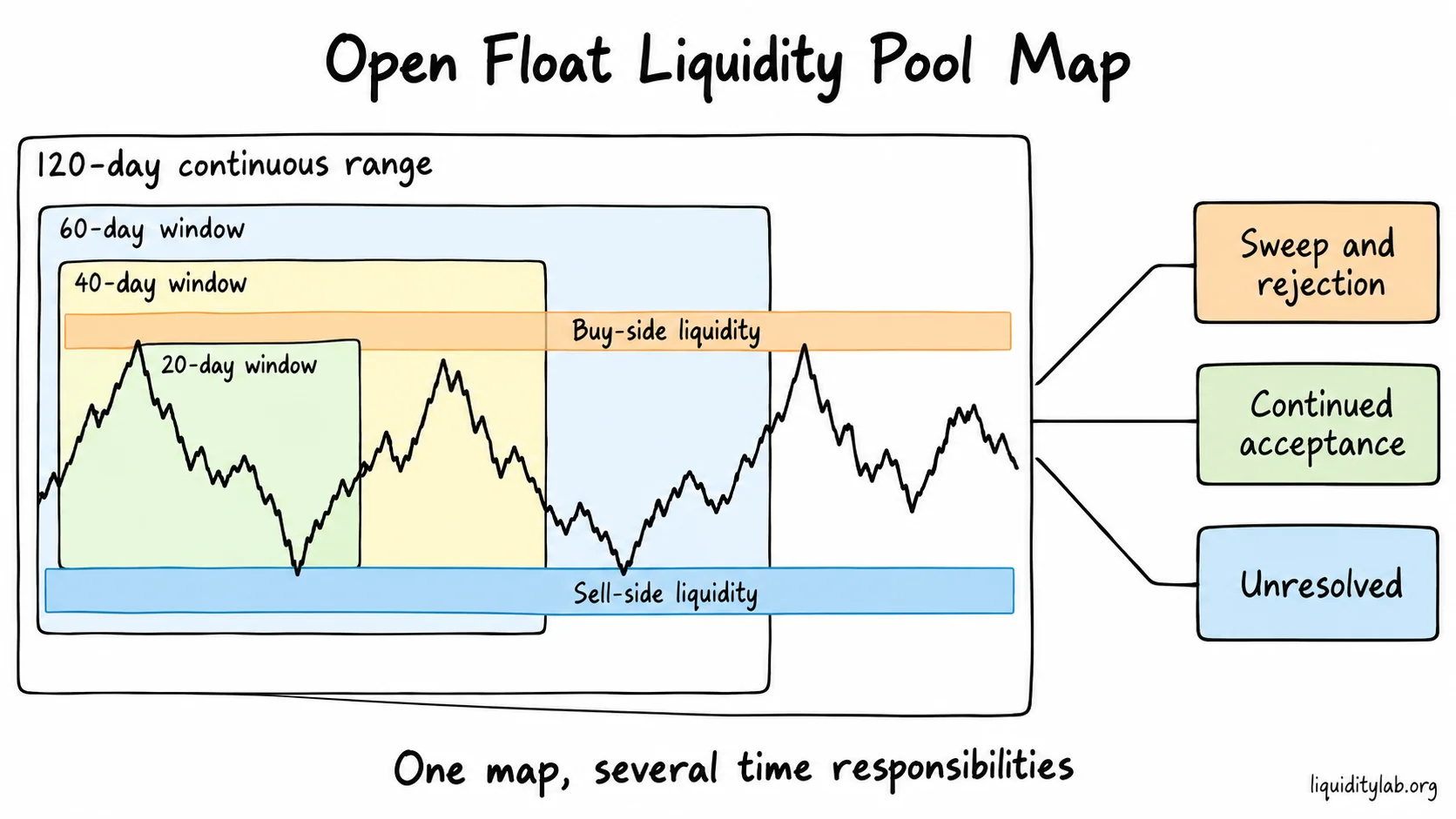
A broad range gives context while shorter windows describe recent delivery.
What an unfinished pool can explain
Protective orders above visible highs and below visible lows can create areas of potential forced activity. This is a hypothesis about order placement, not evidence of a specific participant or a guaranteed route.
Sweep, rejection and acceptance
A boundary break may return quickly, continue accepting or remain unresolved. Record the excursion, body closes and later structure. A false-break explanation becomes weaker when acceptance persists beyond the reference.
Use futures and daily structure as context
When the review question requires it, compare related futures data and the daily structure. Additional data should answer a defined question; it should not become a pile of unranked levels.
Review workflow
- Draw the 120-day continuous range.
- Nest the 20-, 40- and 60-day windows.
- Mark visible highs, lows and possible liquidity pools.
- Record sweep, rejection, acceptance or unresolved response.
- Compare the result with daily structure and related data.
- State what would weaken the current liquidity explanation.
A city map with nested districts
The 120-day range is the city map, while the 20-, 40- and 60-day windows are districts with different responsibilities. A visible pool belongs to a question about location and response, not to a promise that price must travel there.
Misconceptions: a larger map is not more predictive; nested windows can conflict; a pool is not a destination.
Review exercise
Choose three completed 120-day ranges. Hide later candles, mark both sides and write competing sweep and continuation explanations. Reveal the response and include one range where the apparent pool was never revisited.
Short review
1. Short and broad windows disagree. Sample reasoning: retain both observations and explain which timeframe each answers.
2. A visible pool is never reached. Sample reasoning: record unresolved during the selected window instead of treating it as a failed rule.
Learning boundary
Open Float and liquidity pools do not provide automatic entries, stops, targets, probabilities or guaranteed destinations. Continue with Unit 043: Swing Points and Stop Runs to study how a boundary response can become a structural reference.
Review questions
- What does the 120-day view add to the shorter windows?
- Which visible references define the pool?
- Did the break reject, persist or remain unresolved?
- What evidence would weaken the forced-order explanation?