
ICT 2016 Unit 032: Propulsion Blocks
Review propulsion blocks as shallow pullbacks followed by renewed movement, with explicit failure and uncertainty boundaries.
A propulsion block is a compact way to review a shallow return followed by renewed movement. Its value comes from the sequence and immediate response, not from a candle shape or a promise that price must continue.
A shallow return is a question
First describe the existing directional move and the area where price paused. Then record whether the return was shallow, whether the larger structure stayed intact and whether the next move actually expanded.
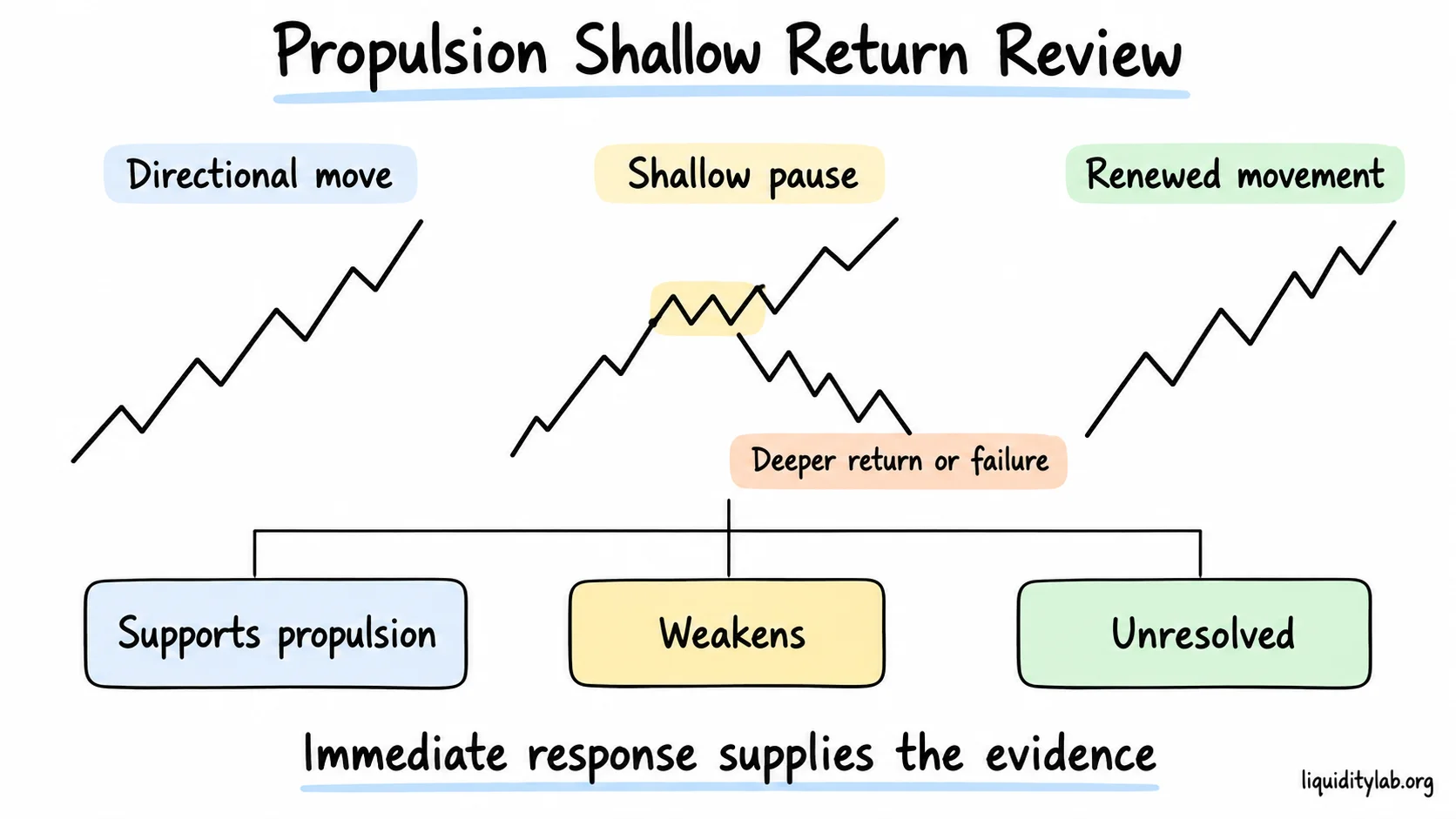
A shallow return matters only through its immediate response.
Immediate response and failure
Renewed movement can support the propulsion explanation, but hesitation, deeper retracement or clean failure weakens it. Define the observation window before judging the result so a later move is not used to rewrite the earlier evidence.
Propulsion versus an ordinary order block
An order-block candidate is a possible work area that awaits structural evidence. Propulsion language focuses on the relationship between a shallow return and a second expansion. The distinction is temporal and contextual, not a special candle category.
Review exercise
Mark three pauses inside completed directional moves. For each, record return depth, surrounding liquidity, next response and failure condition. Include one pause that did not produce renewed movement.
Learning boundary
Propulsion blocks do not provide automatic entries, stops, targets, probabilities or guaranteed continuation. Continue with Unit 033: Vacuum Blocks to study fast repricing and later repair.
Review questions
- What was the directional context before the pause?
- How shallow was the return, and what is directly observable?
- Did the next move expand, hesitate or fail?
- What condition would weaken the propulsion explanation?