
ICT 2016 Unit 027: Order-Block Footprints
Treat an order block as a candidate work area and review displacement, retests, invalidation and higher-timeframe context.
An order block is a candidate price area, not a magic candle. A useful review asks what preceded the area, whether a later displacement changed the structure, how a return behaved and where the original explanation would be invalidated.
Candidate before confirmation
A conspicuous down candle near support may be worth marking, but its shape alone cannot identify unfinished institutional orders. Treat it as a candidate until later price action supplies evidence. The same discipline applies to a bearish candidate near resistance.
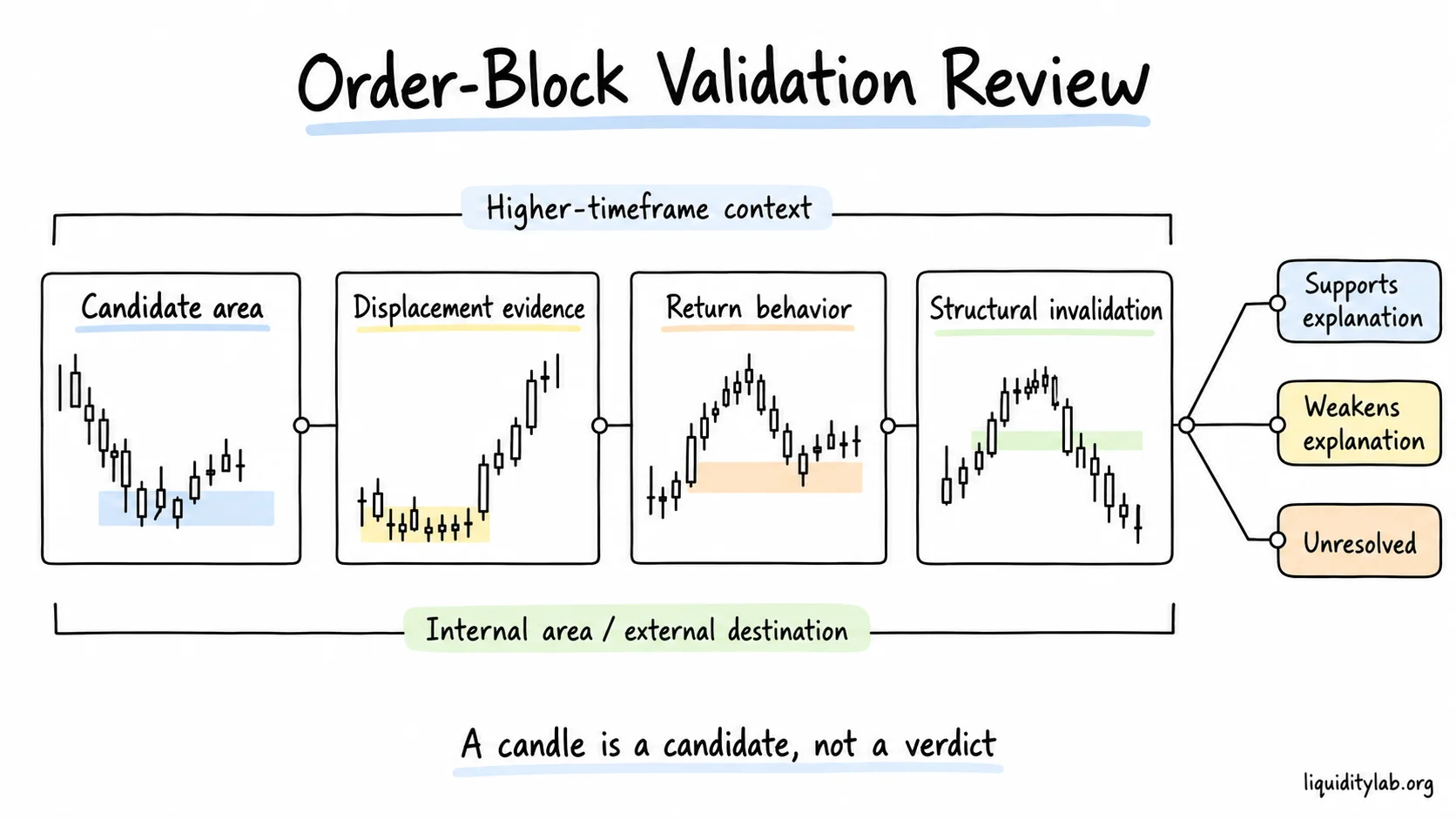
Structural evidence upgrades or weakens an order-block explanation.
Displacement changes the evidence
A clear move away from the candidate area, followed by a meaningful structural break, gives the zone more review value. It still does not prove who placed the orders or guarantee a future reaction. Weak drift, overlap and immediate failure should lower confidence in the original interpretation.
Return and invalidation
When price returns to a candidate area, record the exact interaction: acceptance, rejection, partial response or clean failure. Define the invalidation condition before interpreting the outcome. A midpoint can be a measurement reference, but it is not a universal protection line.
Higher-timeframe context
The larger range sets the question. A local bullish candidate inside a broad decline needs a different explanation from one aligned with a higher-timeframe accumulation hypothesis. Compare monthly or weekly context with daily and intraday detail, then keep disagreements visible in the notes.
Internal area, external destination
Order-block candidates often sit inside a range, while visible highs, lows and other external pools sit outside it. This distinction helps describe a possible path without turning the zone into an automatic target or execution rule.
Review exercise
Mark three candidate areas from a completed chart. For each one, write the preceding context, the displacement evidence, the return behavior and the invalidation condition. Keep one candidate that failed so the exercise does not select only successful examples.
Learning boundary
Order-block language supports structured review. It does not provide entries, stops, targets, position sizing, probabilities or proof of institutional intent. Continue to the broader ICT / SMC Learning Path after comparing candidate, confirmation and failure.
Review questions
- What made the area a candidate before confirmation?
- Did displacement change the surrounding structure?
- How did the return behave, and what was the invalidation condition?
- Does the higher-timeframe context support or weaken the explanation?
- Which failed candidate prevents hindsight selection?