Wyckoff Method Market Cycle
Learn Wyckoff as a supply-and-demand framework for accumulation, distribution, springs, upthrusts, and effort versus result.
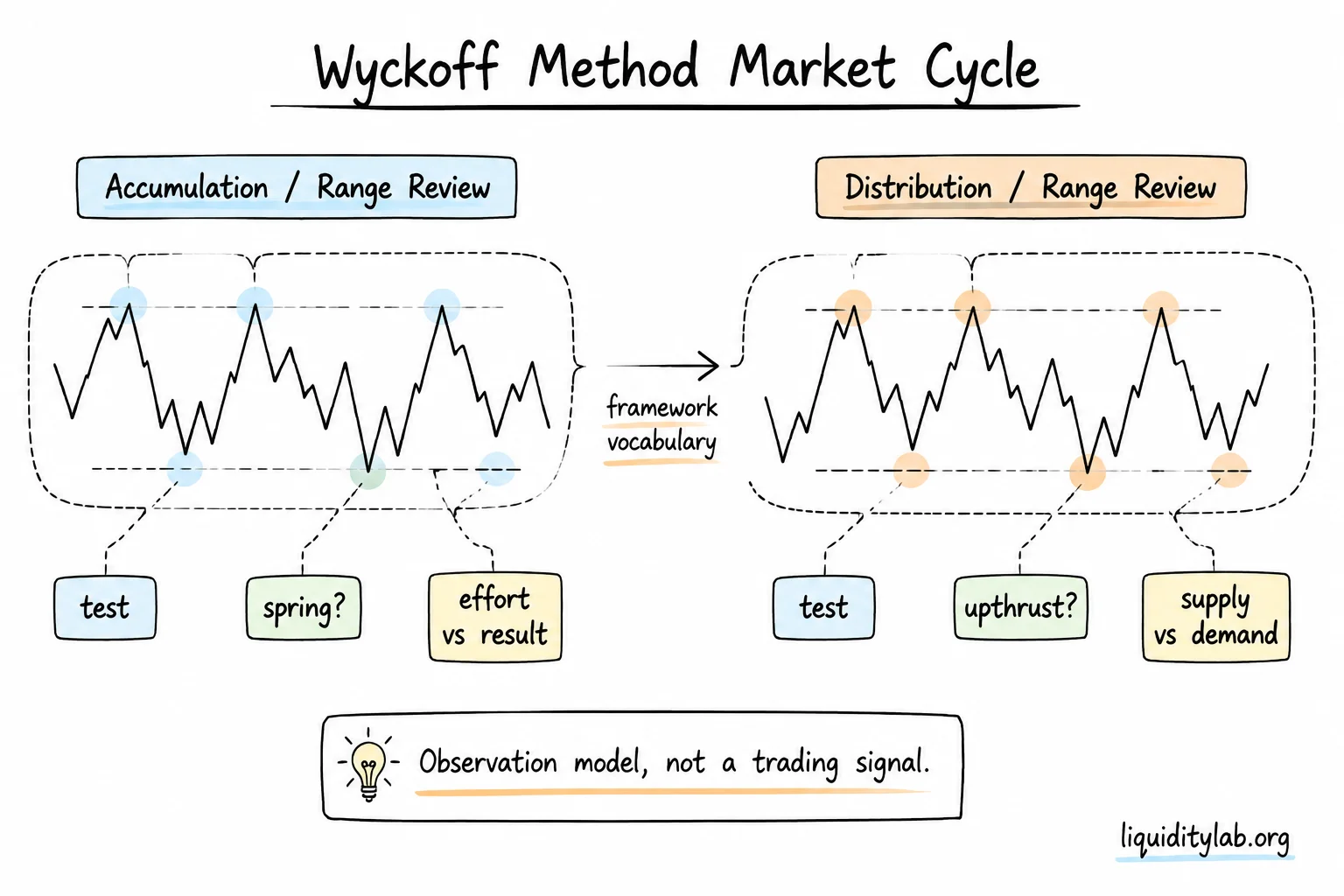
The Wyckoff Method is a framework for describing market cycles through supply, demand, trading ranges, and volume-price behavior.
In LiquidityLab, Wyckoff belongs to the Framework Mapping layer. It can help you name what a market may be doing, but it does not replace the Market Structure OS and it does not provide buy direction, sell direction, entries, exits, stop placement, targets, position sizing, leverage, or return expectations.
What Wyckoff is trying to describe
Wyckoff thinking usually starts from a simple question:
Is price showing a change in supply and demand, or only moving inside noise?
Instead of reading every candle as an isolated event, Wyckoff asks you to observe the relationship between:
- where price is inside a range
- how much effort appears in the move
- how much result follows that effort
- whether tests near highs or lows show acceptance, rejection, or uncertainty
This is useful as observation language. It is not proof that a specific participant is controlling the market.
Composite Man as a teaching model
Classic Wyckoff material often uses the idea of the Composite Man.
The safest way to read this concept is as a teaching model: a simplified way to think about how larger, better-informed, or more patient participants may behave around supply and demand.
It should not be treated as evidence that a specific institution, entity, or hidden actor is causing each move.
In practice, Composite Man language can be translated into a more neutral question:
If larger participation existed here, what price behavior would make that visible?
Three observation laws
Wyckoff is often explained through three broad laws. LiquidityLab treats them as observation lenses, not market laws.
Supply and demand
When demand is stronger than available supply, price may be able to move higher. When supply is stronger than demand, price may struggle or move lower.
In observation terms, the useful question is not "who is winning forever?" It is:
- When price returns to a prior high or low, does it reject quickly?
- Does price spend time there and then continue?
- Does volume expand without much movement?
- Does movement continue after a level is tested?
These questions help describe current structure. They do not produce a trade signal.
Cause and effect
Wyckoff often treats a trading range as a potential cause and a later directional movement as a possible effect.
This does not mean every range must produce a trend.
The safer translation is:
A long period of balance can create important reference points. If price later leaves the range, those reference points can help review whether the move has follow-through.
Effort versus result
Effort usually refers to activity or volume. Result refers to the amount of price progress.
For example, if activity increases but price barely advances, that mismatch may be worth noting. It may suggest absorption, resistance, exhaustion, or simply uncertainty.
The key word is "may." Effort-versus-result is a review lens, not a trigger.
Accumulation and distribution
Wyckoff is famous for the ideas of accumulation and distribution.
Accumulation
Accumulation is often used to describe a range where supply appears to be absorbed over time before a possible later markup.
In neutral structure language, an accumulation-like environment may include:
- a prior selloff or decline
- a trading range that forms after the decline
- tests below the range that fail to continue
- improving reactions from the lower side of the range
- later attempts to hold above the middle or upper side of the range
None of these details confirm accumulation by themselves. They are pieces of a review.
Distribution
Distribution is often used to describe a range where demand weakens over time before a possible later markdown.
In neutral structure language, a distribution-like environment may include:
- a prior advance
- a trading range after the advance
- tests above the range that fail to hold
- weaker reactions from the upper side of the range
- later pressure toward the middle or lower side of the range
Again, the label should come after the behavior, not before it.
Common Wyckoff events
Different teachers use slightly different labels, but several terms are common.
| Wyckoff term | Neutral translation |
|---|---|
| Preliminary Support / Preliminary Supply | Early slowing or reaction before a range becomes clearer |
| Selling Climax / Buying Climax | A sharp exhaustion-like move after an extended move |
| Automatic Rally / Automatic Reaction | The first strong reaction after a climax-like move |
| Secondary Test | A later retest of the same area |
| Spring | A test below a range that does not continue lower |
| Upthrust | A test above a range that does not continue higher |
| Sign of Strength | A move showing stronger upside response inside the framework |
| Sign of Weakness | A move showing stronger downside response inside the framework |
These are labels for reviewing price behavior. They are not instructions.
How to use Wyckoff safely
Use Wyckoff to ask better questions:
- What is the visible range?
- Which side of the range has been tested?
- Did the test hold, fail, or remain unclear?
- Is price showing more progress for the same effort, or less progress for more effort?
- Is the current label based on behavior, or am I forcing a story?
Do not use Wyckoff to decide that price must follow a phase roadmap.
Mapping back to Market Structure OS
Wyckoff can be useful, but LiquidityLab still starts from structure:
- Market state: trend, pullback, range, or transition.
- Visible structure: highs, lows, ranges, and breaks.
- Liquidity and observation zones.
- Evidence versus uncertainty.
- Invalidation of the current reading.
Wyckoff language can sit on top of that structure as a translation layer.
It should not replace the structure layer.
Summary
Wyckoff is best used as a supply-and-demand observation framework.
It helps describe accumulation, distribution, tests, effort, and result. It does not prove hidden intent, predict the next move, or provide a trading setup.