Multi-Timeframe Structure Integrity
Learn how to use multi-timeframe structure to describe trend level, structural integrity, and false breakouts without turning analysis into execution.
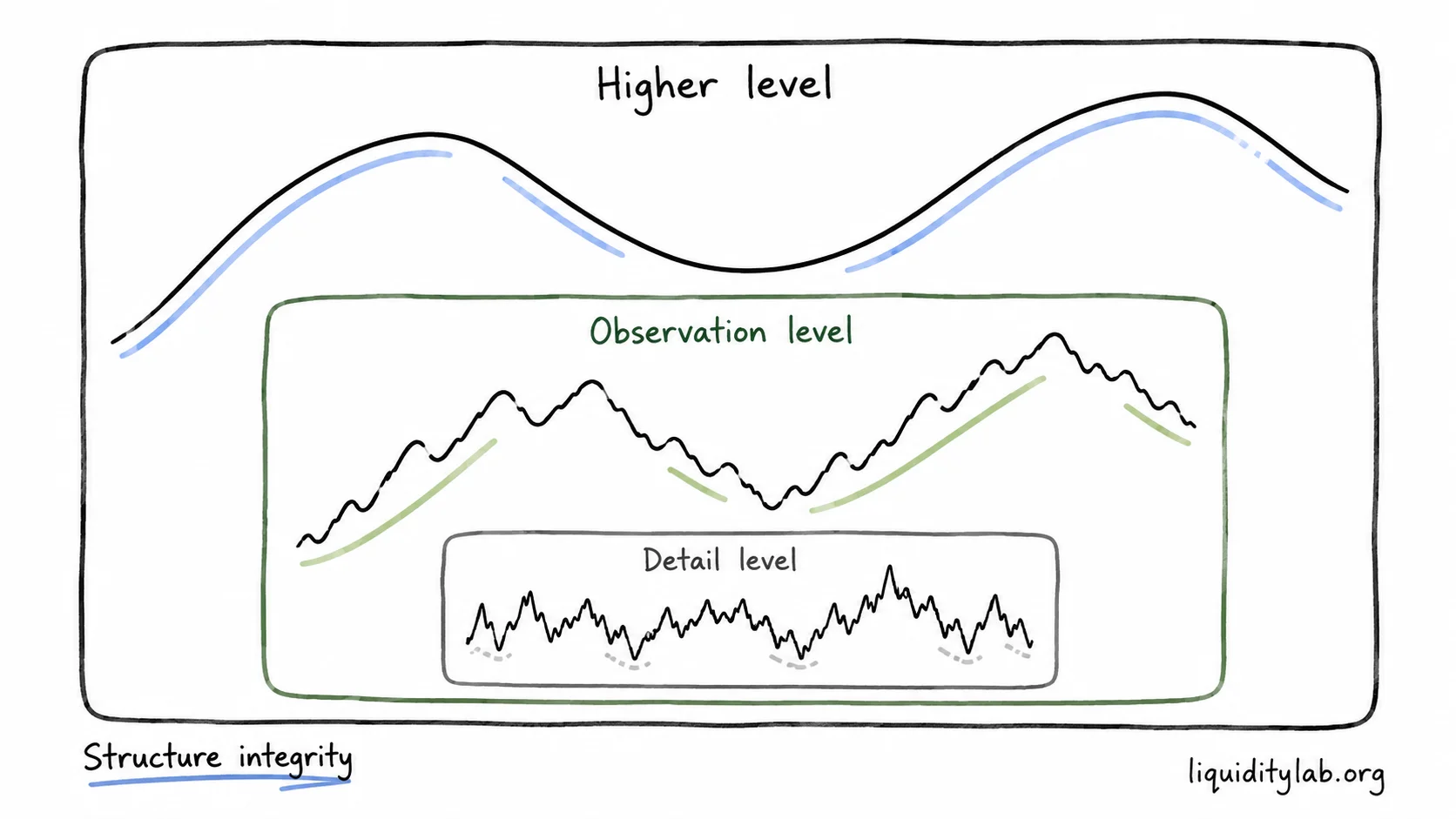
Multi-timeframe analysis should not start with "find direction on the higher timeframe, execute on the lower timeframe."
That is an execution workflow.
In LiquidityLab, multi-timeframe analysis is first a structure-reading method. Its purpose is to describe how different levels of price movement fit together.
The core question
Every timeframe answers a different question.
| Structural level | Useful question |
|---|---|
| Higher level | What larger structure is price inside? |
| Current observation level | Is this structure intact or weakening? |
| Detail level | What smaller movement is happening right now? |
The goal is not to force all levels to agree.
The goal is to understand what each level is saying.
Direction level and detail level
A useful distinction is:
- Direction TF: the timeframe or structural level used to describe the larger direction
- Detail TF: the timeframe or structural level used to inspect smaller movement
These labels are descriptive. They do not decide where to trade.
For example, a daily chart may define the broader structure while a one-hour chart shows a detailed pullback. The lower timeframe may look bearish during that pullback, while the higher timeframe remains structurally intact.
Both descriptions can be true.
What structure integrity means
Structure integrity asks whether the important sequence is still holding.
In an uptrend, useful questions include:
- are higher lows still forming?
- are higher highs still being created?
- which low would matter if it broke?
- has the center of gravity started to move lower?
In a downtrend, the questions reverse:
- are lower highs still forming?
- are lower lows still being created?
- which high would matter if it broke?
- has the center of gravity started to move higher?
A single broken small swing does not always mean the larger structure has failed. The level of the break matters.
False breakouts across timeframes
A false breakout often looks obvious on one timeframe and ambiguous on another.
On a lower timeframe, price may break a small level and quickly return.
On a higher timeframe, the same movement may only be a wick inside a larger range.
That is why a breakout should be described with its structural level:
"This is a failed break on the detail level, while the higher-level range remains intact."
That sentence is more useful than simply saying:
"This was a fakeout."
Common mistakes
| Mistake | Better interpretation |
|---|---|
| "Higher timeframe says up, so lower timeframe is for entries." | This is an execution workflow, not structure reading. |
| "A false breakout means reversal." | A false breakout is a structure event, not a reversal promise. |
| "More timeframes means better analysis." | More charts do not help if the structural relationship is unclear. |
| "The first breakout is usually fake." | That depends on context. Treat it as a question, not a rule. |
A simple structure note
Before forming any conclusion, write:
"On the higher level, price is ___. On the detail level, price is ___."
If those two blanks conflict, do not force a single answer too quickly.
The conflict itself may be the most important observation.
Continue with
Educational content only. Not financial advice.