Order Block
Learn the basic idea behind order blocks, why traders watch them, and how they relate to structure, displacement, and liquidity.
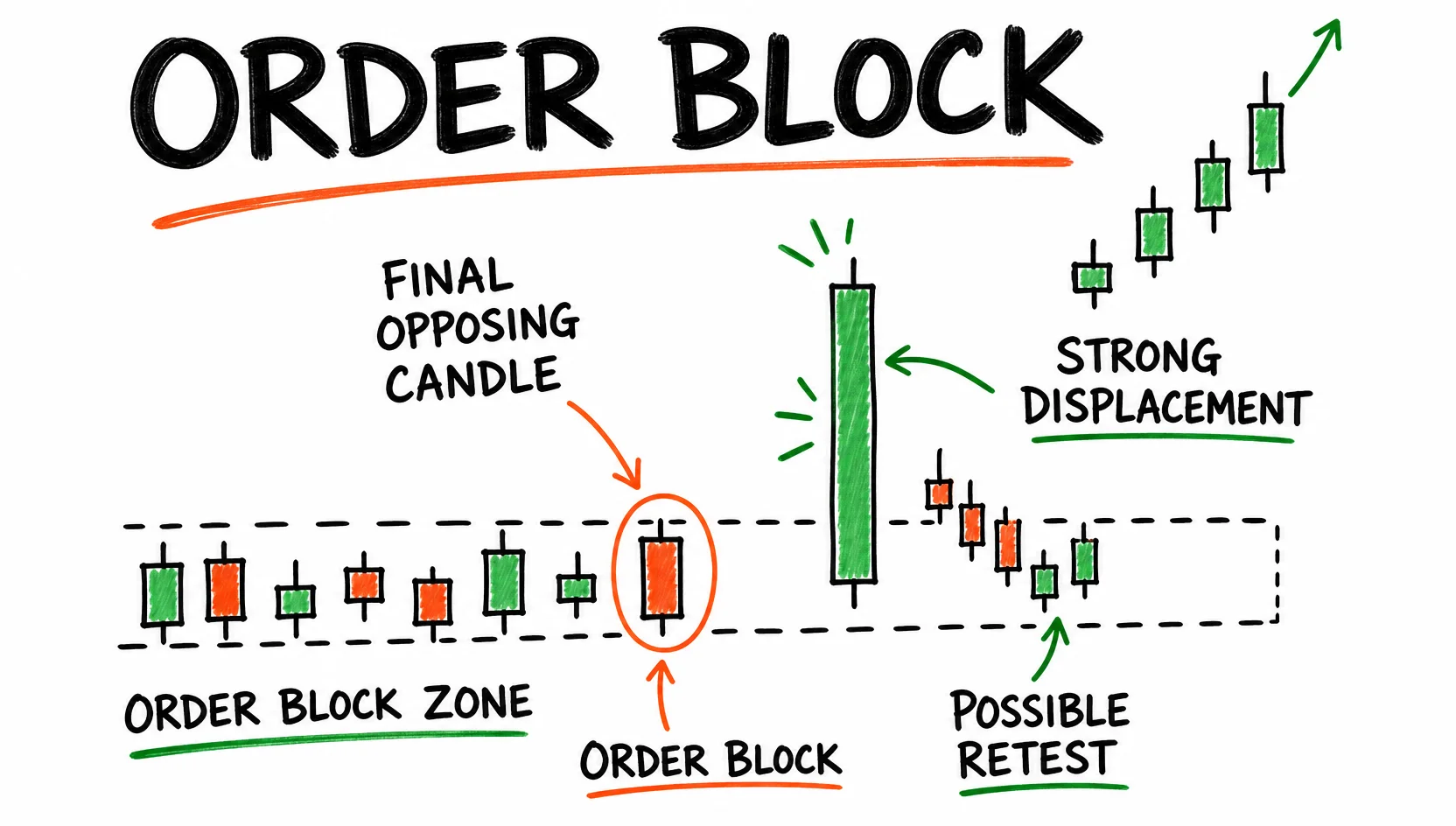
An order block is usually described as the final opposing candle or small base before a strong move starts.
Why it matters
The concept tries to answer one question: where did meaningful participation show itself before price accelerated?
That makes order blocks less about magic zones and more about context:
- what structure was in place?
- was there real displacement?
- did the move leave evidence that price accepted the direction?
A practical way to think about it
Instead of asking “is this an order block?” too early, ask:
- Was there a strong move away from this area?
- Did that move change or confirm structure?
- If price returns, is there still a reason to care?
Order block vs FVG
These ideas often overlap:
- an order block highlights the base before expansion
- an FVG highlights the imbalance left during expansion
When both ideas align with structure, the area becomes more interesting. When they do not, caution matters more than naming.
Order block family language
SMC communities often use a wider family of order-block-related labels.
Definitions vary by teacher, so treat them as vocabulary rather than fixed rules:
| Label | Safer LiquidityLab translation |
|---|---|
| Order Block (OB) | A prior base or opposing candle area before displacement. |
| Rejection Block | A wick or rejection area where price briefly tested and returned. |
| Breaker Block | A prior zone that failed and may be reused as a structural reference. |
| Mitigation Block | A repair or revisit area after structure has moved away. |
| Liquidity Void | An extreme imbalance or low-participation area. |
The names can help describe what kind of structure you are reviewing.
They do not prove that price must react. They do not turn the area into an entry zone.
Many order-block-family labels become clearer only after later structure develops.
For review, ask:
- did the zone lead to displacement?
- did later structure confirm or reject the area?
- has the area been revisited so often that the original reaction is less meaningful?
This keeps the family label tied to evidence rather than preference.
Continue with
Educational content only. Not financial advice.