Channels in Market Structure
Learn how price channels describe the transition between trend and trading range, without turning channel lines into buy or sell signals.
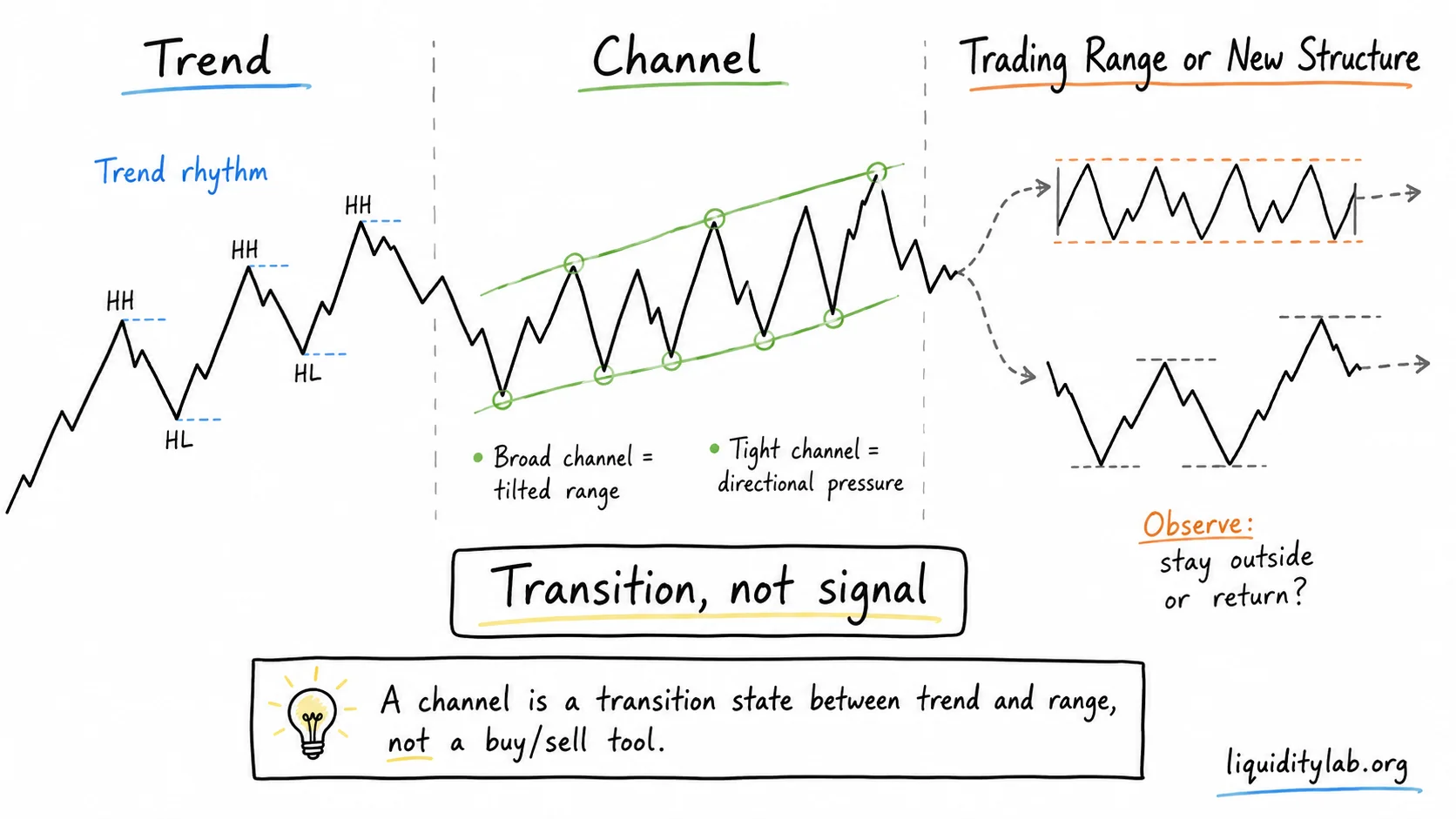
A channel is not a tool for automatically buying at one line and selling at another.
It is a way to describe market state.
When price begins moving inside a channel, the useful question is not:
"Which side should I trade?"
The better question is:
"Is the market still trending cleanly, entering balance, or transitioning into a new structure?"
What a channel means
In price-action reading, a channel often sits between a clean trend and a trading range.
A clean trend usually has a clearer impulse-and-pullback rhythm. A trading range rotates around two sides without making clean directional progress. A channel is the middle zone: price still leans in one direction, but the internal movement is no longer as clean as a strong trend.
That is why channels are useful for structure reading. They help describe transition.
Trend -> channel -> trading range or new trend structureThe channel itself does not decide which outcome must happen.
Broad channel vs tight channel
Not all channels communicate the same market condition.
Broad channel
A broad channel has visible two-sided movement inside it.
Common clues:
- price rotates between two sloped areas
- candles overlap more
- both sides appear repeatedly
- the structure leans in one direction but still contains disagreement
A broad channel can be understood as a tilted trading range.
That phrase is useful because it reminds you not to treat every touch of the channel boundary as a clean signal. The market may still be in a state of argument, even if the argument is leaning upward or downward.
Tight channel
A tight channel has very little pullback.
Common clues:
- candles are smaller or more orderly
- pullbacks are shallow
- price keeps pressing in one direction
- the opposite side does not create much visible reaction
A tight channel describes stronger agreement in the current movement.
But it still does not guarantee continuation. A tight channel can appear early in a move, in the middle of a trend, or near the exhaustion phase of a larger structure. The location matters as much as the shape.
Why location changes the meaning
The same channel can mean different things depending on where it appears.
A tight channel that appears after a long trend may describe final momentum rather than healthy continuation. A broad channel that appears after a trading range may describe an early transition into trend. A channel that appears inside a higher-timeframe pullback may look important on the lower timeframe while still being only a small part of the larger structure.
This is why channel language should always include context:
- What was price doing before the channel?
- Is the channel inside a larger trend or a larger range?
- Is the channel becoming tighter, wider, cleaner, or more overlapping?
- Is price reacting around the same areas repeatedly?
These are observation questions, not trade instructions.
Channel breaks are not proof by themselves
When price leaves a channel, two common outcomes can appear.
Outcome 1: price returns into the old channel
Sometimes price breaks a channel boundary, attracts attention, and then returns back inside the prior structure.
This does not automatically mean the break was fake. It simply means the market did not yet maintain a new structure outside the channel.
Outcome 2: price forms a new structure
Sometimes price leaves the channel and begins forming a new trend leg, a new channel, or a new trading range.
That is a structural change, but it still needs to be described through what price actually does after leaving the old channel.
Useful review questions:
- Did price stay outside the channel or return quickly?
- Did candles expand or become hesitant after the break?
- Did price form a new swing structure?
- Did the old channel boundary become irrelevant, or did price keep reacting to it?
What channels can help with
Channels are best used as background context.
They can help you:
- recognize when a trend is becoming less clean
- describe the transition between trend and range
- compare broad disagreement with tight directional pressure
- avoid treating every candle as a separate signal
- decide when the structure is too uncertain to summarize confidently
Channels are not independent confirmation. If a moving average, trend line, and channel all point the same way, they may simply be describing the same price movement from different angles.
More tools do not automatically mean more evidence.
A simple comparison
| Market state | What it describes | Safer wording |
|---|---|---|
| Trend | Price keeps making cleaner directional progress | "The trend rhythm is still visible." |
| Channel | Price still leans, but the movement is becoming more structured and transitional | "Price is moving through a channel on this observation timeframe." |
| Trading range | Price rotates without clean directional progress | "Price is balancing between two areas." |
This table is not a ranking. It is a vocabulary tool.
The goal is to describe what price is doing before making any stronger interpretation.
Continue with
- Market Structure Basics
- Trading Range Structure
- Pullback and Breakout Structures
- Trend Reversal Framework
Educational content only. Not financial advice.