Relative vs Absolute Reversal
Learn the difference between a local reversal and a larger structural trend change so lower-timeframe movement is not mistaken for full reversal.
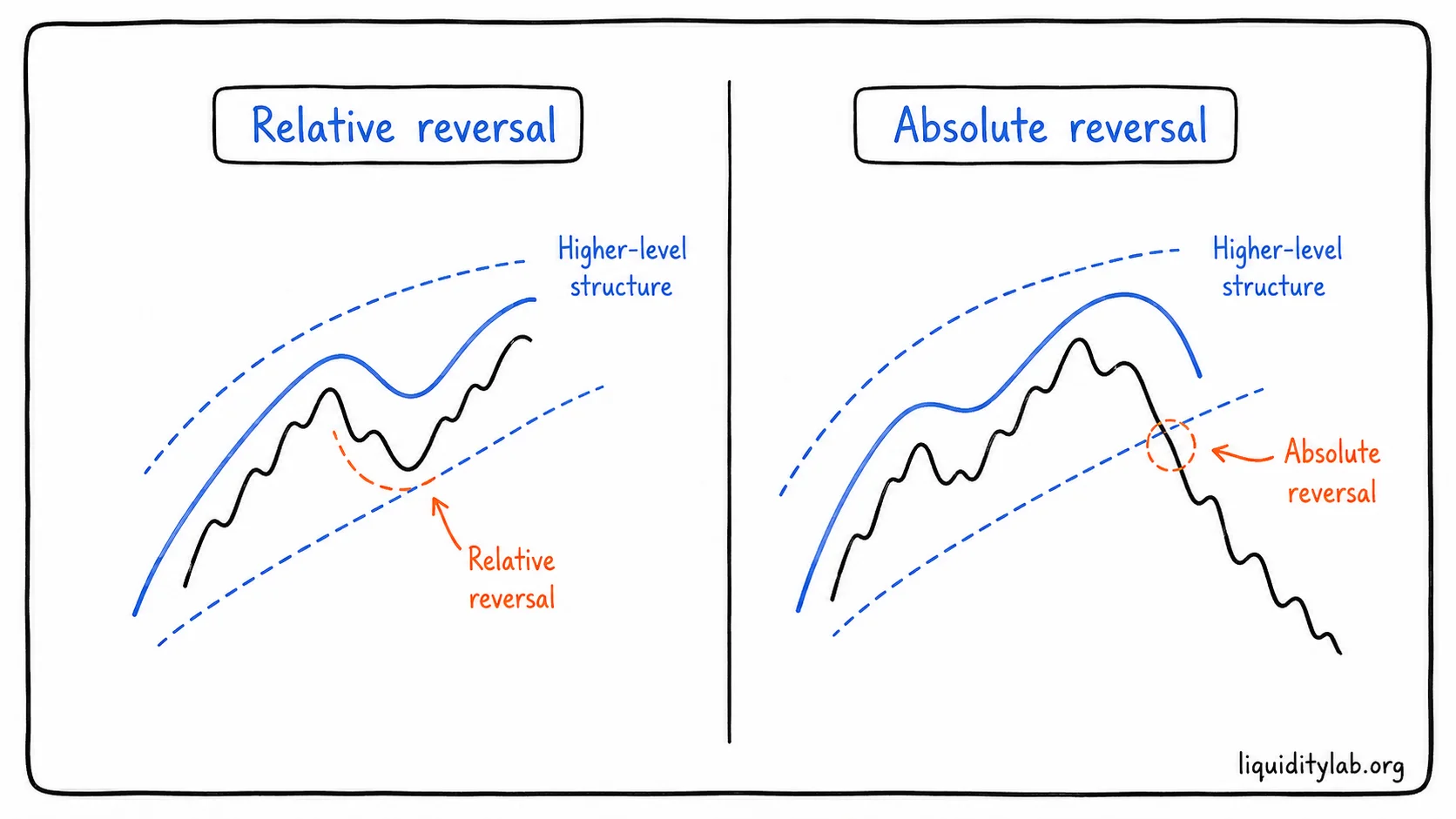
"Is this with the trend or against the trend?"
That question is incomplete unless you also ask:
"Trend on which structural level?"
Relative and absolute reversal help answer that problem.
There is no trend without a level
A trend is always tied to a timeframe or structural level.
The same movement can look like a reversal on a small chart and a normal pullback on a larger chart.
This is why two people can disagree about whether price is "with trend" or "against trend" and both may be describing something real.
They may simply be using different structural levels.
Relative reversal
A relative reversal is a direction change on one level that does not change the larger structure.
Example:
- the higher-level trend remains up
- a lower-level structure turns down
- price is still inside the higher-level pullback area
From the lower level, that movement may look like a reversal.
From the higher level, it may only be a pullback.
The value of this concept is that it prevents a common mistake: treating every local direction change as a major trend shift.
Absolute reversal
An absolute reversal means the structure of the relevant level has changed.
It is not just a small counter-move.
It means the price movement has broken the structure that defined the prior trend on that level.
In practice, this usually requires more than one candle or one small break. The market has to show that the old sequence no longer holds.
Why both can be true
One move can carry different meanings at different levels.
| Level | Possible reading |
|---|---|
| Higher level | Trend still intact |
| Middle level | Relative reversal or deeper pullback |
| Detail level | Absolute reversal on the small structure |
These readings do not contradict each other.
They describe the same movement from different distances.
A useful habit
Avoid saying:
"This is a reversal."
Say:
"This is a reversal on the detail level, but the higher-level structure is still intact."
Or:
"This move has now affected the higher-level structure, so the prior trend reading needs review."
The second version is less dramatic but much more useful.
Relationship with BOS and MSS
BOS vs MSS can help describe structure breaks.
But BOS or MSS labels still need a structural level.
A small MSS inside a higher-timeframe trend may mark a local shift, not a full reversal of the larger trend.
This is why reversal language should always include context.
Review question
When price turns sharply, ask:
"Which structure has actually changed, and which structure is still intact?"
That question is the heart of relative vs absolute reversal.
Continue with
Educational content only. Not financial advice.