SMC Liquidity and Order Flow Language
Learn SMC and ICT order flow vocabulary for liquidity, order blocks, FVG, BMS and SMS without treating them as trade signals.
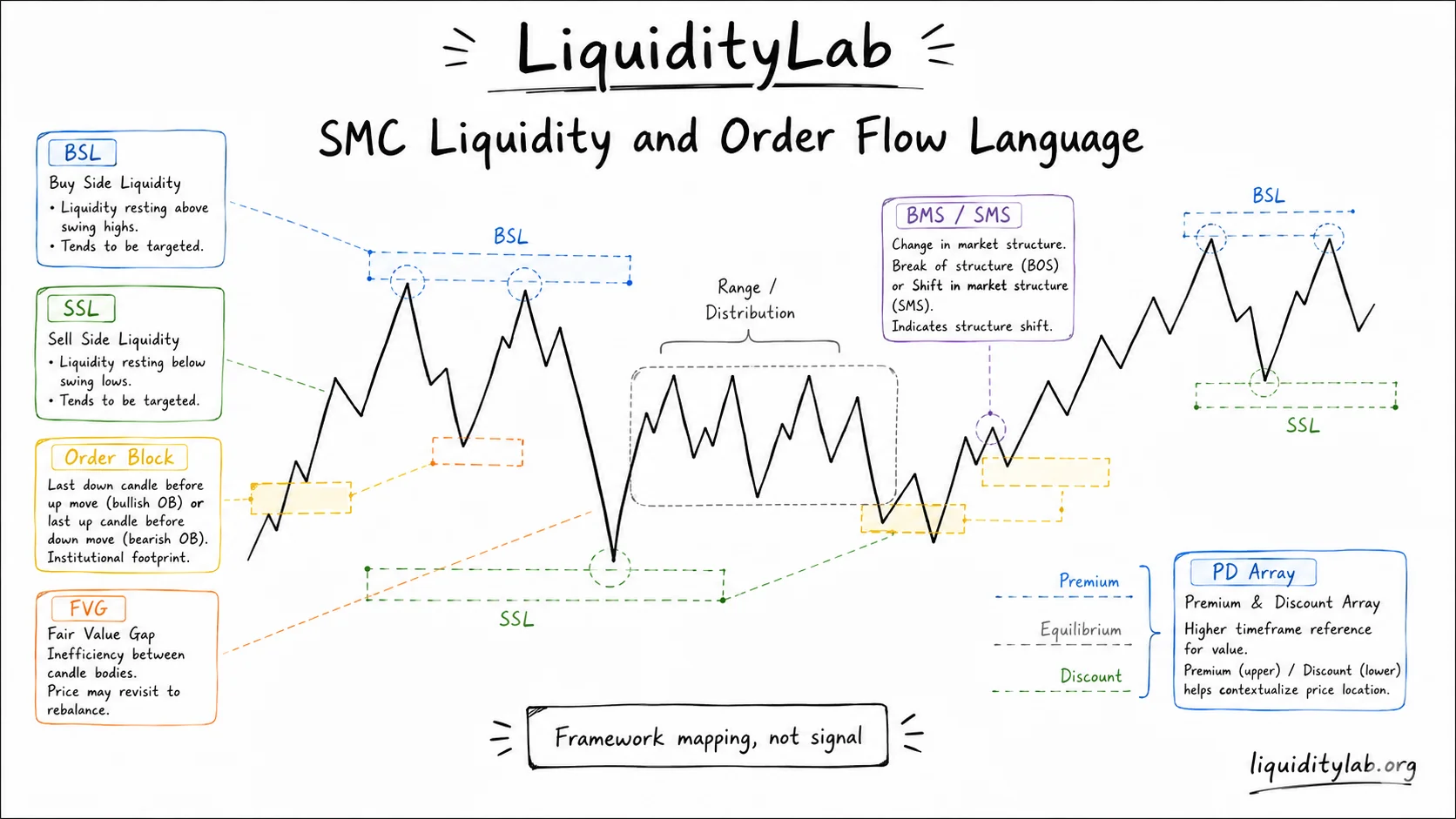
This page explains SMC / ICT order-flow terminology as a framework-mapping language.
It does not provide buy direction, sell direction, entries, exits, stop placement, profit targets, position sizing, leverage, or return expectations.
In LiquidityLab, SMC belongs to the Framework Mapping layer. It is a way to describe market structure with a specific vocabulary. It does not replace the Market Structure OS.
If you are new to this layer, read LiquidityLab Market Structure OS first, then use the Framework Mapping Learning Path to place SMC beside Wyckoff, Elliott Wave, harmonic patterns, and Chan Theory.
Why this page exists
SMC, or Smart Money Concepts, describes market movement through ideas such as liquidity, stop runs, supply and demand zones, order blocks, fair value gaps, and structure shifts.
These ideas can be useful as vocabulary. They help traders understand how one framework interprets price behavior.
But vocabulary is not a trading system.
The safest way to use this page is to treat SMC as a translation layer:
one market structure, one price path, many possible framework languages.
Liquidity in SMC
In SMC language, liquidity often refers to areas where pending orders or stop orders may be clustered.
Common examples include:
- prior highs
- prior lows
- equal highs
- equal lows
- range boundaries
- obvious swing points
SMC often separates liquidity into two broad terms:
Buy-side liquidity (BSL) usually refers to order flow that may be triggered above prior highs or resistance-like areas.
Sell-side liquidity (SSL) usually refers to order flow that may be triggered below prior lows or support-like areas.
This language can help you describe why price may move through an obvious level before returning. But the presence of liquidity does not prove that price must move there, reverse there, or continue from there.
Supply and demand zones
In SMC, supply and demand zones are often marked around the area before a strong displacement move.
A demand zone is usually associated with the origin of a strong upward move.
A supply zone is usually associated with the origin of a strong downward move.
These zones are not magic areas. They are annotations around places where price previously moved away with force.
Different observers may draw these areas differently because they may choose different candles, bodies, wicks, or local structures as boundaries.
Useful observation questions:
- How long did price stay in the area before leaving?
- Did price leave with clean displacement or noisy movement?
- Has the area already been revisited many times?
- Is the zone connected to a larger structure, or isolated?
These questions are for structure review, not execution.
BMS and SMS
SMC uses several terms for structure change. Two common terms are BMS and SMS.
BMS (Break in Market Structure) usually describes a continuation-type break within an existing structure. For example, price pulls back and then breaks a prior swing point in the original trend direction.
SMS (Shift in Market Structure) usually describes a more meaningful structural shift, often when price breaks the swing point that supported the prior directional move.
The important boundary is this:
BMS and SMS are classification terms, not certainty terms.
A BMS can fail to continue. An SMS can fail to reverse. They describe what structure appears to have changed; they do not guarantee what happens next.
Order blocks
An order block is commonly described as the final candle or group of candles before a significant move away.
SMC traders often divide order blocks into several types, such as:
- propulsion block
- rejection block
- breaker block
- mitigation block
- rebalance block
The names vary by teacher and community.
For LiquidityLab, the safer translation is simple:
An order block is a local structure marker around a prior price reaction.
It marks a place where price previously changed behavior. It does not mean price must react there again. It does not mean the area is an entry zone.
Fair Value Gap (FVG)
FVG, or Fair Value Gap, is an SMC / ICT term for an imbalance area left by a fast move.
Many explanations describe FVG with a three-candle structure where part of price traded inefficiently or quickly, leaving a visible gap-like area between neighboring candles.
In observation language, an FVG can be read as:
- a fast movement area
- an imbalance reference zone
- a place to review whether price later returns
- a context clue around displacement
It should not be treated as a guaranteed fill, a target, or an entry condition.
Some SMC materials classify FVG into regular gaps, breakaway gaps, or measuring gaps. These are better treated as after-the-fact review categories. When an imbalance first appears, you do not yet know which category it will become.
PD Array
PD Array, in ICT language, organizes premium and discount areas together with different structural reference points.
It can include ideas such as:
- prior highs and lows
- order blocks
- breaker or mitigation blocks
- FVG or imbalance
- liquidity voids
- equilibrium
The educational value is not that PD Array gives a required route for price.
The safer translation is:
PD Array is a framework-specific way to organize reference areas inside a premium-discount structure.
It is a map of language, not a map of guaranteed movement.
For a deeper non-execution explanation, see PD Array Structure-Reference Sequence.
Price delivery as state language
ICT often uses the phrase price delivery to describe how price moves from one state to another.
In a neutral LiquidityLab translation, this can be rewritten as:
Consolidation / equilibrium
  -> expansion
  -> later observation: retracement, reversal, or renewed consolidation
This sequence is useful because it prevents premature labeling.
If price is still in balance, it is too early to call the next movement a retracement or reversal. Price first needs to show some form of expansion or structural change before later behavior can be compared.
This is not a required path. It is a state-description language.
SMC vs LiquidityLab Market Structure OS
| SMC / ICT term | LiquidityLab translation | Boundary |
|---|---|---|
| BSL / SSL | liquidity near prior highs or lows | not a destination guarantee |
| Supply / demand zone | prior reaction area or key zone | not an entry zone |
| BMS / SMS | continuation or shift classification | not confirmation of outcome |
| Order block | local reaction marker | not a trade trigger |
| FVG | imbalance reference area | not a guaranteed fill |
| PD Array | ordered framework reference map | not a price route |
SMC often uses a stronger institutional narrative. LiquidityLab keeps the structure layer more neutral.
That difference matters. You can learn SMC terms without adopting every narrative assumption.
Common misunderstandings
| Misunderstanding | Safer reading |
|---|---|
| "SMC shows exactly where institutions enter." | SMC infers behavior from price structure; it does not reveal actual institutional orders. |
| "An order block is an entry signal." | An order block is a structure marker. Reaction still depends on later behavior. |
| "FVG must be filled." | Some imbalances are revisited; some are not. |
| "Liquidity sweep always reverses." | A sweep can reverse, continue, or lead into range behavior. |
| "SMC is more advanced than price action." | SMC and price action are different languages for describing market behavior. |
Suggested reading order
For English readers, the safest order is:
- Market Structure Basics
- Price Action Reading Basics
- Liquidity Pool
- This page
- SMC and Price Action Integration Language
What this page is not
This page is not an SMC trading strategy.
It does not teach entries, exits, stops, targets, order management, execution timing, kill zones, session trading, or position sizing.
It is a vocabulary bridge for reading SMC / ICT material more safely.
Educational content only. Not financial advice.