SMC and Price Action Integration Language
Learn how SMC and price action describe the same market structure, and why framework alignment is not double confirmation.
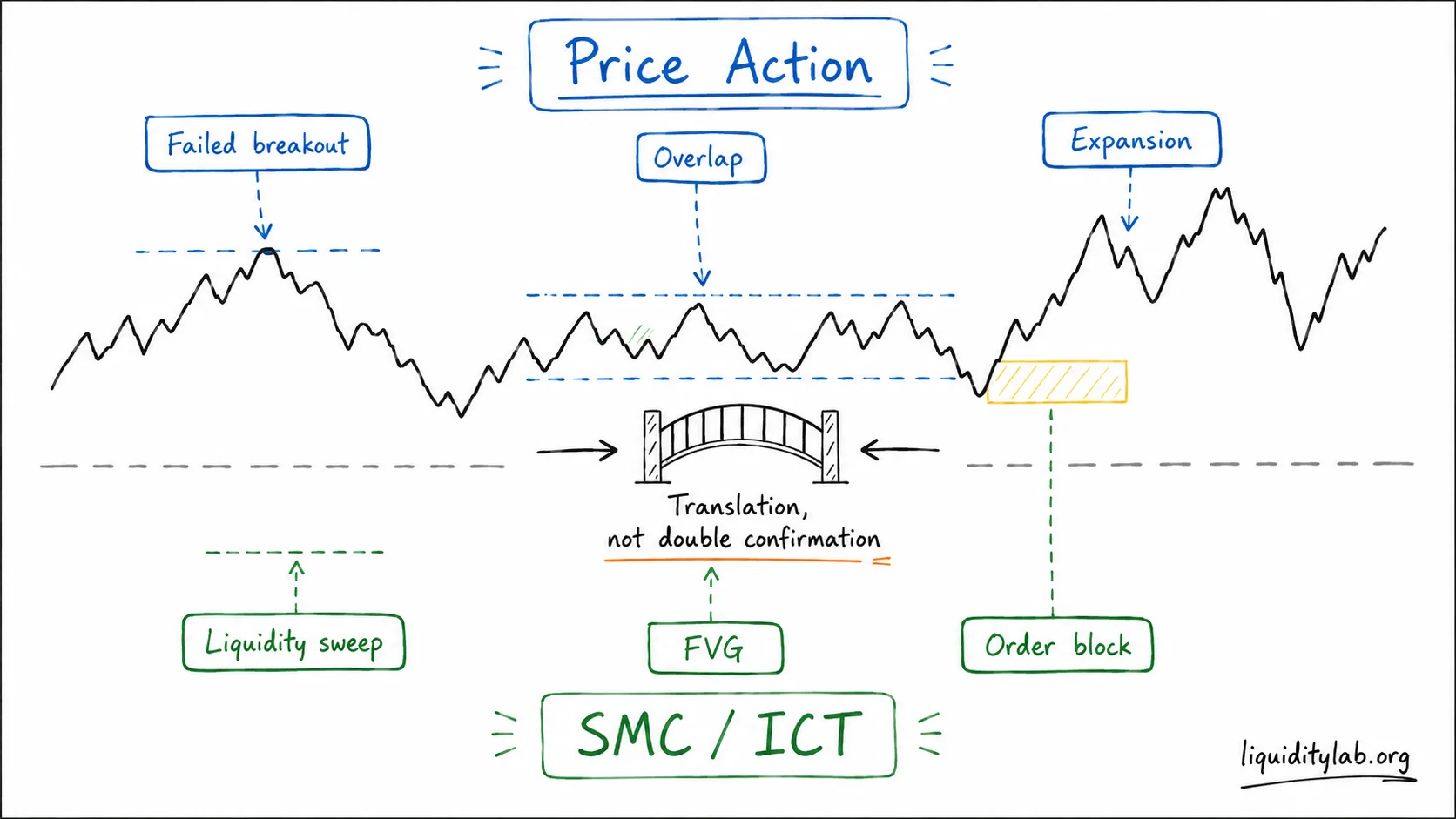
SMC and price action can describe the same market.
That does not mean they create double confirmation.
This page explains how to translate between the two languages without turning framework alignment into a trading signal.
Translation, not signal stacking
SMC and price action often look at the same price movement from different angles.
SMC may describe a move as liquidity being swept and price reacting from an order block.
Price action may describe the same move as a failed break above a range high followed by weak closes and increased overlap.
These are not two independent discoveries. They are two descriptions of one structure.
That distinction matters because many traders make this mistake:
"SMC agrees with price action, so the setup is stronger."
In LiquidityLab's framework, that is not the right conclusion.
A better conclusion is:
"Two languages are describing the same structural behavior."
What SMC tends to emphasize
SMC language often emphasizes:
- liquidity above highs or below lows
- stop runs or liquidity sweeps
- supply and demand zones
- order blocks
- fair value gaps
- market structure shifts
- institutional intent narratives
This vocabulary can be useful when you want to describe why price may interact with obvious levels or why a fast move created imbalance.
Its risk is that the institutional story can become too confident. Price structure does not prove actual institutional intent.
What price action tends to emphasize
Price action language often emphasizes:
- candle bodies and wicks
- overlap and contraction
- expansion and displacement
- swing highs and swing lows
- trend bars and non-trend bars
- range boundaries
- reaction around key levels
This vocabulary is more direct. It avoids assuming who caused the move and focuses on what price actually did.
Its risk is that candle-by-candle reading can become too narrow if larger structure is ignored.
One structure, two translations
| Market behavior | Price action language | SMC / ICT language |
|---|---|---|
| Price breaks an obvious high and returns quickly | false breakout / failed breakout | buy-side liquidity sweep |
| Price leaves a balanced area quickly | expansion / displacement | displacement from a zone |
| Price returns into a prior fast-move area | retest of imbalance area | FVG revisit |
| Price reacts near a prior rejection area | reaction at key level | order block or supply / demand zone |
| Price stops making progress and overlaps | range or transition | consolidation / equilibrium |
| Price breaks the swing that supported the prior move | possible structure shift | SMS / MSS-style shift |
The point is not to choose a winner.
The point is to notice that different frameworks often rename the same behavior.
Why "SMC + PA confirmation" can mislead
If two frameworks describe the same evidence, they are not independent confirmations.
For example:
- SMC says price swept buy-side liquidity.
- Price action says price failed above the range high.
Both observations may come from the same event: price moved above a high and returned.
Calling that "two confirmations" can create false confidence because the same evidence has simply been counted twice.
A safer workflow
Use one primary structure layer first.
For LiquidityLab, the primary layer is Market Structure OS:
- What is the market state?
- Where is price located?
- What structure is visible?
- What liquidity or key areas are nearby?
- What would make this reading invalid?
After that, SMC can be used as a translation layer:
"How would SMC describe the same structure?"
Not:
"Does SMC give me permission to trade it?"
Multi-timeframe structure as recursion
SMC discussions often use higher-timeframe, intermediate-timeframe, and lower-timeframe structure.
The safer translation is structural recursion:
Higher structure: outer context
  -> Middle structure: transition and detail
      -> Lower structure: local movement
This is not simply opening three chart timeframes.
The useful question is:
Which swing structure contains the current movement?
A lower-level shift does not automatically change the higher-level structure. Many lower-level breaks are only internal movement inside a larger range or pullback.
Quasimodo / QML as translation
QML, often called Quasimodo, is sometimes discussed in SMC communities as a reversal-style structure around a failed high or failed low.
In price-action language, it often resembles a head-and-shoulders-like failure or a failed swing continuation.
The safe translation is:
QML is a framework-specific label for a structure where one swing attempt fails and price later revisits the broken area.
It should not be treated as a standalone trade pattern.
What "integration" should mean
In this page, integration means:
- translate one framework into another
- compare the vocabulary used for the same structure
- notice where one framework adds assumptions
- keep Market Structure OS as the neutral base layer
- avoid counting one price event as multiple confirmations
Integration does not mean:
- use SMC for direction and price action for entry
- stack two systems to increase confidence
- treat framework agreement as higher probability
- mix target logic from one framework with entry logic from another
- turn terminology into an execution checklist
Suggested reading order
If you are new to this topic, read in this order:
Common misunderstandings
| Misunderstanding | Safer reading |
|---|---|
| "SMC and PA both agree, so the trade is confirmed." | They may be describing the same evidence with different words. |
| "SMC is the upgraded version of price action." | SMC and price action use different assumptions and vocabulary. |
| "Use SMC for bias and PA for entry." | This mixes framework layers and can hide inconsistent logic. |
| "More frameworks means better analysis." | More frameworks can also mean duplicated evidence and more confusion. |
| "Multi-timeframe means more screen timeframes." | The core idea is nested structure, not simply chart count. |
What this page is not
This page does not provide a combined SMC + price action strategy.
It does not provide entry triggers, exits, stop placement, targets, position sizing, or execution rules.
It is a translation guide for reading multiple market languages without confusing them for stronger signals.
Educational content only. Not financial advice.