Pullback and Breakout Structures
Learn how pullbacks and breakout attempts can be described as observation structures without treating them as automatic trade setups.
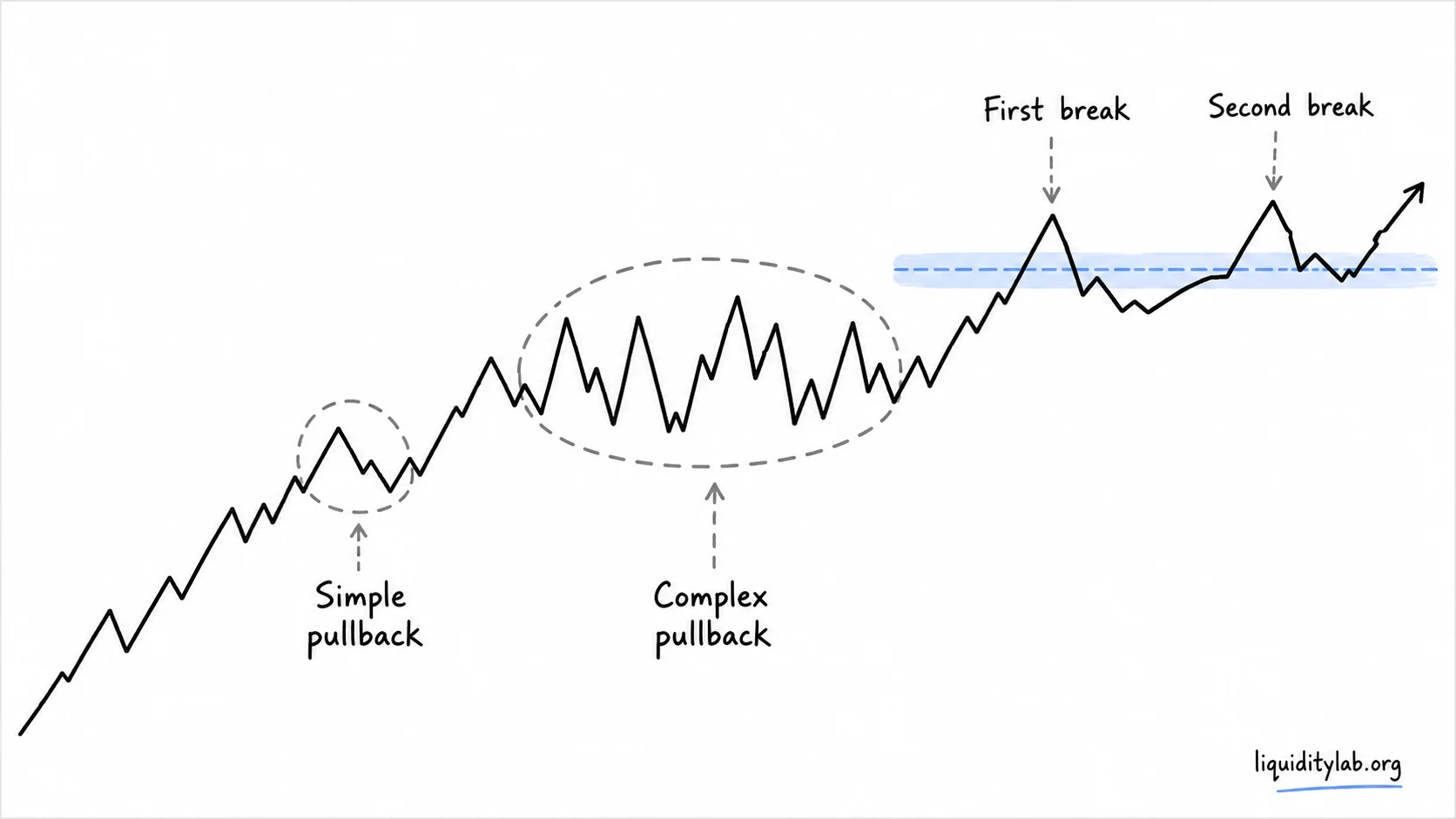
Trends do not move in straight lines.
They move, pause, pull back, test, and try again.
Pullback and breakout language helps describe that rhythm. It should not be treated as a set of automatic trade instructions.
Pullback as a pause in trend
A pullback is movement against the current trend.
The key question is not whether a pullback exists. Pullbacks are normal. The better question is:
"What kind of pause is this?"
A short and clean pause says something different from a long, overlapping, uncertain one.
Simple pullback
A simple pullback is usually brief and orderly.
Common clues:
- the counter-move is short
- candles overlap less
- price returns toward the prior direction without much struggle
- the larger structure remains intact
This does not mean continuation is guaranteed. It only means the pause has not yet shown much structural disagreement.
Complex pullback
A complex pullback lasts longer and contains more disagreement.
Common clues:
- more overlapping movement
- more hesitation
- internal shapes such as ranges, wedges, or triangles
- repeated tests without clean continuation
Complex pullbacks matter because they show that the market is no longer moving with the same efficiency.
They can still resolve in the original direction. They can also become the early stage of a structural change.
First break and second break
Some price-action models describe breakout attempts as:
- First Break (FB): the first attempt to break a meaningful level
- Second Break (SB): a later attempt after the first one failed or stalled
These labels are useful for replay because they separate the first test from the market's later response.
The second attempt may carry more information because participants have already seen the first attempt fail or hesitate.
But neither label is a signal by itself.
What two failed attempts can reveal
If price fails twice at the same area, the failure itself is not an instruction.
It is a reason to ask better questions:
- did the second attempt reach farther than the first?
- did price reject quickly or stay near the level?
- did momentum increase or weaken?
- did the surrounding structure become cleaner or more confused?
The value is in comparing behavior, not in memorizing a pattern.
Measured movement as replay reference
Some models compare one movement leg with another.
For example, after a trend leg and a pullback, a later move may be compared with the earlier leg.
This can be useful in replay:
- did price pause around a similar distance?
- did movement become less efficient there?
- did the structure change before or after that area?
But equal-distance observation is not a target tool. It should not be treated as a required destination.
Review checklist
When studying pullback and breakout structures, ask:
- What is the larger structure?
- Is the pullback simple or complex?
- Has a meaningful level been tested more than once?
- Did the second attempt behave differently from the first?
- What would invalidate this structure reading?
These questions keep the focus on observation.
Continue with
Educational content only. Not financial advice.