Liquidity Pool
Learn what liquidity pools are, where they commonly form, and why price often reacts around obvious highs, lows, round numbers, and repeated levels.
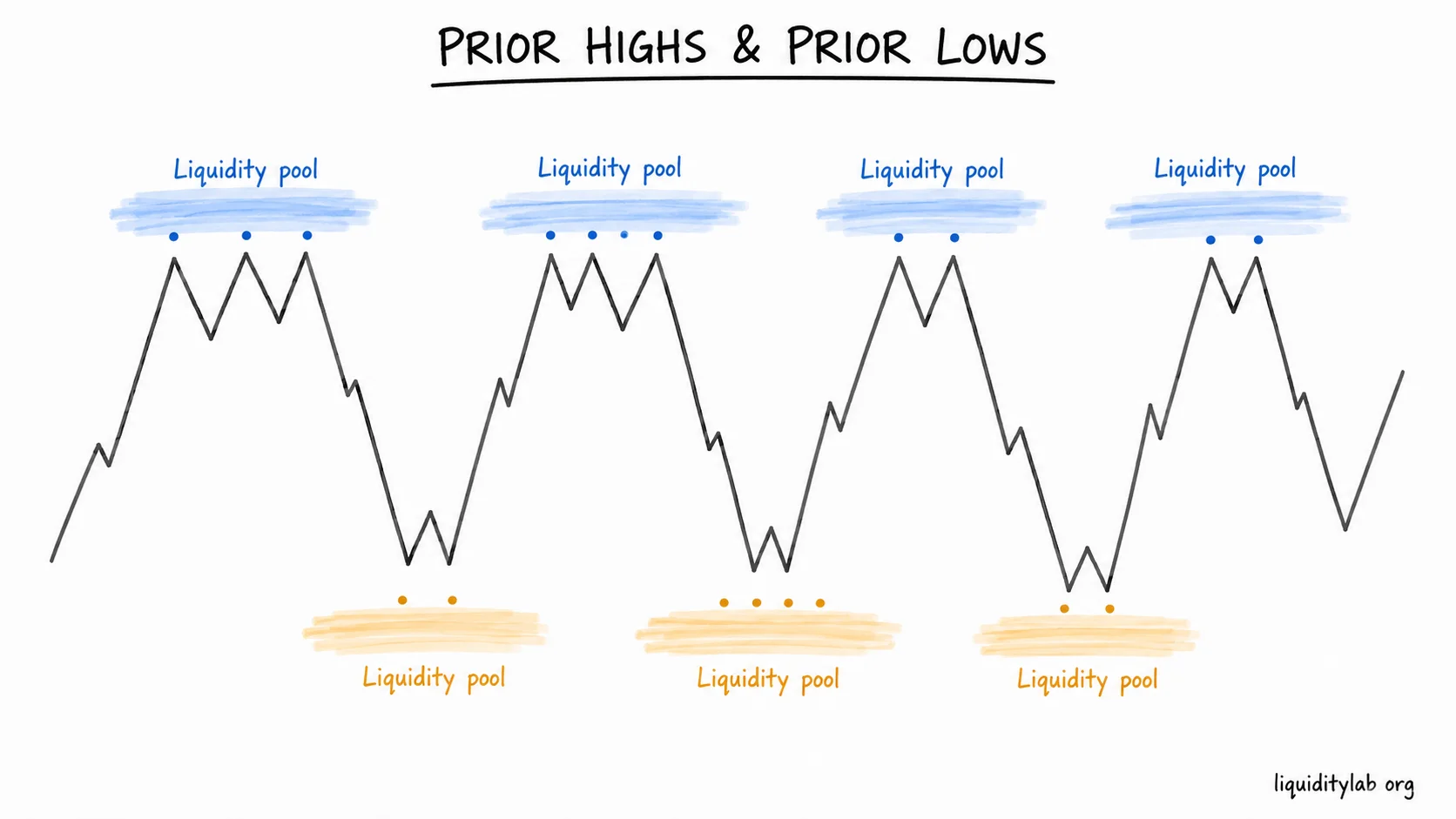
A liquidity pool is an area where many orders are likely to be clustered.
It is not a magic line. It is a place where market participants may have placed stops, breakout orders, or pending decisions around the same visible price area.
Why liquidity pools form
People tend to use similar reference points.
They often pay attention to:
- prior swing highs
- prior swing lows
- equal highs or equal lows
- round numbers
- obvious range boundaries
- key levels that many traders can see
When many participants focus on the same area, orders can cluster there.
That cluster is what traders often call liquidity.
Common locations
| Location | Why it matters |
|---|---|
| Above prior highs | Breakout interest and stop orders may cluster there. |
| Below prior lows | Breakdown interest and stop orders may cluster there. |
| Equal highs / equal lows | Repeated tests make the level more visible. |
| Round numbers | Psychological attention can concentrate around simple numbers. |
| Range boundaries | Both sides of a range often attract repeated decisions. |
These are observation zones, not automatic trade locations.
Order mechanics behind liquidity
Liquidity language becomes clearer when you separate three order types:
| Order type | Simple role | Observation meaning |
|---|---|---|
| Market order | Consumes available liquidity immediately | Can push price when one side is aggressive. |
| Limit order | Provides liquidity at a chosen price | May slow, absorb, or pause movement. |
| Stop order | Often becomes a market order when triggered | Can add fuel when many stops activate near the same area. |
This does not mean you know who placed the orders.
It only gives you a cleaner way to describe why obvious highs, lows, and range boundaries can become active areas.
When many stops or breakout orders cluster near the same visible level, a move through that level may trigger additional market orders. This is sometimes called a stop cascade.
For LiquidityLab, a stop cascade is a risk and structure phenomenon, not a signal.
Liquidity and market structure
Liquidity pools make more sense when they are read with structure.
A pool above price may matter differently in:
- a strong uptrend
- a mature trading range
- a weakening trend
- a possible reversal process
The pool itself does not decide the outcome. It only marks where reaction may become more likely because many participants are focused there.
Liquidity can be consumed or rebuilt
After price trades through an obvious liquidity area, that area may no longer carry the same meaning.
But liquidity can also rebuild if price keeps returning to the same location and participants keep placing decisions around it.
This is why liquidity reading is dynamic. It is not enough to mark a level once and assume it will remain important forever.
Useful observation questions
When studying a liquidity pool, ask:
- Why is this area visible?
- Which participants might be focused here?
- Has price already traded through it?
- Did price react, pause, or continue after reaching it?
- Does the higher-level structure support this area as meaningful?
These questions keep liquidity reading descriptive rather than predictive.
Continue with
Educational content only. Not financial advice.