Reaction at Key Levels
Learn three common ways price can react at key levels: rejection, breakout, and range behavior, framed as observation rather than trade instruction.
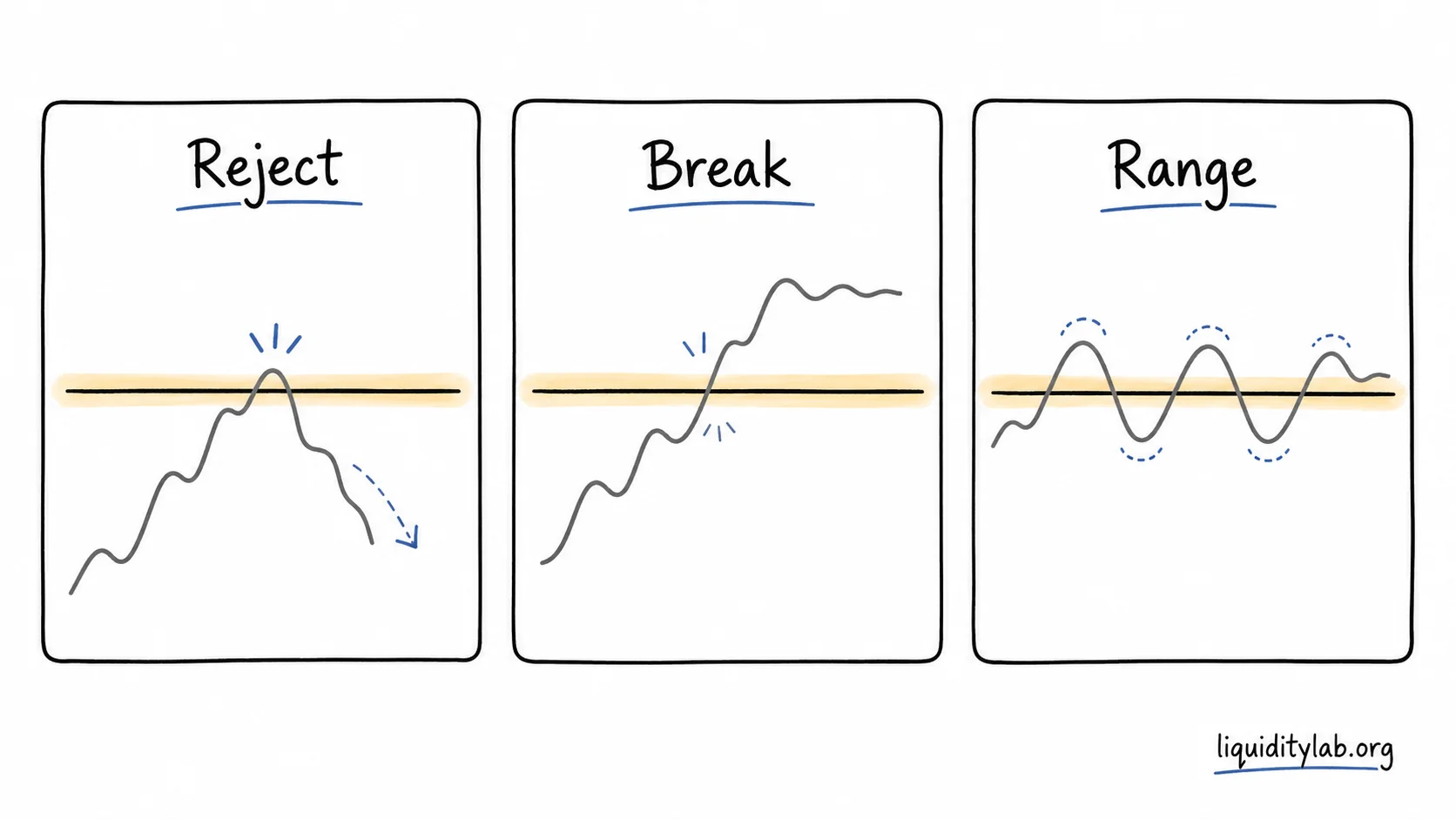
A key level is only the stage.
The important part is how price behaves when it reaches that stage.
Price may reject the level, break through it, or spend time rotating around it. These are not commands. They are observation categories.
Reaction type 1: rejection
Rejection means price reaches a level and fails to move through it cleanly.
Common clues:
- long wick near the level
- quick return away from the level
- smaller candles after a strong approach
- loss of momentum near the area
Rejection does not automatically mean reversal. It only says that price met resistance or support there.
Reaction type 2: breakout
A breakout means price moves beyond the level.
The key question is whether price can stay beyond it.
Useful observations:
- did price close clearly outside the level?
- did it immediately return inside?
- did later candles continue away from the level?
- did the level become meaningful again after the break?
A breakout is not proven by one emotional candle.
Reaction type 3: range behavior
Sometimes price does not reject cleanly and does not break cleanly.
It rotates near the level.
That can look like:
- repeated tests
- smaller candle bodies
- overlapping movement
- narrowing volatility
- no clear winner between buyers and sellers
When that happens, the level may become part of a small range rather than a clean turning point.
Three interaction labels
It can help to describe the interaction in plain language:
| Label | Meaning |
|---|---|
| Touch-and-stop | Price approaches the level and turns before fully moving through it. |
| Fail-and-return | Price moves through the level but quickly returns inside the prior area. |
| Pass-and-confirm | Price moves through the level and later treats it as meaningful from the other side. |
These are descriptive labels, not entry models.
What to avoid
Avoid turning a key level into a prediction.
Weak framing:
"Price reached resistance, so it must reverse."
Better framing:
"Price reached a prior reaction area. I need to observe whether it rejects, breaks, or ranges."
The second version keeps the chart open.
Continue with
Educational content only. Not financial advice.