Chan Theory Structure Language
Learn Chan Theory as a Chinese structure-analysis framework using inclusion, fractals, strokes, segments, central pivots, and levels.
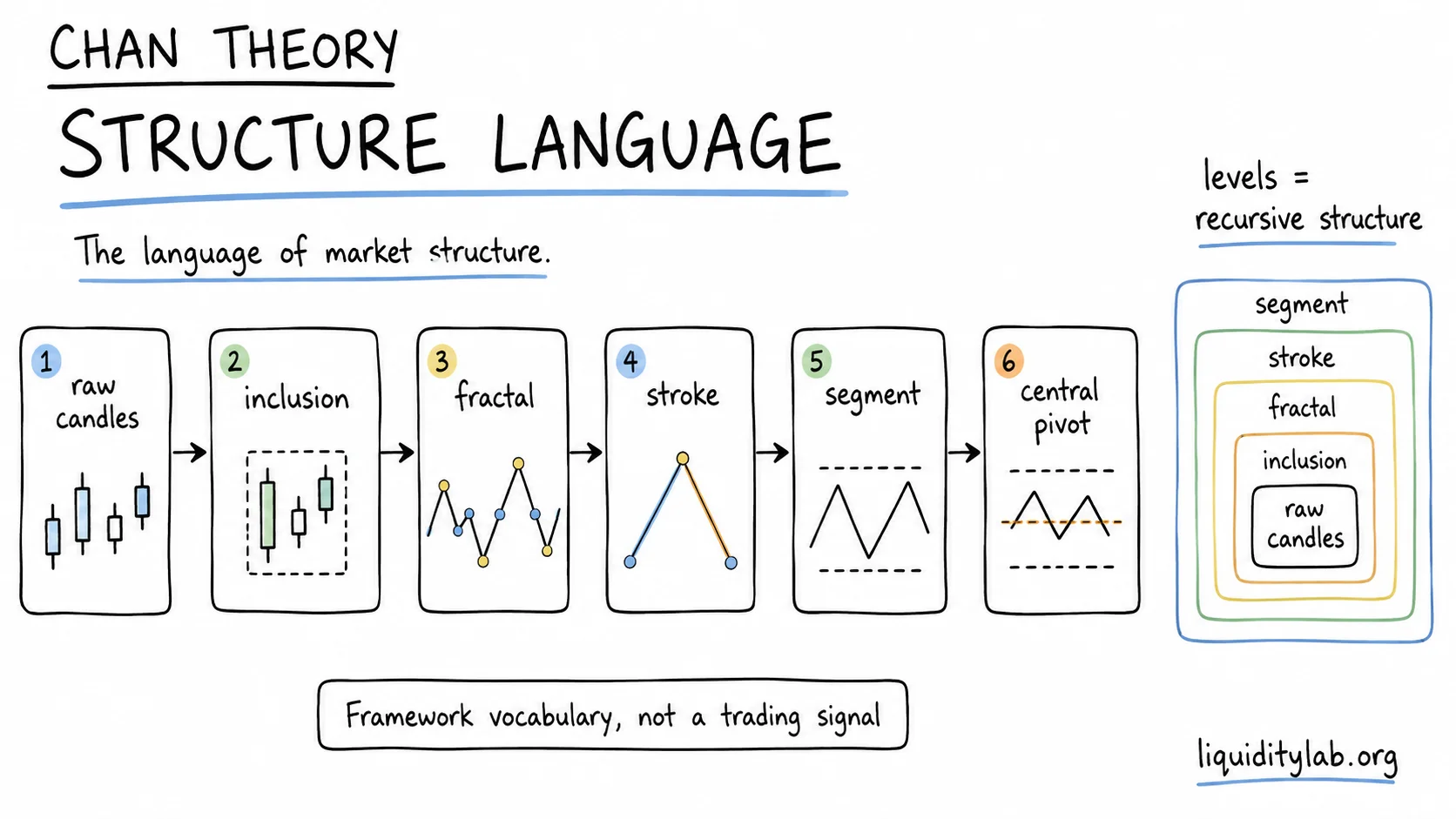
Chan Theory, also called Chanlun, is a Chinese structure-analysis framework for organizing price movement into nested structural units.
In LiquidityLab, Chan Theory belongs to the Framework Mapping layer. It can help describe how one framework reads structure, but it does not replace the Market Structure OS and it does not provide buy direction, sell direction, entries, exits, stop placement, targets, position sizing, leverage, or return expectations.
For the broader study sequence, see LiquidityLab Market Structure OS and the Framework Mapping Learning Path. This page is one framework language inside that larger system.
Why this is a hub page
The Chinese LiquidityLab site has several detailed Chan Theory pages.
The English site starts with one curated hub instead of mirroring those pages one-to-one.
That choice is intentional:
- English readers first need a clear orientation to the vocabulary.
- Chan Theory contains many Chinese-derived terms that do not map cleanly into standard English trading language.
- A single hub is safer than several deep pages that may make internal framework terms look like trading instructions.
This page introduces the structure language first. Deeper mapping pages can come later.
The core idea
Chan Theory tries to describe how price structure grows from smaller units into larger units.
A simplified ladder looks like this:
raw candles
-> included / standardized candles
-> fractals
-> strokes
-> segments
-> central pivots
-> trend type and nested levels
This is not the same as ordinary candlestick reading.
Price action often reads raw candles directly: body, wick, close, reaction, momentum, and location.
Chan Theory first standardizes the candle sequence, then builds structure from that standardized sequence.
Inclusion and standardized candles
One of the first Chan Theory ideas is inclusion.
An inclusion relationship exists when one candle's high-low range is contained inside another candle's range.
Chan Theory processes these included candles before defining later structures. The goal is to reduce noise and create a cleaner sequence for structure marking.
In plain English:
the raw candle sequence is transformed before the framework starts labeling structure.
This matters because a Chan Theory structure is not always based on the same raw candle details a price-action reader would emphasize.
Fractals
After inclusion processing, Chan Theory marks local turning structures often translated as top fractals and bottom fractals.
A top fractal usually marks a local high structure.
A bottom fractal usually marks a local low structure.
These labels are framework-defined structural markers. They are not reversal signals.
The safest question is:
Has the framework identified a local structural point here?
Not:
Should I trade from this point?
Strokes
A stroke connects alternating fractal structures.
You can think of it as a minimum movement unit inside Chan Theory.
The important part is that a stroke is not drawn freely like a trendline. It depends on the framework's rules for fractals, spacing, and structural validity.
In LiquidityLab language, a stroke is closest to a short structural leg.
But it is not identical to a price-action swing, because the data preparation and definition rules are different.
Segments
A segment is built from multiple strokes.
It is a larger structure unit than a stroke. Where a stroke describes a smaller leg, a segment describes a higher-order movement formed by several legs.
The exact boundary of a segment depends on Chan Theory's internal rules.
For English readers, the useful idea is:
Chan Theory does not jump from candles directly to trend. It builds intermediate structure layers.
Central pivot
The central pivot is one of the most important Chan Theory concepts.
It is often described as the overlapping area created by consecutive structural movements.
It resembles a trading range in ordinary price-action language, but the definitions are different.
| Concept | Plain comparison | Important difference |
|---|---|---|
| Trading range | A visible area where price rotates | Can be drawn flexibly from highs and lows |
| Chan central pivot | A framework-defined overlap area | Built from specific structural units and their overlap |
The central pivot is not just "a box on the chart." It is a structural object inside the Chan Theory framework.
Levels are not the same as timeframes
Chan Theory uses levels recursively.
This is easy to confuse with timeframes.
In many trading frameworks, a level might simply mean a chart timeframe such as 5-minute, 1-hour, or daily.
In Chan Theory, level is more structural. A higher-level structure is built from lower-level structures.
The safer translation is:
level means recursive structure, not just the timeframe selected on the chart.
This is one of the main reasons Chan Theory should not be mixed casually with ordinary multi-timeframe analysis.
Trend type, divergence, and completion language
Chan Theory also contains language for describing trend type, divergence, nested observation, and structural completion.
In simplified form:
- a trend type depends on how central pivots are arranged
- divergence compares the strength of related structural movements
- nested observation looks at how smaller levels appear inside larger levels
- completion language describes how one structure may finish and connect to another
The dangerous misuse is to treat this as a precise reversal method.
LiquidityLab uses a narrower interpretation:
these are framework-internal ways to describe structure maturity and uncertainty.
They do not produce a trade command.
About buy-point and sell-point terminology
Chan Theory contains terms often translated as first buy point, second buy point, third buy point, and corresponding sell-point terms.
On LiquidityLab, these terms are not used as trading instructions.
If they appear, they are treated only as framework vocabulary:
- a way Chan Theory names certain structural locations
- not a recommendation to buy or sell
- not an entry rule
- not a stop or target model
- not a probability claim
For English learners, it is usually better to understand the structure ladder first before studying those internal terms.
Mapping to Market Structure OS
The closest LiquidityLab translation is:
| Chan Theory term | Approximate LiquidityLab language | Boundary |
|---|---|---|
| Inclusion processing | Candle-sequence filtering | Chan Theory uses explicit processing rules |
| Fractal | Local swing marker | Not automatically a reversal signal |
| Stroke | Short structural leg | Not identical to any freely drawn swing |
| Segment | Higher-order movement | Defined by framework rules |
| Central pivot | Trading range / overlap area | Similar visual idea, different definition |
| Level | Nested structure | Not equal to chart timeframe |
| Divergence | Momentum weakening | Defined through framework relationships |
These are translations, not exact equivalents.
The Market Structure OS remains the main layer:
- Market state.
- Visible structure.
- Liquidity and observation zones.
- Evidence versus uncertainty.
- Invalidation of the current reading.
Chan Theory can be used as a reference language on top of that, not as a replacement.
Common mistakes
Mistake 1: mixing raw candles and standardized candles
If a price-action reader uses raw candle details while a Chan Theory reader uses processed candles, their labels may disagree.
That does not mean one is automatically wrong. It means the frameworks are using different inputs.
Mistake 2: treating central pivot as any range
A central pivot may look like a trading range, but it is not just any box around sideways price.
Its definition depends on overlapping structural units.
Mistake 3: turning buy-point vocabulary into instructions
The word "buy" in a framework term does not make it a LiquidityLab trade instruction.
On this site, buy-point and sell-point language is only terminology background.
Mistake 4: using multiple frameworks as confirmation votes
If Chan Theory and price action both describe a similar area, that does not mean the market has become more certain.
It means two languages are describing the same structure from different angles.
Summary
Chan Theory is a structure-analysis language built around inclusion, fractals, strokes, segments, central pivots, recursive levels, and completion language.
It is valuable as a Framework Mapping reference, especially for understanding how a Chinese technical-analysis tradition describes structure.
It is not a trading system, not a prediction tool, and not a replacement for LiquidityLab's Market Structure OS.