Trading Range Structure
Learn how trading ranges form, why range breakouts often fail, and how to describe range structure without turning it into a trade signal.
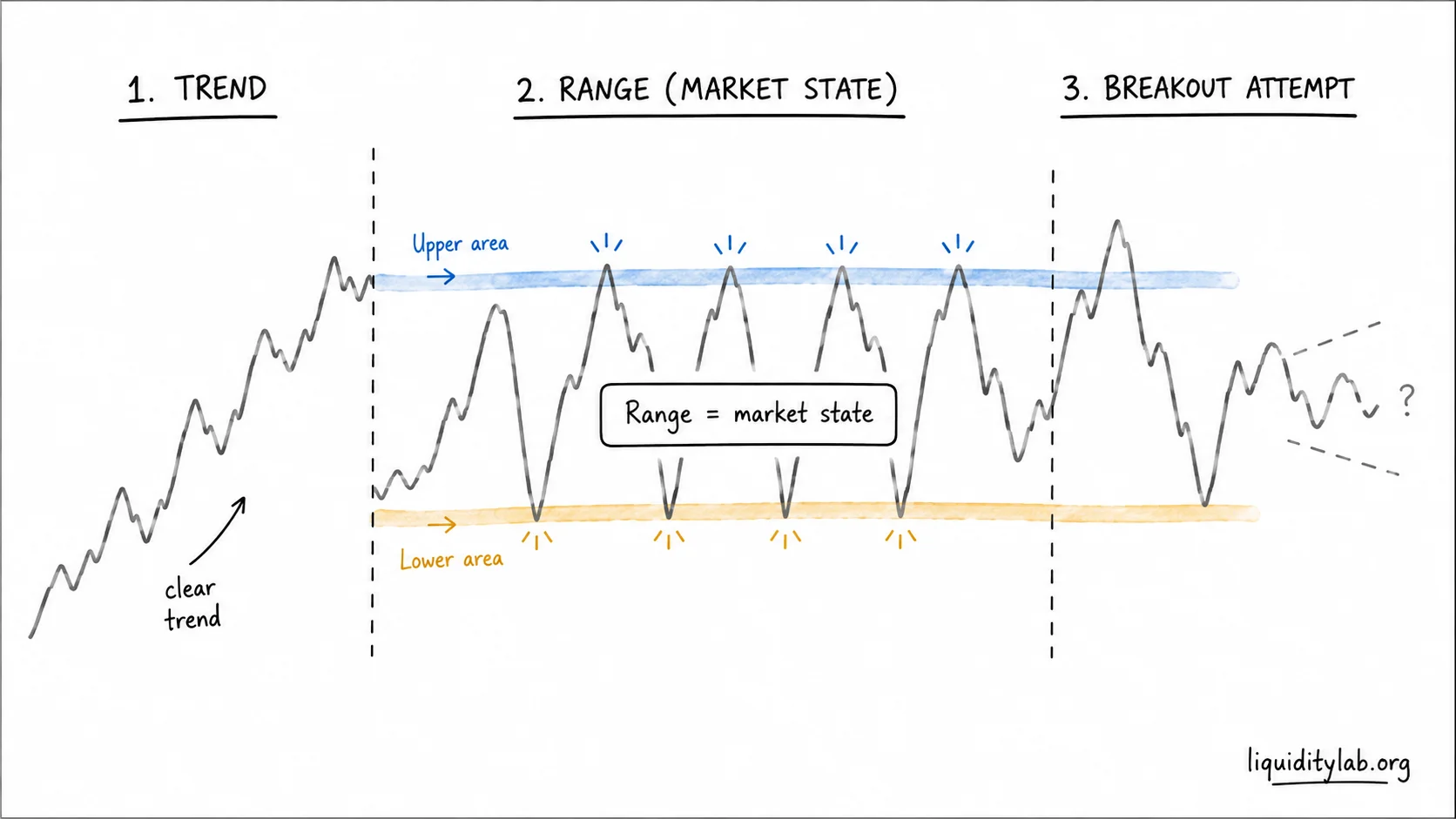
A trading range is not a box for automatic buying and selling.
It is a market state.
When price enters a range, the first job is not to predict which side will win. The first job is to recognize that the market has moved from directional movement into balance.
What a trading range means
A trading range forms when price keeps rotating between an upper area and a lower area without making clean directional progress.
In simple terms:
- buyers react near the lower side
- sellers react near the upper side
- neither side has fully taken control
That balance is why range behavior can feel confusing. Price can look strong near the top and weak near the bottom, yet still remain inside the same structure.
Where ranges appear in a trend
Many trends do not reverse or continue in one clean motion. They often move through a sequence like this:
Trend -> pullback -> complex pullback -> trading range -> breakout attempt -> new structureThe range is the pause in the middle of that chain.
It may become continuation. It may become reversal. The range itself does not decide that. It only tells you that the previous directional rhythm has slowed and that both sides are now testing the same area.
A range can be different on different timeframes
The same price movement can look different depending on the timeframe.
A small trading range on a lower timeframe may simply be a pullback on a higher timeframe. A higher-timeframe pullback may contain a complete lower-timeframe range.
This is why range analysis should stay tied to the timeframe being described.
Better wording:
"Price is ranging on this observation timeframe."
Risky wording:
"The whole market is ranging."
The second statement may be too broad unless the higher-timeframe context also supports it.
Signs of a more established range
There is no universal rule for when a range becomes "confirmed." But several clues make a range easier to describe:
- price has stopped making clean progress in the prior direction
- the upper area has been tested more than once
- the lower area has been tested more than once
- the middle of the range becomes noisy and less useful
- breakout attempts quickly return inside the range
These clues are not trading instructions. They are structure notes.
Why many range breakouts fail
Inside an established range, both sides have accumulated expectations.
When price briefly breaks above the range, some participants treat that move as strength while others treat it as a chance to fade the move. The same can happen below the range.
That is why many breakouts from mature ranges do not continue immediately. Price may move outside the boundary, attract attention, and then fall back inside.
The lesson is not "fade every breakout." The lesson is simpler:
A single boundary break is not enough to prove that the range has ended.
Measured move as observation, not target
Some price-action models compare the height of a range with the distance price travels after a breakout.
This can be useful in replay as a reference area:
- did price pause around a similar distance?
- did volatility contract there?
- did the breakout fail before reaching that area?
- did price continue through it without reaction?
But the measured distance is not a promise. It should not be treated as a target or a required destination.
Use it as a review tool, not as a prediction tool.
Two useful observation questions
When price is inside a range, ask:
- Is price still respecting both sides of the range?
- If price leaves the range, does it stay outside or return quickly?
Those two questions keep the focus on observable behavior.
They are more useful than trying to guess which side will win before price provides enough structure.
Continue with
Educational content only. Not financial advice.