Candlestick Emotion Language
Learn how candlesticks can express market emotion through body size, wick behavior, speed, and context without becoming trade signals.
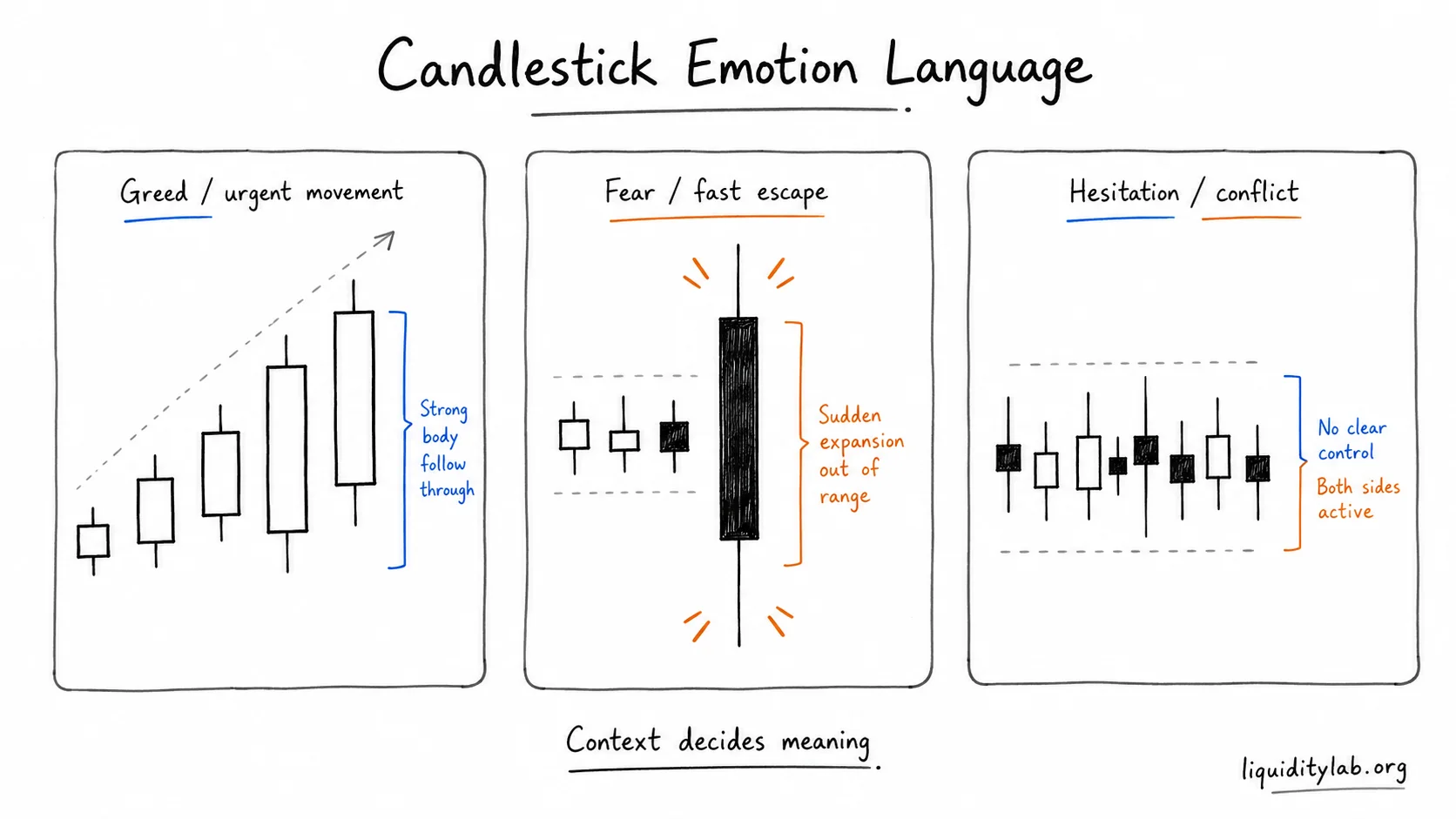
Candlesticks are not just shapes.
They are traces of behavior.
Each candle records how buyers and sellers behaved during one period of time. The goal is not to guess what happens next from a single candle. The goal is to understand what kind of emotion may be present in the current price sequence.
Three basic emotional states
For learning purposes, many candle sequences can be described with three simple emotional states:
- greed
- fear
- hesitation
These words are not psychological diagnoses. They are shorthand for observable price behavior.
Greed: urgent movement
Greed appears when price moves quickly in one direction and participants seem unwilling to wait.
In candlestick terms, this may appear as:
- large bodies in the direction of the move
- small wicks
- little overlap between neighboring candles
- fast continuation after a previous break
But a strong candle does not automatically mean the move is healthy. A large emotional candle near the end of an extended move may be exhaustion rather than clean strength.
Fear: urgent escape
Fear appears when price moves quickly against participants who are trapped or forced to react.
In candlestick terms, this may appear as:
- large down candles
- sudden expansion in range
- long lower wicks after sharp selling
- quick movement through obvious areas
Fear can produce dramatic candles. But dramatic does not always mean directional. A frightening candle inside a larger range may simply be a fast movement through a noisy zone.
Hesitation: conflict and uncertainty
Hesitation appears when neither side can keep control.
In candlestick terms, this may appear as:
- small bodies
- long wicks on both sides
- repeated overlap
- inside bars or compressed ranges
- frequent direction changes
Hesitation often matters more after movement than in isolation. A small candle after a strong push may show pause. The same small candle in the middle of a choppy range may be ordinary noise.
Emotion depends on location
The same candle can express different information in different locations.
A long upper wick near a major upper range boundary may show rejection. A long upper wick in the middle of a messy range may not matter much. A large up candle after a breakout may show follow-through. The same candle after several extended pushes may show late emotional participation.
This is why the question should not be:
What is this candle called?
A better question is:
What did this candle do in this location, after this sequence?
Vacuum candles: scary does not always mean strong
Sometimes a candle looks powerful because price moved very quickly, but the movement may have happened with little resistance.
This can be described as a vacuum candle.
For example, in an uptrend, price may suddenly drop with a large down candle. At first glance it looks bearish. But if the move happened because buyers temporarily stepped away rather than because sellers were truly dominant, the candle may be less meaningful than it looks.
A vacuum candle is not a reversal signal. It is only a reminder to check follow-through:
- do later candles show hesitation?
- does price quickly return into the prior area?
- does the move continue with real pressure?
- does volume or range behavior support the move?
The key idea is simple: one dramatic candle is not enough.
Fast candles inside a range
Inside a trading range, large fast candles are especially easy to misread.
When price is rotating inside a range, a sudden candle can look like a breakout. But if it appears away from the range boundary, or if the next candles immediately hesitate, it may just be internal range movement.
Useful questions:
- Did the candle appear near a meaningful boundary?
- Did price stay outside the area it broke?
- Did follow-through continue, or did price return quickly?
- Was the range already established?
These questions keep the focus on observation rather than reaction.
From emotion to structure
Emotion is useful only when it is connected to structure.
Greed near a breakout area, fear near a lower boundary, or hesitation after a strong push can all provide useful reading context. But none of them is enough by itself.
The purpose of candlestick emotion language is to help you describe what the market is expressing, not to tell you what trade to take.
Classic candle families as reference language
Some teaching models group familiar candlestick examples into broader reference families such as reversal, continuation, and trap-like behavior.
LiquidityLab keeps that language in the review layer only.
It can help you describe why a candle sequence felt urgent, misleading, or exhausted, but it still depends on location, sequence, and higher-timeframe structure. The label is a reference, not a verdict.
What this page is not
This page does not provide buy signals, sell signals, entries, exits, stop placement, targets, or position sizing.
Candlestick emotion is a reading layer. It should be combined with market structure, levels, liquidity, and review, and even then it remains educational observation rather than execution advice.
Continue with
Educational content only. Not financial advice.