Trend Reversal Framework
Understand trend reversal as a structural process involving weakening continuation, stronger counter-movement, ranges, and multi-timeframe context.
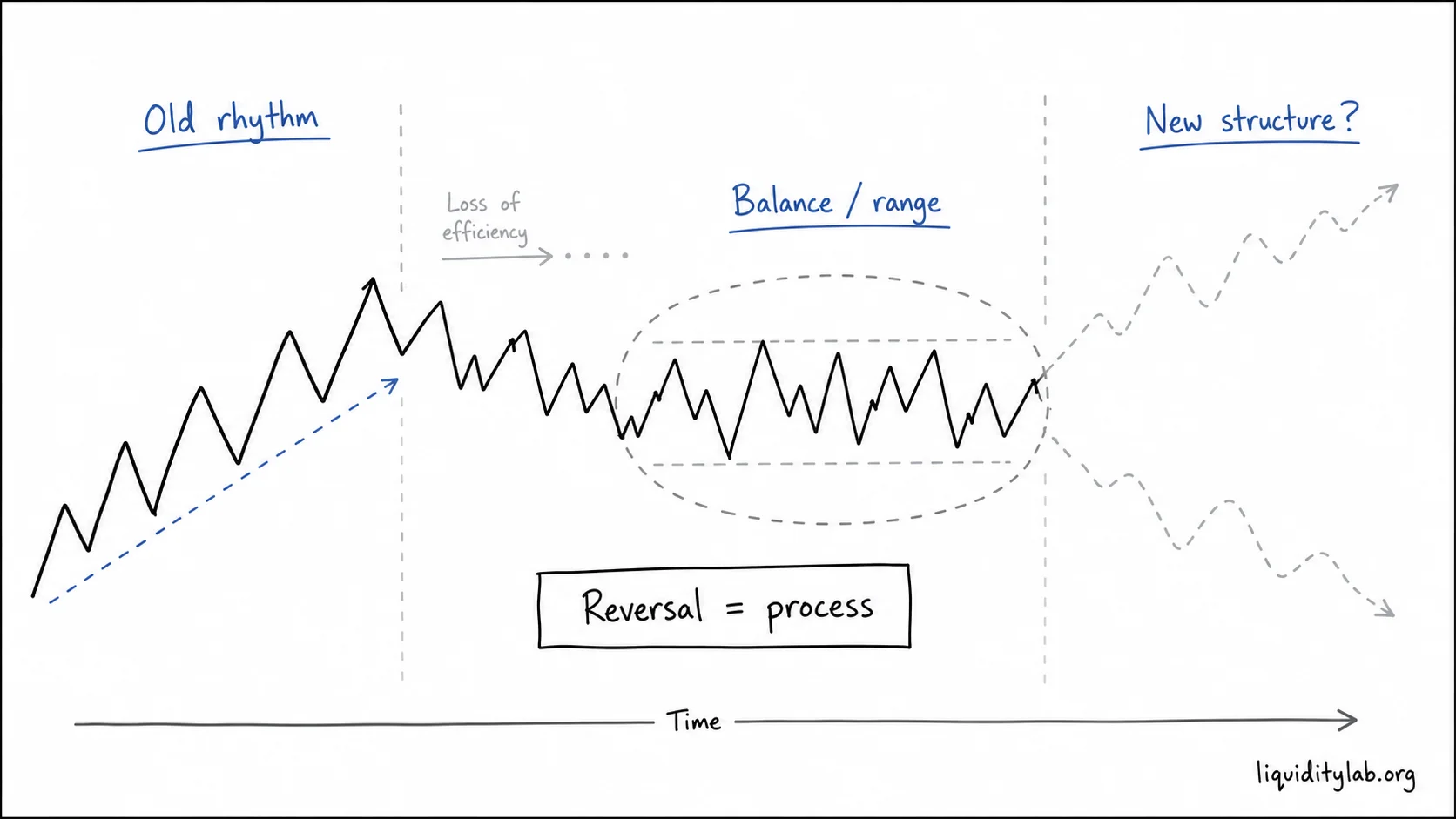
A trend reversal is not the same as guessing the top or bottom.
Reversal reading is about noticing when the old structure is losing control and a different structure may be forming.
That distinction matters. One mindset tries to predict an endpoint. The other describes a process.
The two sides of reversal reading
A useful reversal framework watches two things at the same time:
- continuation strength is weakening
- counter-direction movement is getting stronger
If continuation strength weakens but the opposite side does not strengthen, price may simply enter a range.
If the opposite side suddenly appears but the original trend remains structurally strong, the move may only be a pullback.
A reversal argument becomes more meaningful when both sides are visible.
Reversals often develop through ranges
Many important reversals do not happen in one dramatic candle.
They often develop through a trading range:
- the old trend slows
- pullbacks become deeper or more complex
- price begins rotating between two areas
- the old side fails to regain clean control
- the opposite side begins to build structure
The range is where the market tests whether the old direction still has control.
This is why understanding Trading Range Structure is important before studying reversals.
Narrow reversal vs broad reversal
The word "reversal" can mean different things.
A narrow reversal means the larger trend structure has truly changed. This requires more evidence than one counter-move.
A broad reversal is a local change in direction. A pullback, a reaction from a range boundary, or a lower-timeframe shift may all look like a reversal from one angle.
The safer habit is to ask:
"Reversal on which structural level?"
Without that question, reversal language becomes too vague.
Moving-average gap as a visual warning
Some price-action models watch the distance between price and a moving average, such as a 20-period EMA.
When price moves far away from the average, the gap may suggest that the current pace is stretched.
That can be useful as a visual warning, but it is not a reversal signal.
Price can stay stretched for longer than expected. The gap only says that distance has expanded. It does not say that the trend must turn.
A process-based reversal checklist
Instead of looking for one perfect reversal candle, describe the process:
- Has the trend line or prior rhythm been challenged?
- Has price changed its relationship with the average or value area?
- Has price tested a prior extreme and failed to continue?
- Has a range formed after the trend slowed?
- Has the opposite side built structure, or is price still only rotating?
This checklist is for replay and observation. It is not a sequence of trade instructions.
Do not turn exit stories into certainty
Some case material describes reversals as if "smart money exited" before the public noticed.
That story can be useful as a metaphor, but it should not become a claim about intent. In LiquidityLab, the safer version is process-based:
- continuation attempts become less efficient
- reactions against the trend become more meaningful
- range behavior appears after a strong move
- the old side fails to regain control
- the new side slowly builds structure
The review question is not:
Who exited?The review question is:
What visible evidence showed that the prior structure was losing control?Terminal patterns are only visible in hindsight
Patterns such as terminal flags or three-push wedges are often discussed in reversal education.
They can help explain why a trend may have been running out of energy.
But they are usually clearest after the fact. During live observation, a pattern that looks "terminal" may still continue.
The educational value is in the review question:
"Was the trend becoming less efficient before it changed?"
Not:
"This pattern means the trend must reverse now."
Multi-timeframe context
Lower-timeframe reversals often become higher-timeframe pullbacks.
That is why reversal language should always include structure level.
If the higher timeframe is still trending, a lower-timeframe counter-move may be a local reversal but not a full trend change.
For this reason, Relative vs Absolute Reversal is a useful companion concept.
Continue with
Educational content only. Not financial advice.