Trading Study Time Management
Learn how to manage trading study time with weekly study blocks, review sessions, focused practice, rest, and realistic routines.
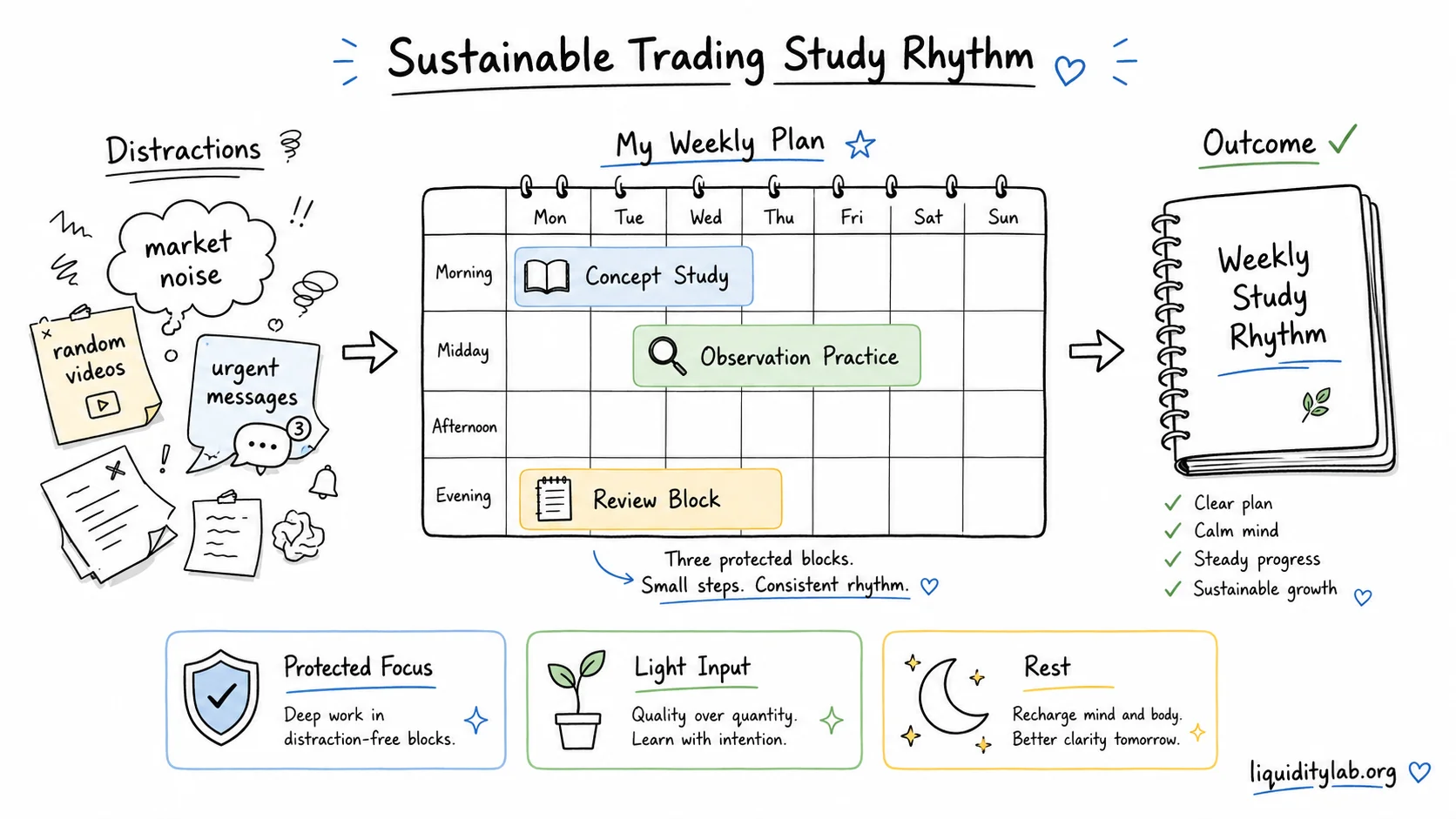
Most learners do not quit because the material is impossible.
They quit because the learning rhythm never becomes real.
Trading study has no fixed classroom, no exam date, and no teacher checking homework tomorrow morning.
That makes it easy for learning to be pushed behind urgent work, messages, market noise, and daily life.
This playbook is about building a study rhythm you can actually keep.
Educational content only. This page does not provide trade direction, entries, exits, stop-loss levels, targets, position sizing, leverage, or return expectations.
Why trading study loses to time
Trading study is easy to postpone because it often feels important but not urgent.
You can always say:
- I will review later.
- I will study after work.
- I will mark charts this weekend.
- I will start once I understand more.
The problem is that "later" is not a time block.
If trading study only exists as a vague intention, it will usually lose to tasks that are clearer, louder, or more urgent.
This is not only a discipline problem.
It is a design problem.
You need a rhythm that gives study a real place in the week.
Start with your reason
Before planning time, ask:
Why am I studying this?
Different reasons require different rhythms.
You may be:
- exploring trading as a second-career option
- learning market structure for personal education
- trying to understand your own investment decisions
- building a long-term review habit
- using LiquidityLab as a structured learning system
None of these reasons is automatically better than the others.
But each one implies a different amount of time, energy, and patience.
If you are only exploring, a few focused hours per week may be enough.
If you want to build an independent skill, the rhythm must be more consistent.
The key is not to copy someone else's pace.
The key is to match your study rhythm to your actual goal.
Important is not the same as urgent
Many trading-related activities feel urgent.
That does not make them important.
Examples of urgent but low-value activities:
- checking market commentary every few minutes
- watching others post profits or losses
- jumping between frameworks because one chart looked confusing
- collecting more indicators before reviewing old notes
Examples of important but not urgent activities:
- reviewing your own observation records
- studying market structure basics
- writing a weekly Plan Card sample
- comparing one original judgment with what price later did
- organizing one small concept until you can explain it clearly
Better time management means protecting the second group.
Once per week, ask:
What are the three most important learning tasks this week?
Then ask:
Where did my time actually go last week?
The gap between those two answers is the real time-management problem.
Use weekly planning instead of perfect daily planning
Daily planning often breaks because life interrupts one day.
Weekly planning is more forgiving.
A simple weekly structure:
- one block for concept study
- one block for chart observation practice
- one block for review
- one lighter block for reading or glossary cleanup
The exact days do not matter as much as the rhythm.
For example:
Monday: read one concept page
Wednesday: write one three-line observation
Saturday: review one old record
Sunday: adjust next week's study focus
If one block is missed, the whole week is not ruined.
You simply move the block or reduce the scope.
The goal is continuity, not perfection.
Write actions, not wishes
"Review more" is not an action.
"Study market structure" is not an action.
These are intentions.
To make them executable, turn them into physical next steps:
Open one saved chart.
Mark the current market state.
Write Structure, Liquidity, and Location.
Add one invalidation sentence.
Save the record without editing it later.
Or:
Read one concept page.
Write three bullet points from memory.
Write one question I still cannot answer.
Link it to one related page.
The smaller the first action, the easier it is to start.
Review needs protected focus
Some learning can happen in small pockets of time.
Review usually cannot.
Good review requires enough continuity to compare:
- what you originally thought
- what price later did
- what you misunderstood
- what should be corrected next time
If review is constantly interrupted, it becomes shallow.
Try to protect one or two review blocks per week.
They do not need to be long.
The useful rule is:
long enough to finish one review without switching context.
During that block:
- silence notifications
- do not watch live market movement
- do not look for new opportunities
- open the original record first
- review the process before judging the result
Review is where learning becomes visible.
Protect it.
Rest is part of the study system
Fatigue changes attention.
When you are tired, the chart can feel more urgent, more emotional, and more confusing.
This does not mean you need a strict sleep method.
It means rest belongs inside the system.
If your routine requires constant exhaustion, it is not a sustainable routine.
A good study rhythm should leave enough energy for:
- reading carefully
- writing clearly
- reviewing without self-attack
- noticing when emotion is shaping the observation
Pushing harder is not always the same as learning better.
Use spare time, but do not fill every gap
Small pockets of time can help.
Use them for light input:
- reading one glossary term
- listening to one short explanation
- reviewing one saved note
- writing one question for later
But do not turn every spare moment into trading content.
Your mind also needs blank space to process information.
If every idle minute becomes input, study can turn into noise.
Use spare time for light material.
Use protected blocks for deep review.
Do not confuse the two.
A weekly study rhythm
Here is a simple rhythm for beginners:
Block 1: Concept
Read one page.
Write:
- what the concept means
- what it does not mean
- one example you can recognize
- one question you still have
Block 2: Observation
Open one chart.
Write:
Structure:
Liquidity:
Location:
Then write:
This reading becomes weaker if...Block 3: Review
Return to an old record.
Ask:
- What did I originally write?
- What did price actually do?
- Was the mistake structural, procedural, or emotional?
- What should I write more clearly next time?
Block 4: Adjust
At the end of the week, adjust only one thing.
Examples:
- shorten the study block
- move review to a quieter time
- reduce the number of pages
- focus on one market state for another week
- stop adding new frameworks until older notes are reviewed
Small adjustments are easier to keep.
Use this with the AI Workbench
The AI Workbench can help, but only if you give it a clear task.
Good time-management prompts:
- "Turn this weekly study plan into three short blocks."
- "Help me convert this vague goal into one review action."
- "Based on this record, what should I review next week?"
- "Help me write a no-action rule for noisy study sessions."
Avoid prompts that outsource discipline:
- "Tell me when to trade."
- "What should I do today in the market?"
- "Which setup should I focus on right now?"
Use AI to organize learning.
Do not use it to replace your study rhythm.
Useful pages:
- Trading System Building
- Trading Review Method
- AI Structure Workbench Beginner Manual
- Cognitive Biases and Trading Psychology Barriers
Reflection exercise
This week, track your study time for seven days.
Each day, write:
- How much time did I actually spend on trading study?
- What activity did I spend it on?
- Was it concept study, observation practice, review, or passive content?
- Did the activity match my stated learning priority?
At the end of the week, choose one adjustment.
Not five.
One.
The best time-management system is not the most ambitious one.
It is the one you can repeat.
Educational content only. Not financial advice.