Risk Awareness for Trading Study
Learn how to think about risk awareness as a study boundary: survival space, worst-case thinking, no-escalation rules, and reviewable observation.
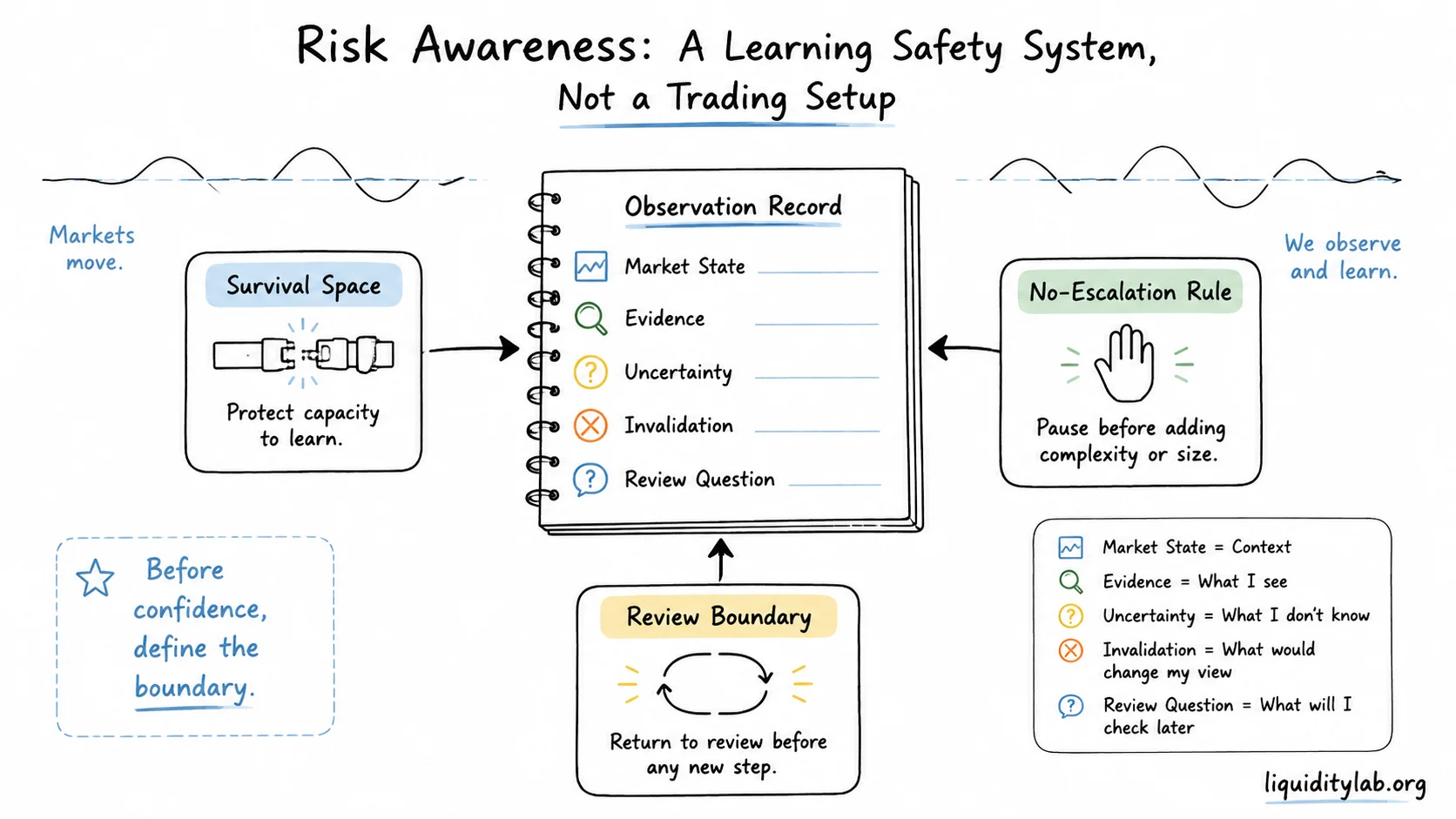
Risk awareness is often misunderstood as a technical calculation.
In LiquidityLab, it begins earlier.
Before a learner asks whether an idea is correct, the healthier question is:
What would keep this learning process survivable if I am wrong?This page is not a position-sizing guide.
It is a study playbook for thinking about risk as a boundary around behavior, attention, and review.
Educational content only. This page does not provide trade direction, entries, exits, stop-loss levels, targets, position sizing, leverage, or return expectations.
Risk awareness is a safety belt, not a prediction tool
A safety belt does not predict an accident.
It exists because the driver cannot control every condition on the road.
Risk awareness works the same way in market study.
It does not tell you what price will do next.
It helps you avoid turning one uncertain reading into an uncontrolled chain of reactions.
The goal is not to become afraid of every loss, mistake, or failed observation.
The goal is to keep the learning process intact long enough that review remains possible.
The first question: what is the worst-case behavior?
Many beginners think the main danger is being wrong about the chart.
That is only part of the problem.
The larger danger is often what happens after the learner feels wrong:
- changing the explanation after the fact
- adding more reasons to defend the first idea
- asking for certainty from a new tool
- forcing a second decision because the first one felt uncomfortable
- turning one failed observation into an emotional identity problem
Risk awareness starts by naming the behavior you do not want to escalate.
A useful study question is:
If this reading fails, what reaction should I prevent first?Three safety valves for the learner
The Chinese source page uses the metaphor of "three safety valves".
For English readers, the safest version is behavioral:
1. Survival space
Survival space means keeping enough room to continue learning after a mistake.
In study mode, that includes:
- enough emotional space to review the original note
- enough time to avoid instant revenge analysis
- enough process clarity to say, "this observation failed"
- enough humility to avoid turning one result into proof
Without survival space, the learner stops reviewing and starts defending.
2. No-escalation rule
A no-escalation rule prevents a small mistake from becoming a larger behavioral spiral.
For study, write this as a boundary:
If my reading fails, I will not add new assumptions to rescue it.
I will mark the reading as failed and review what evidence was missing.
This is not an order-management instruction.
It is a learning rule.
The point is to stop adding complexity when the original observation is already weak.
3. Review boundary
A review boundary tells you when the current interpretation is no longer useful.
Examples:
- the market state changed from range to transition
- the supposed pullback became a deeper structural change
- the expected reaction never appeared
- the chart moved into a condition you did not define
- your note was too vague to review honestly
When that happens, the better question is not "how do I fix the trade?"
The better study question is:
What did this observation fail to describe clearly?Risk boundary versus trade instruction
LiquidityLab often uses the term "risk boundary".
It does not mean a personal stop-loss recommendation.
In this educational context, a risk boundary means:
the condition under which the current reading should no longer be treated as useful.
For example:
- If a range is no longer holding, the range reading may be invalid.
- If a trend pullback becomes a deeper structural transition, the pullback reading may be incomplete.
- If a framework label requires more evidence than the chart currently shows, the label should stay tentative.
- If the learner cannot describe the invalidation condition, the observation is not ready for review.
This keeps risk language inside the learning process.
It does not convert it into execution advice.
Why "being right" is not enough
A learner can be right once and still have a fragile process.
A learner can be wrong once and still have a useful process.
Risk awareness asks a different question:
Can this process survive being wrong?That question changes the tone of study.
Instead of searching for the perfect signal, the learner starts building a process that can absorb uncertainty:
- write the observation
- name the assumption
- define what would weaken it
- avoid escalating after failure
- review the original note later
The outcome matters less than whether the process remains visible.
The risk of emotional accounting
Emotional accounting happens when the learner treats every result as a personal score.
After a good outcome, the learner may feel smarter than the process.
After a bad outcome, the learner may feel the need to immediately recover confidence.
Both reactions can damage observation quality.
Risk awareness helps by separating three things:
Market behavior
My observation
My emotional reaction
These three layers should not be collapsed into one story.
If the market moves sharply, that is market behavior.
If the original note did not define that possibility, that is an observation problem.
If the learner feels urgency, shame, or anger afterward, that is a behavior signal to record.
A safer pre-observation checklist
Before asking for an answer, write a short boundary checklist:
Market state:
Main observation:
What evidence supports this reading:
What evidence is missing:
What would make this reading no longer useful:
What reaction should I avoid if it fails:
What should I review later:
This checklist does not create certainty.
It creates a container for uncertainty.
How this connects to Plan Cards
A Plan Card in LiquidityLab is not a trading plan.
It is an observation record.
The risk-awareness version of a Plan Card should include:
- current market state
- primary observation scenario
- conditions that would make the observation worth reviewing
- invalidation of the reading
- no-action rule
- review question
Avoid turning these fields into:
- entry conditions
- stop-loss placement
- take-profit targets
- position sizing rules
- leverage decisions
- performance promises
The safer question is always:
What should I observe, and what would make this observation fail?Reflection exercise
Choose one old chart note or one practice scenario.
Answer:
1. What was my original market-state reading?
2. What did I assume but not write down?
3. What would have made the reading fail?
4. What behavior did I want to avoid after failure?
5. Was the note clear enough to review later?
6. What boundary should I write more clearly next time?
Do not score the exercise by whether the outcome was favorable.
Score it by whether the observation was clear, limited, and reviewable.
The point
Risk awareness is not pessimism.
It is respect for uncertainty.
The market can remain uncertain, and the learner can still become more organized.
That organization begins with a simple rule:
Before confidence, define the boundary.
Before reaction, write the observation.
Before judgment, protect the review process.
The goal is not to remove risk from learning.
The goal is to prevent risk from destroying the ability to learn.