Mindfulness and Cognitive Defusion for Trading Study
A non-medical trading study playbook for using mindfulness and cognitive defusion to notice emotional pressure before reacting.
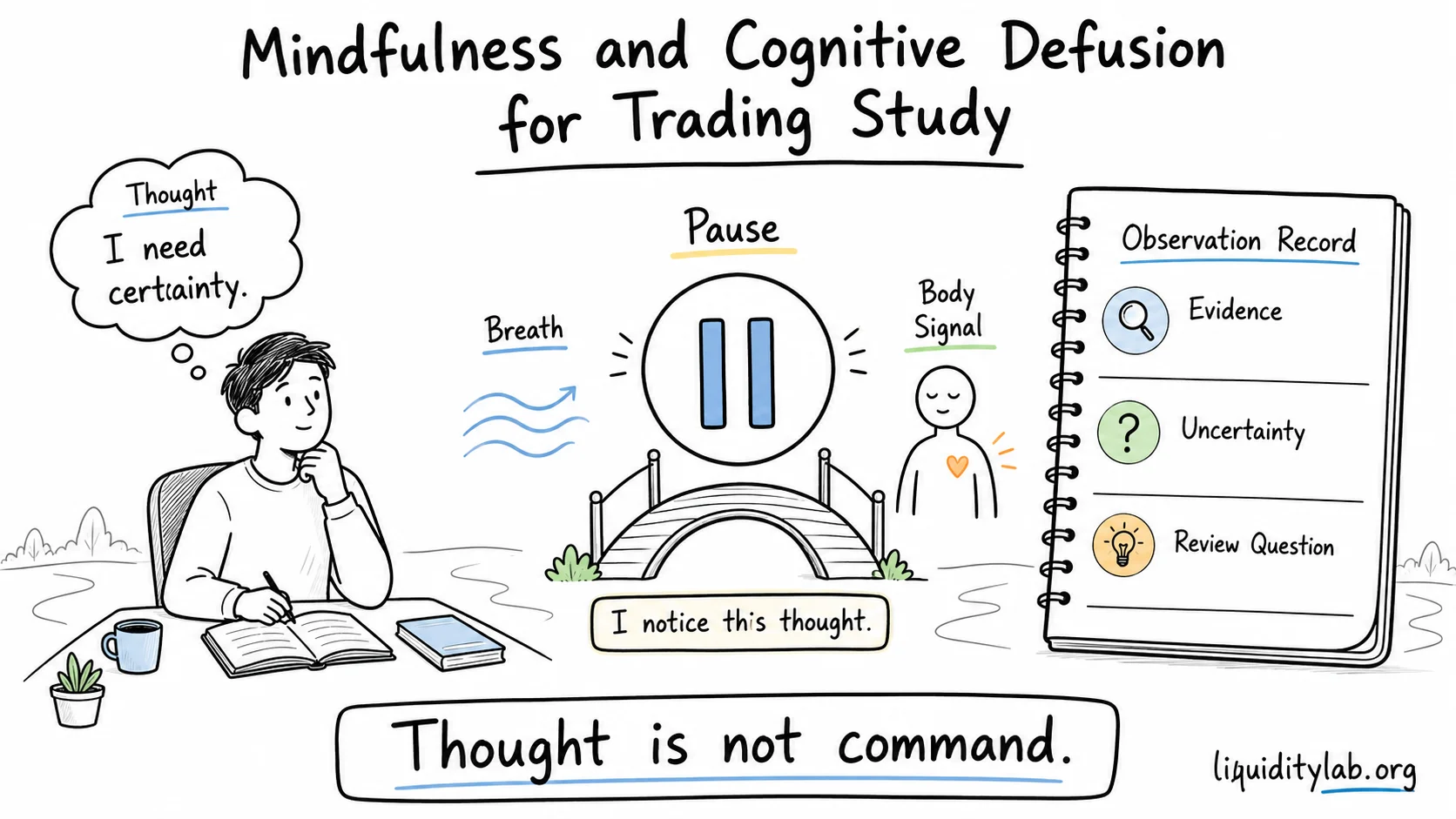
Trading psychology is not only about naming bias.
The harder part is what happens after you notice it.
You may know that fear is present.
You may know that FOMO is present.
You may know that one thought is pulling you toward a reaction.
But knowing that is not always enough.
This playbook introduces two practice ideas:
- mindfulness: noticing your current state without immediately reacting to it
- cognitive defusion: seeing a thought as a thought, not as a command
These ideas are not magic techniques.
They are small ways to create space between pressure and behavior.
Educational content only. This page is not medical advice, psychotherapy, mental-health treatment, or financial advice. If you are experiencing severe anxiety, depression, panic symptoms, sleep disruption, or other mental-health concerns, seek support from a qualified professional.
This page does not provide trade direction, entries, exits, stop-loss levels, targets, position sizing, leverage, or return expectations.
The problem: discomfort trains reaction
Imagine a learner who feels strong discomfort while watching a chart.
The discomfort rises.
The learner takes an action that makes the discomfort go away.
The immediate relief feels good.
The brain remembers:
When discomfort appears, action removes it.This is not only a trading problem.
It is a learning loop.
The next time discomfort appears, the urge to act may arrive faster.
The learner may not be responding to new market evidence.
They may be responding to the desire to end discomfort.
That distinction matters.
The purpose of mindfulness practice is not to remove discomfort.
The purpose is to notice discomfort without letting it automatically choose the next behavior.
Mindfulness is not blanking the mind
Mindfulness is often misunderstood.
It does not mean:
- having no thoughts
- forcing yourself to relax
- becoming emotionally neutral
- pretending uncertainty is comfortable
For trading study, a simpler definition is enough:
Noticing what is happening now without immediately turning it into action.You might notice:
- "My chest feels tight."
- "I want to check another source."
- "I feel late."
- "I am trying to make the chart give me certainty."
The noticing is the practice.
You do not need to like the feeling.
You do not need to make it disappear.
You only need enough space to keep the record honest.
A five-minute attention pause
Use this before a study session, after a reactive moment, or before reviewing a difficult record.
It is not a replacement for a plan, risk boundary, or review method.
It is a short attention reset.
Step 1: feel contact
Sit in a normal position.
Notice:
- feet touching the floor
- legs touching the chair
- hands resting somewhere
- the weight of the body
Do not correct your posture aggressively.
Just notice contact.
Step 2: observe breathing
Bring attention to the breath.
Do not force a special rhythm.
Notice:
- air entering
- air leaving
- the chest or abdomen moving
- the pause between breaths
If attention moves away, that is not failure.
Noticing the movement is the repetition.
Step 3: label one thought
When a thought appears, label it lightly:
thinking
planning
remembering
worrying
wanting certainty
Then return to the next breath.
The label is not analysis.
It is a gentle way to notice that the thought appeared.
Step 4: return to the record
After a few minutes, write one sentence:
The strongest pressure right now is:Examples:
- "The strongest pressure right now is to prove the first reading correct."
- "The strongest pressure right now is to avoid feeling wrong."
- "The strongest pressure right now is to ask for a clearer answer than the chart provides."
Now the pressure is visible.
That makes it reviewable.
Cognitive defusion: thoughts are not commands
Cognitive defusion is a useful phrase from acceptance and commitment therapy.
For LiquidityLab's learning context, use it in a simple, non-clinical way:
A thought is something I can observe.
It is not automatically something I must obey.
Compare these two sentences:
I need to fix this right now.and:
I notice that I am having the thought: "I need to fix this right now."The second sentence creates distance.
The thought is still present.
But it is no longer fused with immediate action.
That small distance is often enough to return to structure, evidence, uncertainty, and review.
A practical language switch
When pressure rises, change the sentence from:
I should...to:
I notice an urge to...Examples:
| Automatic sentence | Defused sentence |
|---|---|
| "I should know what happens next." | "I notice an urge to know what happens next." |
| "I need to change the reading." | "I notice an urge to change the reading." |
| "I cannot miss this." | "I notice FOMO pressure." |
| "This proves I was right." | "I notice attachment to being right." |
The defused sentence is slower.
That is useful.
Slow language makes fewer hidden promises.
Practice away from the chart first
The chart is a high-pressure environment.
It is not always the best place to learn a new attention skill.
Practice during ordinary activities:
- drinking coffee
- walking
- typing
- waiting in line
- reviewing notes
For 30 seconds, notice sensory details:
- temperature
- pressure
- sound
- rhythm
- movement
Then notice when attention drifts.
Bring it back without criticism.
This is not about becoming a calm person.
It is about practicing the return.
The return is the skill.
How to use this with a trading record
Before changing a market reading, write:
Current thought:
Current body signal:
Current urge:
Evidence I have:
Uncertainty I still have:
Example:
Current thought: I am probably wrong.
Current body signal: tight chest and fast checking.
Current urge: ask for another answer.
Evidence I have: price is still inside the range boundary.
Uncertainty I still have: whether the next test will break or reject.
This does not solve the market.
It protects the observation record from being silently rewritten by pressure.
What this practice cannot do
Mindfulness and defusion cannot:
- guarantee better market outcomes
- remove all fear
- create certainty
- replace a learning system
- replace professional mental-health support
- turn a weak market reading into a strong one
They can help with one smaller task:
noticing pressure before pressure becomes behaviorThat is enough to make review more honest.
A seven-day practice
For the next seven days, keep the practice very small.
Each day:
- Do a five-minute attention pause.
- Write the strongest pressure you noticed.
- Rewrite one automatic sentence as a defused sentence.
- Review whether the sentence changed your next behavior.
Do not score the practice as good or bad.
Just record whether you returned.
Pair with the AI Structure Workbench
This page works best beside:
- Fear and Greed as Emotional Signals
- Cognitive Biases and Trading Psychology Barriers
- Observation Management After a Trade Idea Starts
- Trading Review Method
Use the workbench to write what you observed.
Use this playbook to notice what pressure tried to do with that observation.
Reflection exercise
Choose one recent moment when you felt a strong urge while studying a chart.
Write:
- What was the thought?
- What body signal appeared?
- What behavior did the thought push toward?
- What evidence was visible?
- What uncertainty remained?
- How could you rewrite the thought as "I notice that I am having the thought..."?
The goal is not self-criticism.
The goal is to build a small space where review can happen.