Fear and Greed as Emotional Signals
Learn how to treat fear and greed as observable emotional signals, not enemies to suppress, with a reviewable checklist for trading study and behavior training.
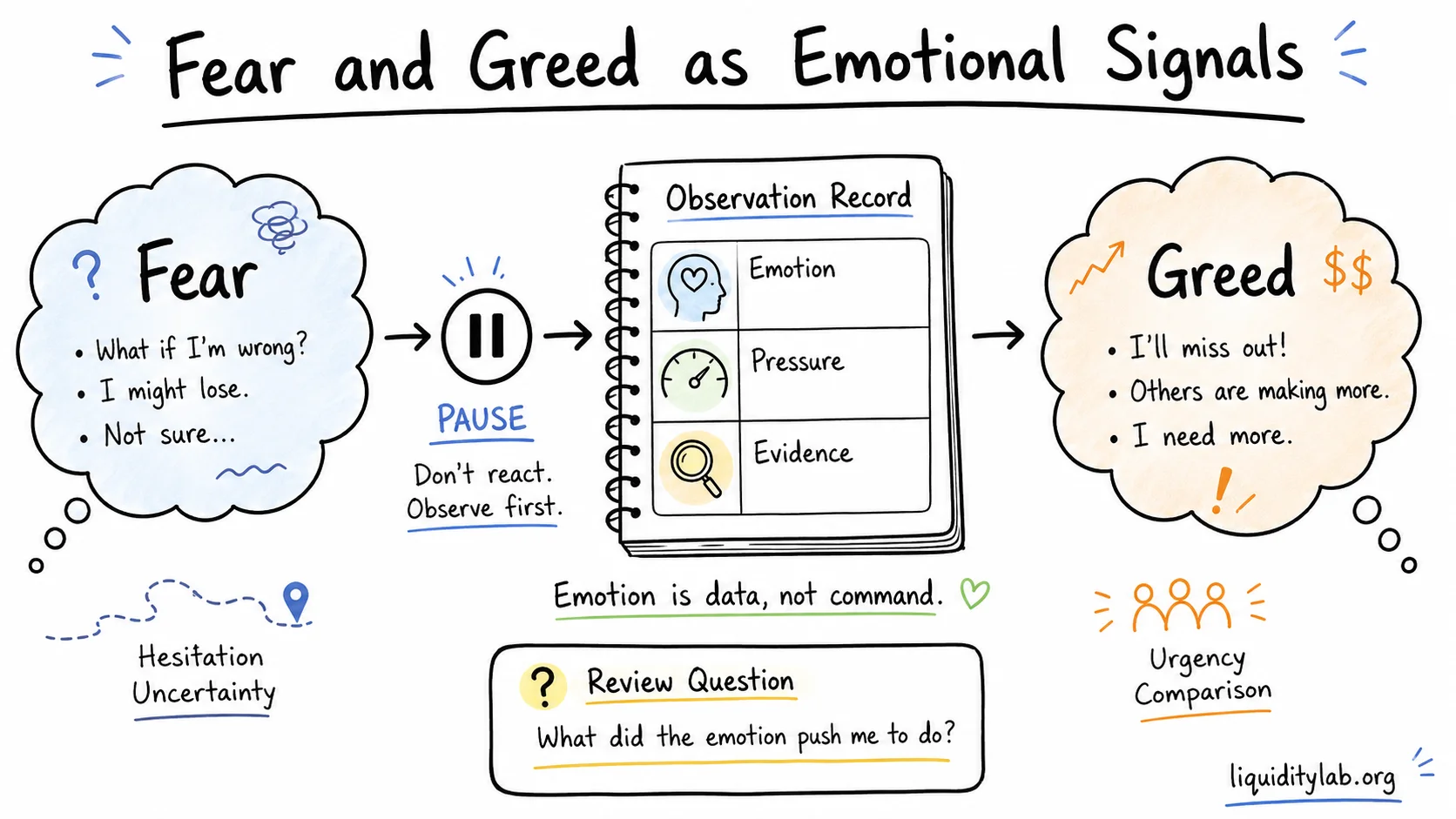
Fear and greed are usually described as problems.
But for learning, a more useful question is:
What is this emotion telling me to observe?Fear often points to uncertainty, lack of preparation, or unclear boundaries.
Greed often points to pressure, comparison, or the urge to rewrite a plan after price has already moved.
This playbook does not teach you to eliminate emotion.
It helps you turn emotional pressure into something reviewable.
Educational content only. This page does not provide trade direction, entries, exits, stop-loss levels, targets, position sizing, leverage, or return expectations.
Fear is not only fear of losing
Many beginners think fear means:
"I am afraid of losing money."
That may be true, but it is not the whole picture.
In trading study, fear often comes from a deeper feeling:
I do not know what I am supposed to do with this uncertainty.The chart moves.
The original reading becomes less comfortable.
The learner wants the discomfort to end.
That is when fear can turn into reactive behavior:
- closing the chart too early
- asking another tool for certainty
- changing the explanation after every candle
- avoiding review because the original note feels embarrassing
- treating one failed observation as proof that the whole learning path is broken
The first task is not to become fearless.
The first task is to notice what fear is trying to make you do.
Four common forms of fear
Fear does not always look the same.
For review purposes, it helps to separate several common forms.
Fear of being wrong
This is the fear that the original reading may be incorrect.
It often shows up as hesitation, over-checking, or asking for one more confirmation even after the observation has already been written.
Review question:
What evidence would show that this reading is no longer useful?The goal is not to force confidence.
The goal is to make invalidation visible before emotion starts editing the story.
Fear of loss
This is the fear that a negative outcome means personal failure.
In a learning context, this fear can make a learner avoid recording mistakes clearly.
Review question:
Did I record the boundary clearly enough to review it later?The problem is not discomfort.
The problem is allowing discomfort to destroy the record.
Fear of missing out
FOMO is the feeling that the current movement is the last chance.
It often turns observation into urgency.
Review question:
Am I observing what price is doing, or reacting because I feel late?If the answer is "I feel late," the best learning move is usually to slow the record down.
Write what changed.
Write what is still unclear.
Do not let urgency become analysis.
Fear of giving back a favorable result
Sometimes fear appears after price has moved in a way that feels favorable.
The learner becomes attached to the current result and starts watching every small movement as a threat.
Review question:
Am I protecting a reviewable process, or emotionally protecting a momentary outcome?This distinction matters.
One is process review.
The other is outcome attachment.
Greed is often pressure in disguise
Greed is usually described as wanting more.
But in practice, greed often has a quieter source:
I do not want this opportunity to be enough.The learner sees movement and starts expanding the story:
- "Maybe this is bigger than I thought."
- "Maybe I should keep looking for more."
- "Maybe the original boundary was too conservative."
- "Other people seem to be getting more out of this."
Greed is not only desire.
It is also comparison, impatience, and the refusal to let a record stay limited.
For study purposes, greed becomes dangerous when it causes silent revision.
The original note said one thing.
The updated feeling wants another.
Without a record, the learner may never notice the change.
The emotional seesaw
Fear and greed often appear in a loop:
fear -> hesitation -> missed movement -> greed -> chasing the story -> discomfort -> stronger fearThis loop is not a character flaw.
It is a behavior pattern.
And behavior patterns can be reviewed.
The important question is not:
Why am I emotional?The more useful question is:
What did the emotion make me do next?That turns a vague feeling into a reviewable sequence.
Market stories can replay emotional loops
Case narratives often describe repeated cycles: excitement, confidence, discomfort, denial, and later fear.
The useful lesson is not that every cycle follows the same script. The useful lesson is that emotional pressure often returns in familiar forms.
When a market story feels familiar, write:
- what emotion appeared first
- what belief became stronger because of that emotion
- what behavior the emotion pushed toward
- what evidence would have slowed the reaction
This turns a dramatic story into a repeatable emotional record.
The three-line emotional record
When emotion rises, write a short record before interpretation.
Use three lines:
Emotion:
What I feel pressure to do:
What I will observe before changing the reading:
Example:
Emotion: I feel late and impatient.
What I feel pressure to do: I want to reinterpret the move as stronger than my original note.
What I will observe before changing the reading: whether price actually breaks the structure boundary or only moves inside the current range.
This is not a trading plan.
It is an emotional interruption record.
Its purpose is to place a small pause between feeling and reaction.
Before the session: write the acceptable discomfort
Before observing a chart, write one sentence:
The discomfort I expect today is:For example:
- "I may feel late if price moves before I understand the structure."
- "I may feel defensive if my first reading becomes invalid."
- "I may feel tempted to ask for certainty when the chart is still unclear."
This sentence does not predict the market.
It predicts your likely emotional pressure.
That makes the pressure less surprising when it appears.
During the observation: do not make a new identity story
When emotion rises, learners often create identity stories:
- "I always miss the move."
- "I am not good at this."
- "I finally understand the market."
- "I should be able to handle this by now."
These stories are sticky because they feel meaningful.
But they are usually not reviewable.
Replace identity language with behavior language.
| Identity story | Reviewable rewrite |
|---|---|
| "I always miss it." | "I felt late after price moved without my record." |
| "I am bad at this." | "My structure note did not define an invalidation condition." |
| "I finally understand it." | "This sample matched one previous observation, but one result is not proof." |
| "I should know what to do." | "The current state still has uncertainty that I have not written down." |
The rewrite is quieter.
That is the point.
Quiet language is easier to review.
After the observation: review the emotion, not only the chart
At the end of a sample, ask four questions:
- What emotion was strongest?
- What action did it push me toward?
- Did I change the reading because of new evidence or because of discomfort?
- What should I write earlier next time?
The answer does not need to be long.
The key is consistency.
Repeated emotional records reveal patterns that one dramatic memory cannot.
A simple no-escalation rule
When fear or greed becomes strong, use a no-escalation rule:
No new interpretation until I write:
1. what changed,
2. what did not change,
3. what would invalidate the current reading.
This rule does not tell you what the market will do.
It only prevents the next thought from becoming automatic.
That is enough to make review possible.
Pair this with the AI Structure Workbench
This playbook pairs well with:
- AI Structure Workbench Beginner Manual
- Cognitive Biases and Trading Psychology Barriers
- Risk Awareness for Trading Study
- Trading Review Method
Use the workbench to write the structure record.
Use this page to write the emotional record that sits next to it.
The market record says:
What did I observe?The emotional record says:
What did I feel pressured to do with that observation?Both are part of learning.
Body signals are part of the record
Emotion does not always appear first as a clear thought.
Sometimes it appears as a body signal:
- faster heartbeat
- tight shoulders
- shallow breathing
- sweaty palms
- the urge to click, refresh, or ask for another answer immediately
These signals are not proof that the market is dangerous or favorable.
They are simply evidence that the learner's nervous system is becoming activated.
When that happens, add one line to the emotional record:
Body signal:For example:
Body signal: I noticed my breathing became shallow when price approached the prior high.This keeps the record concrete. Instead of saying "I panicked" or "I was greedy," you can review what actually happened in the body before the behavior changed.
Reflection exercise
Choose one recent observation that made you feel reactive.
Write:
- What was the body signal?
- What was the emotional signal?
- What behavior did it push toward?
- What evidence was actually visible?
- What uncertainty was still unresolved?
- What sentence should be written earlier next time?
Do not use the exercise to criticize yourself.
Use it to make the next record easier to review.