Cognitive Biases and Trading Psychology Barriers
Learn common cognitive biases and trading psychology barriers, including System 1 and System 2 thinking, FOMO, confirmation bias, fear, and review prompts.
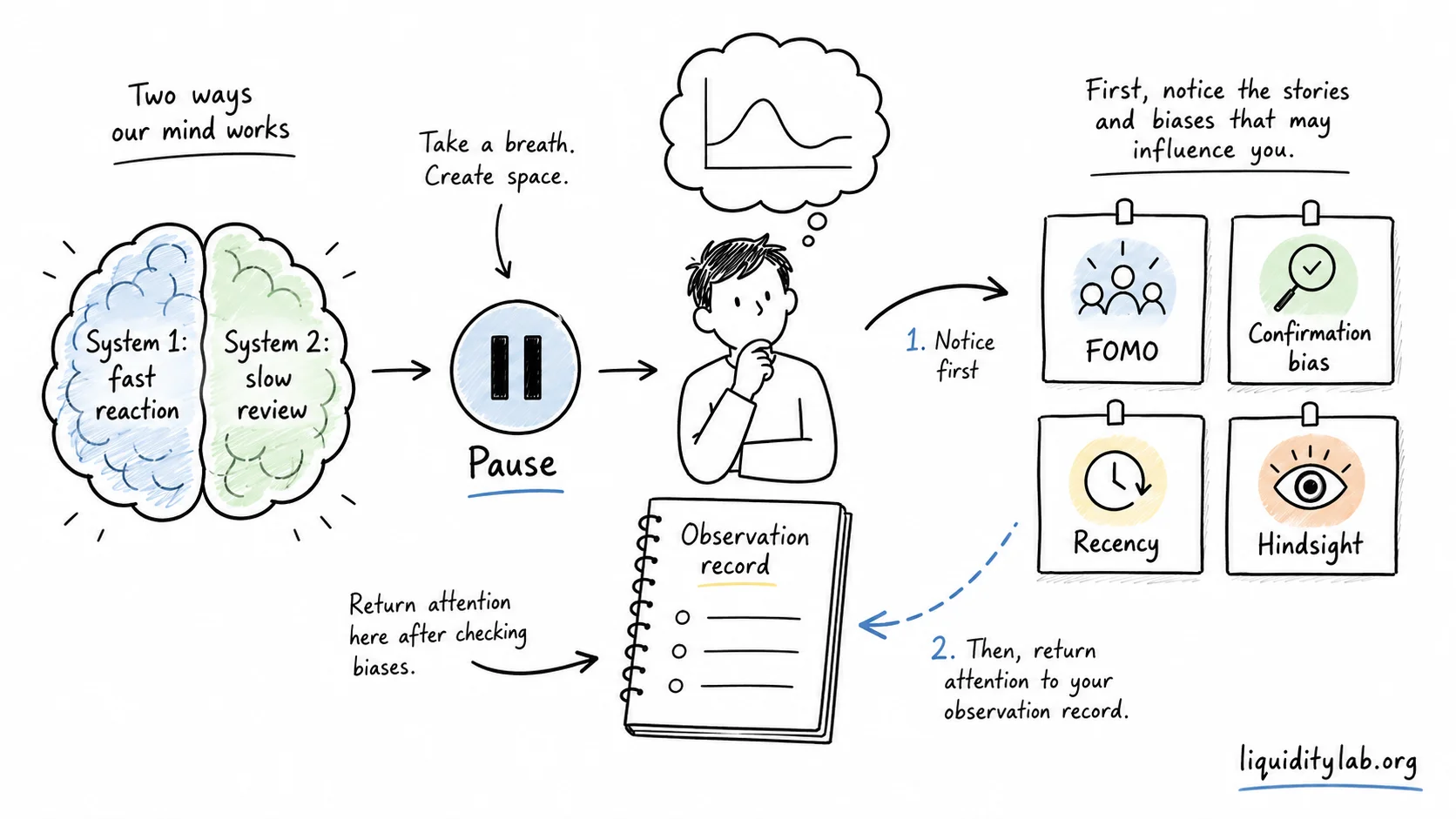
Trading mistakes often feel like technical mistakes.
Sometimes they are not.
Sometimes the chart was confusing because your attention was already pulled by fear, urgency, recent losses, overconfidence, or the need to be right.
This playbook gives you a vocabulary for those moments.
It does not try to remove emotion. It helps you notice when emotion or bias is shaping the way you read the chart.
Educational content only. This page does not provide trade direction, entries, exits, stop-loss levels, targets, position sizing, or return expectations.
System 1 and System 2
Daniel Kahneman's System 1 / System 2 model is a useful way to describe judgment under pressure.
System 1 is fast, automatic, and intuitive.
It reacts quickly. It recognizes patterns. It saves mental energy.
It can also jump to conclusions.
System 2 is slower, deliberate, and analytical.
It checks assumptions. It compares evidence. It asks whether the first impression is supported by structure.
In market study, many mistakes happen when System 1 reacts to a visible feature before System 2 checks the context.
Example:
A strong candle appears. System 1 says, "This is the move." System 2 should ask, "Where did it appear, what structure came before it, and what would invalidate this reading?"
The goal is not to use only System 2. That is unrealistic.
The goal is to notice when System 1 is driving and create a pause long enough for reviewable observation.
Common cognitive biases
These biases are not character flaws.
They are normal patterns in human thinking.
Representativeness bias
You see something that looks like a familiar pattern and assume it will behave the same way.
Observation prompt:
Besides shape, is the current market background similar enough to the earlier example?
Check:
- trend or range context
- location relative to key levels
- what happened before the pattern
- whether liquidity or structure has actually changed
Availability bias
Recent or emotionally vivid events feel more important than the full sample.
After two difficult reviews, you may feel that the whole method is failing, even if the larger sample is still unclear.
Observation prompt:
Am I reacting to the most recent example, or reviewing a meaningful sample size?
Check:
- last 3 records
- last 10 records
- whether the mistake repeated
- whether the error was structural, procedural, or emotional
Confirmation bias
Once you form a view, your attention starts collecting evidence that supports it.
The chart may feel clearer than it really is because you stopped looking for opposing evidence.
Observation prompt:
What would make this reading weaker?
Check:
- opposite scenario
- wait / no-action scenario
- invalidation condition
- evidence that does not fit the first view
Recency effect
The newest candle or move can overpower the broader structure in your mind.
A sharp move can feel like a full trend change before the structure has actually changed.
Observation prompt:
Did the latest move change the structure, or only my emotional state?
Check:
- higher timeframe context
- whether a key high or low actually broke
- whether price accepted outside the prior range
- whether the move was followed by confirmation or immediate rejection
Hindsight bias
After the chart develops, the answer looks obvious.
You may tell yourself, "I knew that would happen," even though the original record did not contain that judgment.
Observation prompt:
What did I actually write before the outcome was known?
Check:
- original note
- original market state
- original invalidation condition
- what was visible then, not what is visible now
Fear has different forms
Fear is not one thing.
It can show up in several ways:
Fear of being wrong
You hesitate because being wrong feels personal.
Training response:
Shift the question from "Was I right?" to "Was my observation reviewable?"
Fear of loss
You focus on pain avoidance rather than structure.
Training response:
Name the emotion, then return to market state, location, and invalidation.
Fear of missing out
You feel urgency because price already moved.
Training response:
Ask what would still need to happen before the observation becomes clear. If the only reason is urgency, the record is not ready.
Fear of giving back gains
You become protective after a positive outcome and start reading every fluctuation as danger.
Training response:
Separate outcome emotion from structure review. Ask whether the current reading changed, or only your attachment to the result changed.
When emotion is activated
Strong emotion changes attention.
It narrows the field.
It makes one path feel more obvious than it is.
That is why the safest training behavior is often a pause, not a new conclusion.
Use a short reset:
- Stop forming a new view for a moment.
- Write the emotion in plain words: fear, urgency, frustration, excitement, revenge, or overconfidence.
- Return to the three-line record: Structure, Liquidity, Location.
- Add one invalidation sentence.
- If you cannot write it clearly, mark the state as uncertain.
This is not therapy, and it is not a trading rule.
It is a study routine for protecting the observation process.
Three practice tools
1. Premortem
Before treating a reading as clear, ask:
If this reading fails, what are the most likely reasons?
Write two or three possibilities.
This forces System 2 to enter before hindsight does.
2. Opposite-case check
If you feel certain, ask:
What would a reasonable opposite view notice?
You are not trying to reverse your view.
You are checking whether your view has become too narrow.
3. Trigger log
During review, record the emotional trigger:
- I felt urgency after a strong candle.
- I felt defensive after a loss.
- I ignored uncertainty after a winning streak.
- I looked for evidence that confirmed my first idea.
The trigger log is useful because repeated emotional patterns are easier to correct than isolated memories.
Use this with the AI Workbench
When asking AI for help, do not ask it to validate your emotion.
Better prompts:
Help me separate visible structure from my interpretation.What evidence in my record is missing or uncertain?Which bias might be affecting this observation?Turn this into a review question, not a trade decision.Pair this page with:
- Independent Thinking and Judgment Boundary
- Trading Review Method
- AI Structure Workbench Beginner Manual
Reflection exercise
Choose one recent observation record.
Answer:
- Which bias may have appeared?
- Which emotion was strongest?
- Did the emotion change what you noticed?
- What was visible in the chart before the outcome?
- What should your next record include more clearly?
The goal is not to judge yourself.
The goal is to become easier to review.
Educational content only. Not financial advice.