Trading as a Second Career: A Self-Assessment
A balanced self-assessment for deciding whether trading study fits your time budget, risk tolerance, emotional capacity, and learning horizon.
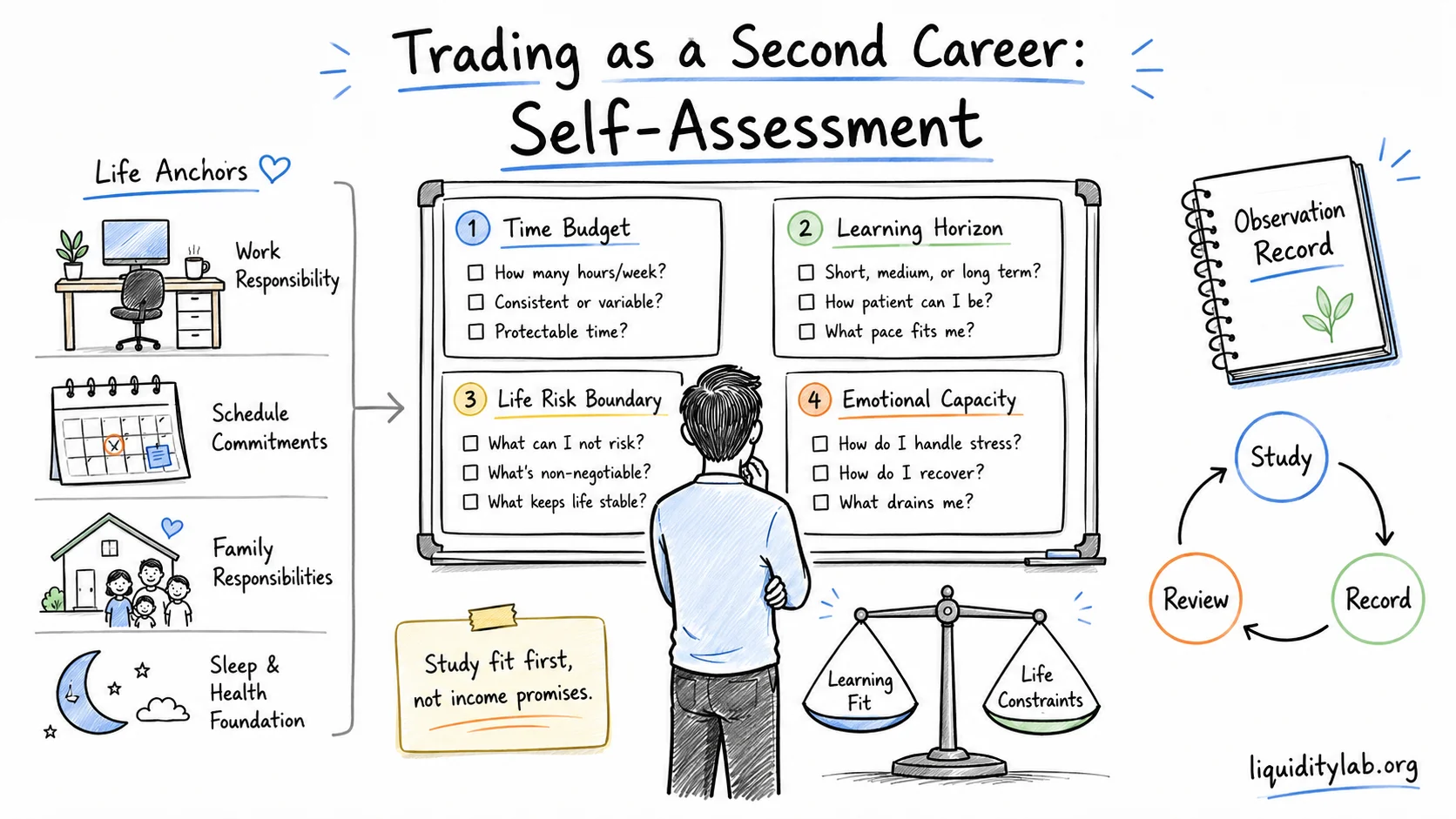
Thinking about trading as a second career can feel exciting.
It can also create unrealistic expectations.
This playbook is not here to tell you that trading is the right path.
It is a self-assessment framework for asking a quieter question:
Does trading study fit my current life constraints?Educational content only. This page does not provide income expectations, trade direction, entries, exits, stop-loss levels, targets, position sizing, leverage, platform recommendations, or investment advice.
Why this question needs a sober frame
Trading is often described as flexible, independent, and scalable.
Those words may be partly true in a broad sense, but they hide the harder parts:
- the learning curve is long
- feedback is noisy
- losses are emotionally real
- progress is not guaranteed
- study time must be protected
- uncertainty does not disappear after you learn more terms
The healthier starting point is not:
Can trading replace my income?It is:
Can I study this field without damaging my finances, time, attention, or emotional stability?The five dimensions to assess first
Use the following dimensions as a checklist.
Do not use them to convince yourself.
Use them to slow the decision down.
1. Time budget
Trading study needs repeated attention.
That usually means:
- reading
- chart review
- journaling
- learning terminology
- practicing observation
- reviewing old notes after price develops
If your plan depends on "I'll study whenever I have time," the plan may disappear when life gets busy.
A better question is:
Which weekly hours can I protect without harming sleep, work, family, or health?If the answer is unclear, start by designing a study rhythm before adding more market tools.
See also: Trading Study Time Management.
2. Learning horizon
Trading knowledge does not become useful just because it is interesting.
Most beginners first collect:
- indicators
- patterns
- framework labels
- opinions
- rules from different systems
That collection phase can be useful, but it can also create confusion.
Progress usually requires a longer horizon:
learn -> observe -> record -> review -> simplifyIf you need quick income, fast certainty, or immediate proof that the path is worth it, trading study may create more pressure than clarity.
See also: Trader Growth Path: Three Learning Stages.
3. Financial risk boundary
This page does not tell you how much money to use.
The useful self-assessment question is different:
Can I separate learning risk from life risk?Learning risk means the cost of practice, mistakes, tools, data, time, and emotional energy.
Life risk means rent, debt, family obligations, emergency savings, health, and basic security.
If these two categories are mixed, trading study can become dangerous quickly.
A sober boundary might sound like:
I will not use money that would damage my life if lost.This is a self-assessment boundary, not a position-sizing rule.
For a study-first risk frame, read Risk Awareness for Trading Study.
4. Emotional capacity
Trading study puts pressure on identity.
One good outcome can make a learner feel talented.
One bad outcome can make the same learner feel broken.
Neither reaction is a stable learning process.
Before treating trading as a serious second path, ask:
- Do I become impulsive when I feel behind?
- Do I chase certainty after a confusing result?
- Do I change systems quickly after discomfort?
- Can I record a mistake without turning it into a personal failure?
- Can I stop when my attention is compromised?
If the answer is no, the first work may be emotional observation rather than market analysis.
What makes trading different from many side projects
Trading can look simple from the outside because there is no inventory, no customer support, and no physical supply chain.
But that simplicity can be misleading.
The market gives immediate feedback, but not always meaningful feedback.
A good result can happen for the wrong reason.
A bad result can happen even when the observation process was reasonable.
That means the learner must build a review system before trusting outcomes.
In LiquidityLab language:
process quality comes before outcome confidenceIf you cannot review the process, the result teaches very little.
A practical self-assessment worksheet
Answer these questions before deciding how deeply to commit.
Time
How many weekly hours can I protect for study and review?
Which activity will those hours replace?
What would make this schedule fail?
Learning
What is the first small skill I want to practice?
Can I review that skill over 20 samples?
Which tools or topics should I ignore for now?
Risk
What financial boundary protects my normal life?
What would be unacceptable to lose?
What rule prevents learning curiosity from becoming financial pressure?
Emotion
What emotion usually changes my behavior fastest?
What do I do when I feel behind?
What pause rule can I use before making a new decision?
Review
What will I write down before looking for outside opinions?
How will I review the original note later?
What will count as progress besides profit or loss?
Signs this path may not fit right now
Trading study may not be the best second-career direction right now if:
- you need fast income
- you cannot tolerate uncertainty
- you would use money needed for life expenses
- you do not have protected study time
- you feel pressured to catch up with other people
- you are looking for a single system to remove doubt
- you cannot separate learning progress from short-term results
These are not character flaws.
They are fit signals.
A good self-assessment protects you from forcing a path that your current life cannot support.
Signs the study path may be workable
The path may be more workable if:
- you can study slowly without needing immediate proof
- you can protect a small weekly review block
- you can keep life money separate from learning risk
- you can write observations before asking for answers
- you can treat uncertainty as part of the work
- you care more about building a repeatable process than proving yourself quickly
Even then, the goal is not to rush into markets.
The goal is to build enough structure that your learning can survive being wrong.
A safer starting plan
If you decide to continue, start small.
For the next four weeks:
- Choose one market or chart set to study.
- Write one Structure / Liquidity / Location note per session.
- Do not add more than one new concept per week.
- Review old notes after price develops.
- Record emotional pressure separately from market behavior.
This is not a trading plan.
It is a learning plan.
The purpose is to test whether you can keep a process alive, not whether you can force an outcome.
The final question
The most useful question is not:
Can trading change my life?The better question is:
Can I study trading in a way that does not damage the life I already have?If the answer is yes, continue slowly.
If the answer is no, pausing is not failure.
It is good risk awareness.
Educational content only. Not financial advice.